Tuulla
Tuulla is the Prime Goddess of the Andórëan Pantheon, the deity of seasons, nature, storms, and the ever-changing balance of the world. According to myth, she discovered Andórë in its primordial state and reshaped it into a world capable of sustaining life, establishing the cycles of day, night, and the seasons themselves.
Both creator and caretaker, Tuulla embodies change, perseverance, and acceptance. Though often viewed as distant and inscrutable, her influence touches every living thing, and nearly every culture of Andórë acknowledges her as the first and greatest of the gods.
Divine Information
| Property | Value |
|---|---|
| Alignment | Chaotic Neutral |
| Divine Domains | Nature, Tempest |
| Portfolio | Seasons, Change, Balance, Growth |
| Home Plane | Zephyrion |
| Realm | Cycle of Seasons |
| Symbol | The Wheel of Seasons |
| Sacred Animal | Serpent |
| Title | The Goddess of Seasons |
Manifestation
Common Appearance
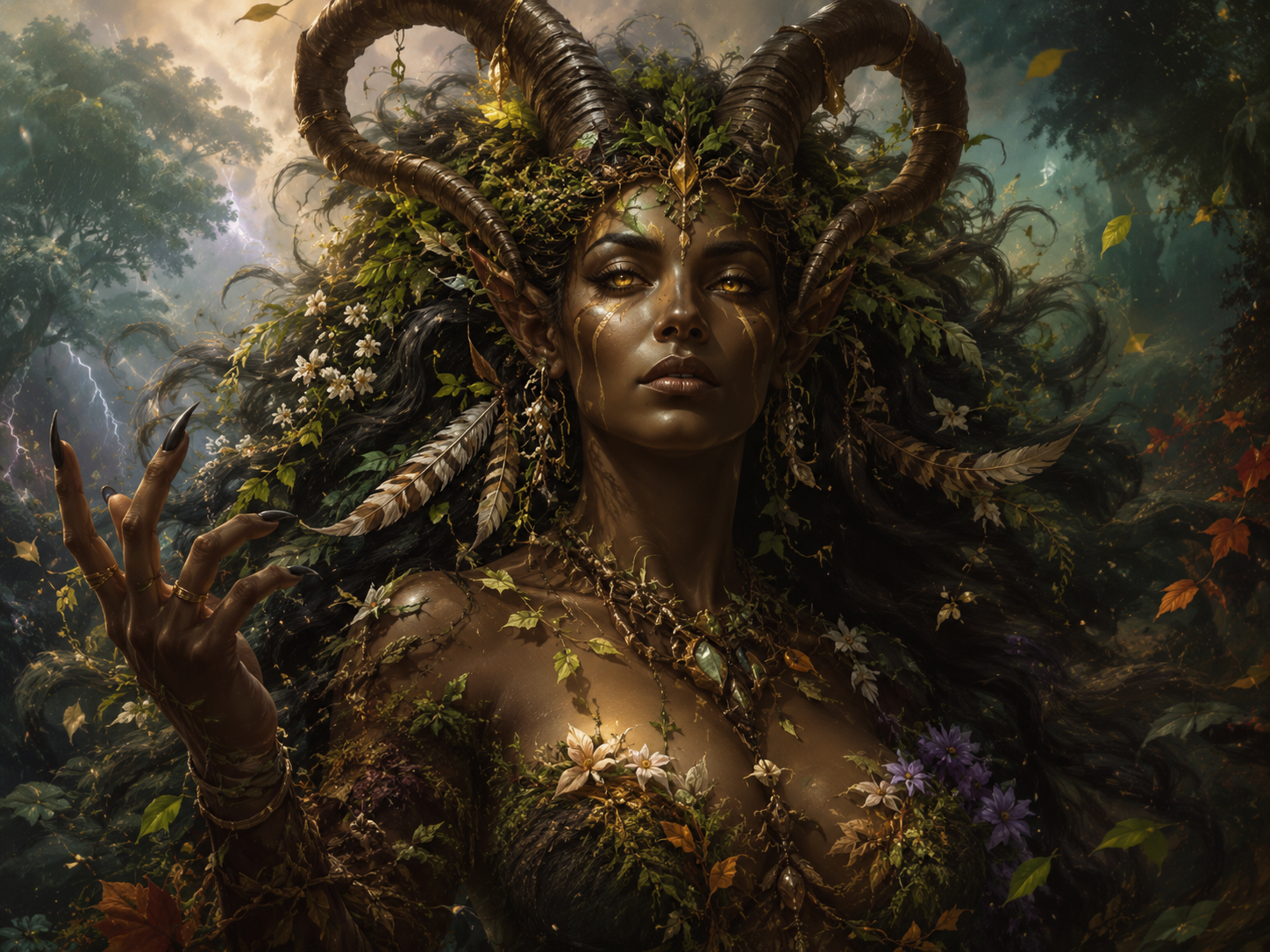
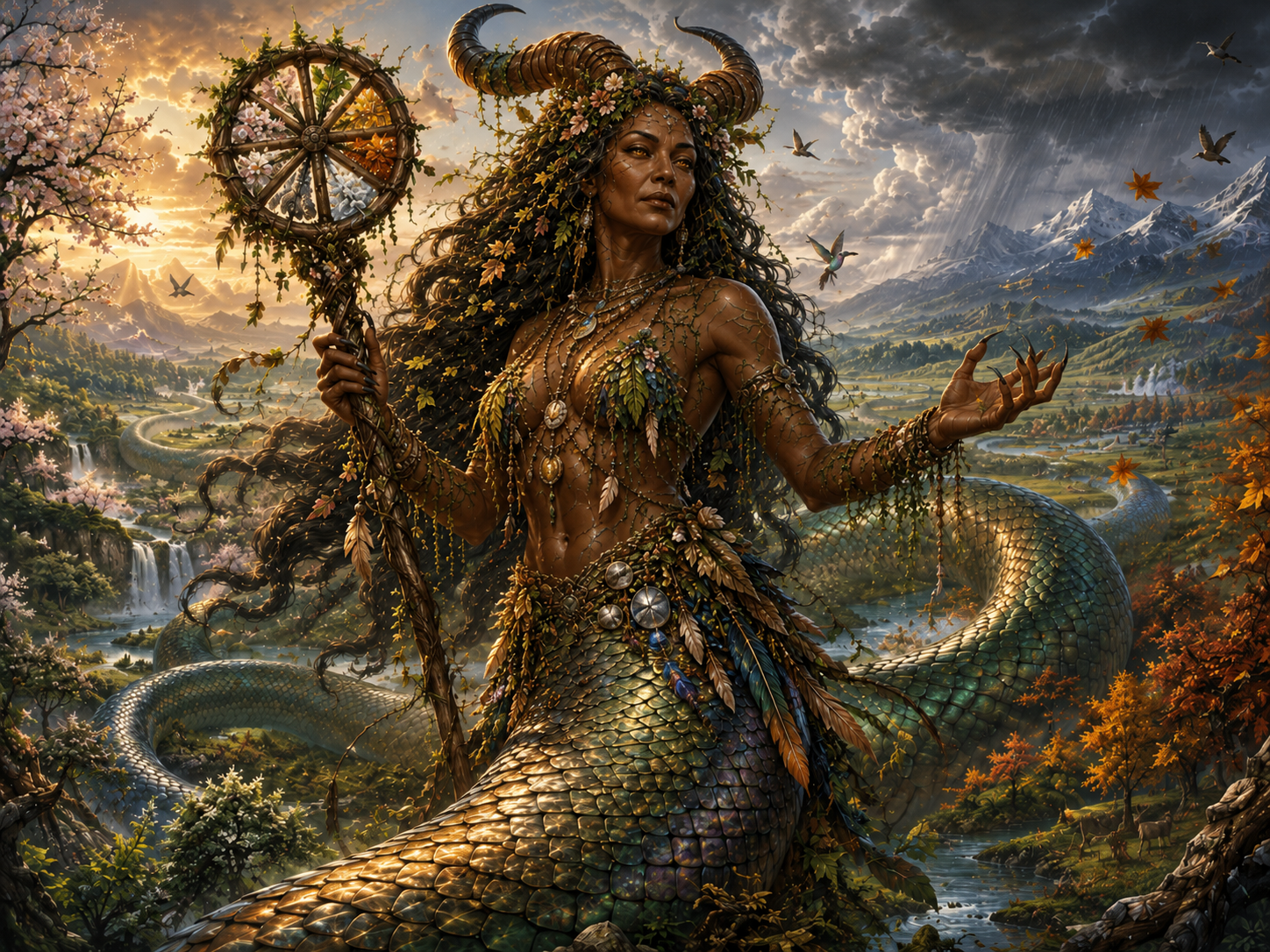
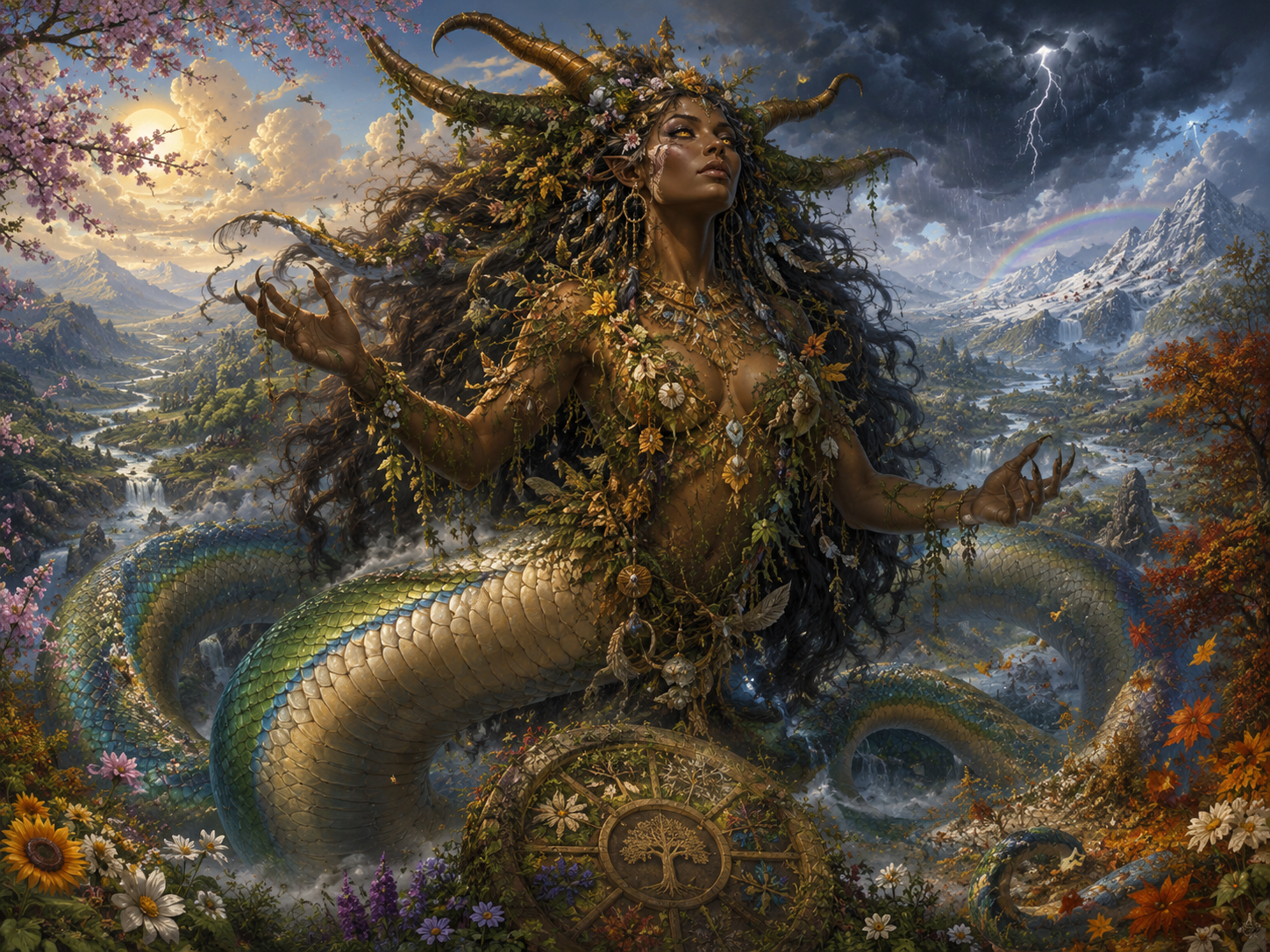
Tuulla most commonly appears as an immense serpent-bodied goddess whose upper form is that of a woman and whose lower body is that of a colossal serpent. Her coiled form is so vast that in many depictions it stretches beyond the horizon, her scales winding through forests, mountains, and seas.
Her skin is a warm, rich brown like fertile earth after rain, while her serpentine scales shimmer with iridescent hues that shift subtly between pearl, green, blue, and gold, much like sunlight reflecting upon water.
From her brow rise a magnificent pair of long, spiraling horns reminiscent of a great antelope. They sweep backward and upward in elegant curves, giving her an appearance that is both regal and primal.
Her eyes are luminous gold with slit pupils, ancient and watchful, seeming to hold the memory of every season that has ever passed. Though her face is beautiful, it possesses an ageless and inhuman quality that makes it difficult to determine whether she appears young or old.
Her long black hair falls in wild, untamed waves, often interwoven with leaves, flowers, feathers, and small living vines. The plants woven into her hair are never the same twice, changing with the seasons and her mood.
Her hands end in dark, polished claws, delicate enough to cradle a flower and powerful enough to reshape mountains.
Unlike many deities, Tuulla wears little in the way of clothing or armor. Instead, she adorns herself with garlands of leaves, flowering vines, feathers, and jewelry crafted from polished stone, wood, shell, and precious metals. These ornaments appear to have grown naturally upon her rather than having been fashioned by mortal hands.
When she moves, the air often carries the scent of rain, blooming flowers, fresh earth, or autumn leaves. Storm clouds may gather above her, flowers may bloom in her wake, or leaves may swirl around her coils.
To behold Tuulla is to witness nature itself given divine form: beautiful, ancient, nurturing, and utterly beyond mortal control.
Preferred Forms
- An immense serpent goddess coiled around mountains.
- A horned woman emerging from a field of wildflowers.
- A giant serpent resting beneath a storm-filled sky.
- A wandering woman carrying a twisted wooden staff.
- A mother seated beneath a great tree with animals gathered around her.
Avatar Forms
- A middle-aged woman with dark braided hair and small antelope-like horns.
- A traveling gardener carrying seeds and a wooden staff.
- A shepherdess accompanied by birds and serpents.
- A mysterious woman whose footprints leave flowers or new growth behind.
- A giant serpent appearing in dreams and visions.
Identifying Characteristics
- The lower body of an immense iridescent serpent.
- Warm brown skin.
- Luminous golden eyes with slit pupils.
- Long black hair adorned with living plants.
- Elegant antelope-like horns.
- An aura that shifts with the seasons.
- The scent of rain, flowers, earth, or fallen leaves.
- Leaves, blossoms, or storm clouds that gather around her presence.
- A twisted wooden staff bearing the Wheel of Seasons.
Divine Symbols & Iconography
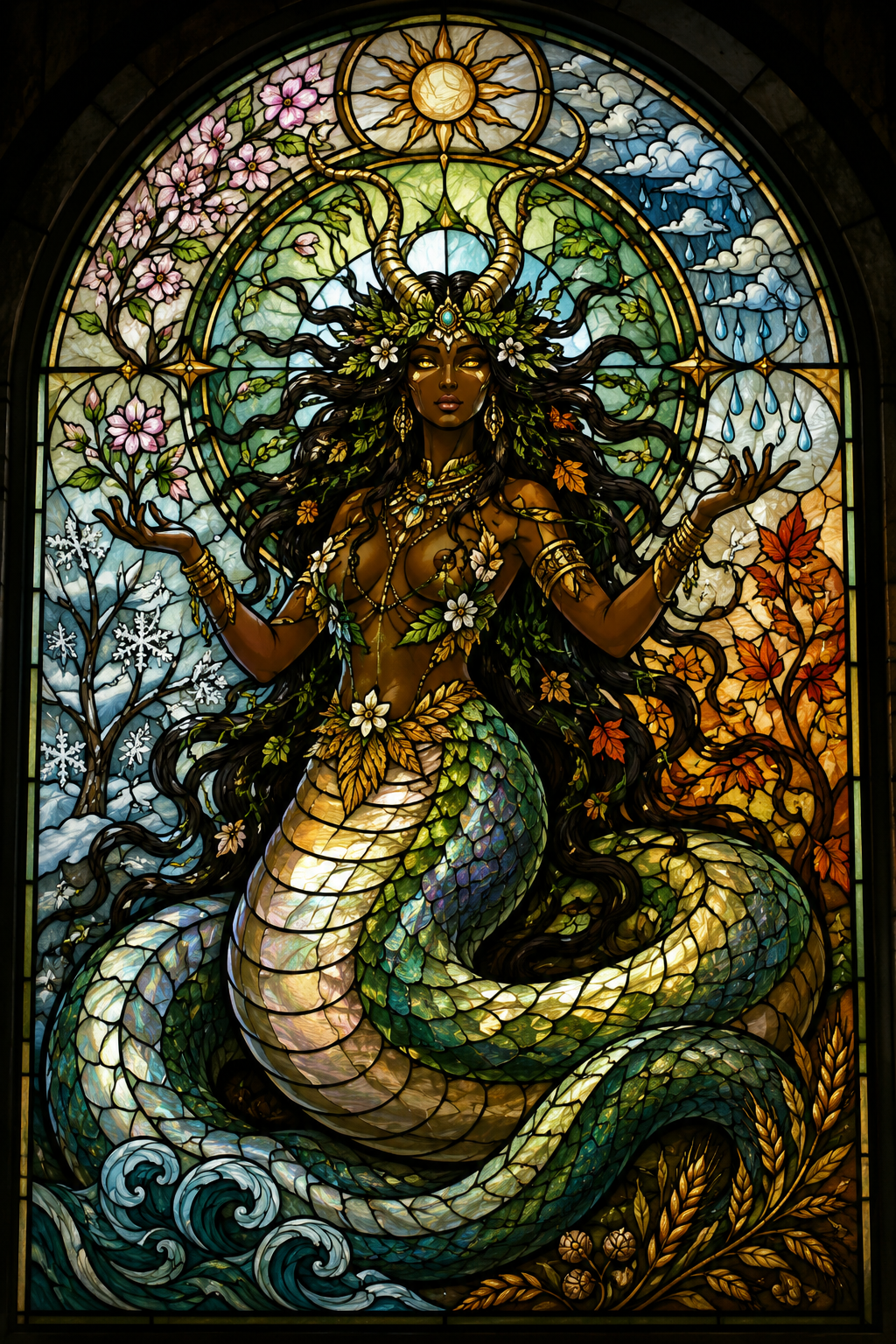
- The Wheel of Seasons.
- Serpents shedding their skin.
- Spiraling antelope horns.
- Storm clouds and rain.
- Flowers blooming from bare branches.
- The sun and moon divided into four seasonal quarters.
- A great serpent encircling the world.
- Seeds and young saplings.
- Rivers winding through fertile land.
Divine Nature
Origins
According to myth, Tuulla wandered the cosmos for ages before discovering Andórë in its primordial state.
The world then existed as a place of extremes, with one half forever scorched by the sun and the other locked in endless ice. Yet life endured in the narrow border between light and darkness, astonishing the goddess.
Seeing the world's potential, Tuulla broke its tidal lock, set it spinning, and tilted it upon its axis, bringing forth the seasons. She then birthed her children—Usjunn, Oxdros, and Sedarr—to help shape and shepherd the young world.
Whether these stories are literal truth or merely the myths by which mortals understand the Prime Goddess is a matter of theology and speculation. To the faithful, however, they represent a deeper truth:
Tuulla found a world of possibility and taught it to change.
Divine Disposition
Tuulla is patient, nurturing, and contemplative, yet also wild, unpredictable, and utterly uncompromising.
She possesses the gentleness of spring rain and the fury of a hurricane, the warmth of summer and the mercilessness of winter.
She loves life in all its forms, but she does not cling to any individual life above the greater balance of the world.
She can be tender as a mother and terrible as a storm. She can also be as indifferent as winter.
Morality & Philosophy
Tuulla teaches that change is inevitable and that all things have their season.
Birth and death, growth and decay, abundance and hardship are not opposites but parts of the same cycle.
She believes that suffering is neither punishment nor failure, but an unavoidable aspect of existence from which growth and wisdom may emerge.
To resist change entirely is folly. To endure, adapt, and continue despite change is wisdom.
Divine Goals & Aspirations
- Preserve the balance of the world.
- Ensure the continuation of life's cycles.
- Preserve the conditions in which life may flourish.
- Teach mortals to live in Harmony with change.
- Protect the natural order from forces that would destroy or unmake it.
Virtues
- Patience
- Wisdom
- Acceptance
- Adaptability
- Perseverance
- Nurturing
- Humility
Flaws & Limitations
- Can appear distant or indifferent to individual suffering.
- Accepts loss more readily than many mortals can understand.
- Rarely intervenes directly, even in times of great loss.
- May prioritize the balance of the whole over the desires of individuals.
- Can be as relentless and unforgiving as nature itself.
Favored Virtues
- Patience in adversity.
- Respect for the natural world.
- Adaptability and resilience.
- Stewardship and caretaking.
- Acceptance of life's changes.
Abhorred Vices
- Needless destruction.
- Arrogance toward nature.
- Wastefulness.
- Attempts to dominate or control the natural order.
- Despair in the face of change.
I especially like the last one because it mirrors her own story of enduring the decline of her worship and seeking a new beginning.
Speech & Mannerisms
Tuulla speaks slowly and deliberately, as though she has all the time in the world.
Her voice often resembles natural sounds: distant thunder, rustling leaves, rainfall upon water, or wind through tall grass.
She rarely raises her voice and seldom appears hurried.
When angered, however, her calm can vanish with terrifying suddenness, like a storm breaking upon a clear day.
Quotes & Catchphrases
"All things have their season."
"Winter is not the end of the garden."
"Nothing living remains unchanged."
"What falls shall nourish what rises."
"The river reaches the sea because it does not fear its winding course."
"You need not welcome change. Only endure it."
"Even the mightiest tree began as a seed."
"Growth often begins in the places we have been broken."
Divine Relationships
Family
Tuulla's closest familial relationships are with her children:
- Usjunn, God of Spring and Renewal.
- Oxdros, God of the Sky and Storms.
- Sedarr, God of the Sea and Tides.
She regards each of them with the patient affection of a mother who knows that all living things must eventually walk their own paths.
Many myths portray her as a patient but distant mother, allowing her children to make their own choices and learn from their own mistakes.
The other gods of the Andórëan Pantheon often refer to her as Mother Tuulla, even when no blood relation exists between them.
Allies
As Overgod, Tuulla maintains cordial relations with nearly every member of the pantheon.
She particularly values gods whose portfolios contribute to the flourishing and stability of the world, including:
- Rildir, for his tranquility and peace.
- Tiseyr, for his gifts of rest and renewal.
- Yxtuna, for bringing order to chaos.
- Hykteus, whose pursuit of understanding deepens mortal appreciation of the world.
Yet she does not form close alliances in the same way that mortals do. Her perspective is too vast and her concerns too broad.
Rivals & Enemies
Tuulla possesses few true enemies.
She has, on occasion, expressed disappointment or disapproval toward gods whose actions threaten the balance of the world or interfere excessively in mortal affairs.
This is perhaps most famously illustrated by Xokone's transformation of the Velhelsinese Elves into the Drow. While the punishment itself was supported by the pantheon, Xokone's severity and personal anger stood in contrast to Tuulla's preference for restraint and measured judgment.
Even so, Tuulla bears no resentment toward Xokone. To the Mother of Seasons, even conflict has its season.
She has no true rivals among the gods.
Relationships with Other Gods
Tuulla is respected, revered, and occasionally feared by the other gods.
As Overgod, she established many of the laws that govern divine conduct, including the prohibition against direct physical intervention in mortal affairs.
The gods do not obey these laws merely because Tuulla commands them. They obey because they recognize the wisdom of preserving mortal agency and preventing divine conflicts from consuming the world.
Many younger gods seek her counsel, though her advice often comes in the form of questions, stories, or observations rather than direct answers.
To most of the pantheon, she is less a ruler and more a force of nature: ancient, patient, and enduring.
Relationships with Mortals
Tuulla's relationship with mortals is notably distant compared to that of many other deities.
She grants spells to her clerics and answers prayers in subtle ways, but she rarely sends visions, dreams, or omens and almost never intervenes in individual lives.
She believes that mortals must be allowed to make their own choices, suffer their own hardships, and grow through their own experiences.
Many of her faithful therefore regard her not as a personal protector, but as a constant presence akin to the changing of the seasons or the rising of the sun.
To pray to Tuulla is not necessarily to ask for aid.
It is often simply to acknowledge one's place within the greater cycles of the world.
Among her priests, a common saying is:
"Mother Tuulla gives us the seasons, not the harvest."
Or, more bluntly:
"She provides the rain. What grows is up to us."
Worship & Faith
Worshippers
Tuulla is among the most widely revered deities in Andórë, though relatively few people devote themselves exclusively to her worship.
Her faithful include:
- Druids and rangers.
- Farmers, shepherds, and foresters.
- Sailors and fishermen.
- Gardeners and herbalists.
- Midwives and healers.
- Scholars of the natural world.
- Those who seek acceptance, resilience, and harmony with the changing circumstances of life.
Even those who do not consider themselves followers of Tuulla often offer prayers to her at the beginning of planting seasons, before long journeys, or during times of hardship and change.
Major Cults
Tuulla possesses few centralized religious institutions.
Her worship is instead practiced through thousands of local traditions, druidic circles, seasonal festivals, and rural shrines.
Notable groups devoted to her include:
- The Keepers of the Wheel, druids who preserve ancient knowledge of the seasons and maintain sacred groves.
- The Gardeners of Renewal, communities dedicated to restoring damaged lands and nurturing new growth.
- The Stormwatchers, priests and sailors who study weather and offer prayers for safe passage upon sea and sky.
Most of these organizations are loosely connected at best, sharing traditions and teachings but rarely possessing any central authority.
Holy Books & Codes
The Book of Seasons
The principal scripture of Tuulla's faith, the Book of Seasons is a collection of myths, parables, poems, prayers, and observations concerning the natural world and the cycles of life.
Its teachings emphasize:
- the inevitability of change,
- perseverance through hardship,
- living in harmony with the world,
- stewardship of future generations,
- and acceptance of life's many seasons.
Many copies of the Book of Seasons differ considerably from one another, with regional additions and local traditions often incorporated into the text.
This lack of strict canon is generally considered entirely appropriate by Tuulla's faithful.
Tenets of Faith
- Embrace Change.
- Endure Every Season.
- Live in Harmony.
- Nurture New Growth.
- Accept Life's Cycles.
Holidays & Holy Days
Spring Equinox
A celebration of renewal, planting, and new beginnings. Communities gather to plant trees, exchange seeds, and bless the coming growing season.
Summer Solstice
A festival of abundance, joy, and life at its fullest. Bonfires, dancing, feasts, and music are common.
Harvest Festival
A time of thanksgiving and communal celebration marking the gathering of crops and the rewards of hard work.
Winter Solstice
A solemn but hopeful observance dedicated to reflection, remembrance, and endurance during times of darkness and hardship.
Sacred Sites
Tuulla's faith possesses few grand temples.
Her sacred places are instead found within the natural world itself:
- ancient groves,
- great trees,
- mountain springs,
- waterfalls,
- untouched forests,
- standing stones,
- secluded gardens,
- and places where the changing seasons are particularly beautiful.
Many villages maintain simple shrines consisting of little more than a stone altar, a tree, or a garden dedicated to the goddess.
Religious Practices
The worship of Tuulla is highly personal and varies greatly between cultures.
Common practices include:
- planting trees in honor of births and deaths,
- maintaining gardens and sacred groves,
- leaving offerings of flowers, fruit, grain, or seeds,
- observing the changing of the seasons with communal feasts,
- meditating in natural places,
- caring for animals and the land,
- and undertaking periods of quiet reflection during seasonal transitions.
Prayer to Tuulla is often contemplative rather than petitionary. Her followers do not typically ask her to solve their problems but instead seek the wisdom and resilience to endure them.
Forbidden Acts
The faithful of Tuulla generally condemn:
- wanton destruction of the natural world,
- needless waste and excess,
- destroying land solely for greed or vanity,
- preventing natural cycles of growth and renewal,
- hoarding resources while others suffer,
- and refusing to adapt to necessary change.
Divine Realm
Home Plane
Zephyrion
Tuulla resides within Zephyrion, the plane of nature, weather, and the untamed beauty of the natural world.
Zephyrion is a vast realm of forests, mountains, rivers, deserts, and seas, where the natural world flourishes in extraordinary abundance. Though many gods possess domains within the plane, its landscapes remain wild and largely untouched, reflecting the beauty and unpredictability of nature itself.
Ancient ruins, strange phenomena, and countless wonders can be found throughout Zephyrion, and even the gods who dwell there often treat the plane with a sense of reverence and humility.
Realm
The Cycle of Seasons
The Cycle of Seasons is an ever-changing realm where spring, summer, autumn, and winter coexist in an endless and unpredictable dance.
No map of the realm remains accurate for long. Forests migrate, rivers alter their courses, and entire landscapes may shift from one season to another without warning.
The changes are seldom dangerous, but they are often whimsical and impossible to predict.
These four domains slowly and endlessly rotate around the realm's center like the turning of a great wheel, symbolizing the eternal cycle of change and renewal.
At the center of this turning world lies the Eternal Sanctuary, a magnificent temple of white stone and crystal where the four seasons meet.
The Sanctuary serves as Tuulla's home and court, though "court" may be too formal a word. It is a place of contemplation, learning, and quiet beauty.
Its gardens contain plants from every season simultaneously:
- spring flowers bloom beside autumn trees,
- ripe fruit hangs from branches dusted with snow,
- and warm summer breezes mingle with cool winter air.
The realm itself is a living expression of Tuulla's philosophy:
Nothing remains the same.
Nothing is ever truly lost.
Every ending gives rise to a new beginning.
Inhabitants
The Cycle of Seasons is populated by a vast array of beings that embody the beauty and diversity of the natural world.
Its inhabitants include:
- celestial beasts,
- nature spirits,
- dryads and nymphs,
- sprites and fairies,
- talking animals,
- elemental beings associated with weather and the seasons,
- and mortal souls who devoted their lives to the stewardship and understanding of the natural world.
Many of its inhabitants migrate between the four seasonal realms, their lives and customs following the turning of the great wheel.
Some creatures dwell permanently within a single season:
- great stags roam the Blossoming Fields,
- radiant songbirds nest within the Golden Glades,
- wise owls and foxes inhabit the Harvest Fields,
- and white wolves and elk wander the Frosty Glaciers.
Tuulla herself is rarely found seated upon a throne.
More often, she can be found:
- tending a garden,
- walking among the forests,
- listening beside a river,
- or watching the slow turning of the seasons from the Eternal Sanctuary.
Among the inhabitants of the realm, it is often said:
"If you seek the Goddess of Seasons, do not look for her palace. Look for the place where something is quietly growing."
Artifacts & Relics
Divine Artifacts
The Staff of Seasons
The foremost relic associated with Tuulla, the Staff of Seasons is a living staff of pale wood that changes continuously throughout the year.
In spring it bears blossoms.
In summer it grows green leaves and ripe fruit.
In autumn its leaves turn gold and crimson.
In winter its branches become white with frost.
Legends claim that Tuulla used the Staff of Seasons when she first taught Andórë to turn and know the passing of the seasons. Though it cannot truly control the world's seasons, it possesses immense power over weather, growth, and the rhythms of the natural world.
The staff is rarely seen and is believed to remain within the Eternal Sanctuary.
The Seed of Life
The Seed of Life appears as a single luminous seed no larger than an acorn.
It is said that wherever the Seed is planted, life flourishes.
Barren lands become fertile.
Dead forests bloom again.
Springs emerge from dry ground.
The Seed is viewed less as an artifact and more as a symbol of renewal and possibility. Some theologians even question whether it truly exists or whether it is merely a parable teaching that even the smallest act of care can restore a dying place.
The Horn of Tempests
Fashioned from one of Tuulla's own antelope-like horns, the Horn of Tempests contains the fury of the sky.
Its call can summon rain, calm storms, or awaken winds powerful enough to reshape landscapes.
Though associated with Tuulla, many traditions claim she gifted the Horn to Oxdros long ago, making it as much a relic of her son as of the Prime Goddess herself.
The Mirror of Reflection
A perfectly smooth disk of silver water held within a frame of living wood.
Those who gaze into the Mirror do not see their appearance.
They see themselves as they truly are.
Many who look upon it are humbled.
Some are inspired.
Others turn away in terror.
Tuulla is said to use the Mirror not to judge, but to remind mortals that growth begins with understanding oneself.
Relics of the Faith
Blooms of Renewal
Certain flowers are said to bloom in places touched by Tuulla's direct presence.
These blossoms appear only briefly and are considered sacred signs of renewal, hope, and new beginnings.
Their appearance often inspires pilgrimages and seasonal celebrations.
Different regions describe the flowers differently, and no two Blooms of Renewal are ever exactly alike.
Holy Weapons
Tuulla possesses no holy weapon in the traditional sense.
She is not a goddess of conquest or battle, and no single blade or spear is associated with her worship.
Instead, her symbols of authority are instruments of cultivation and stewardship:
- the Staff of Seasons,
- the Seed of Life,
- and the Horn of Tempests.
Among her faithful it is often said:
"The Mother of Seasons carries no sword, for the world itself is already her strength."
History
Creation & Early History
Tuulla is among the oldest of all the gods of Andórë and is widely regarded as the first among the pantheon. In the earliest days of existence, when the world was still dominated by primordial elemental forces, she emerged as the embodiment of the natural cycles that would eventually make mortal life possible.
Recognizing that the elemental titans would render the world forever inhospitable to life, Tuulla called the gods together and forged the Divine Alliance, convincing deities of vastly different temperaments and domains to set aside their rivalries and unite against a common enemy. This act of diplomacy and leadership marked the first great cooperation among the gods and established Tuulla as the de facto leader of the pantheon.
During the war against the titans, she personally confronted Aquarion, the Endless Depths, battling the primordial embodiment of water across seas and frozen wastes before finally imprisoning it within the newly created Plane of Water.
Following the victory of the Divine Alliance and the imprisonment of the titans, Tuulla turned her attention to the healing and stabilization of the world. Under her guidance, the seasons began to turn, climates stabilized, and the conditions necessary for life emerged. The flourishing of ecosystems during the Prehistoric Age is traditionally attributed to her influence and stewardship.
Major Deeds
Formation of the Divine Alliance
Tuulla's greatest achievement was uniting the gods against the primordial elemental titans. Without her leadership, the pantheon may never have acted in concert, and mortal life would likely never have come into being.
Defeat of Aquarion
Her victory over Aquarion is remembered as one of the defining battles of The Primordial Age. Through the mastery of all four seasons, she gradually wore down the Endless Depths and imprisoned it within its elemental prison.
Ordering the World
After the Elemental Sundering reshaped the face of Andórë, Tuulla guided the world's recovery. The establishment of stable climates, fertile lands, and the recurring cycle of the seasons are all considered extensions of her divine will.
Expansion of the Pantheon
As the world became more complex, Tuulla recognized that additional divine powers were needed to govern it. During the Age of Prehistory, she welcomed and gave purpose to several deities, most notably Khyzlios and Venera, bringing them into the Andórëan pantheon and helping shape the divine order that exists today.
Preservation of the Natural Order
When the Dragon-Giant War escalated into an apocalyptic conflict, Tuulla forbade the war goddesses from intervening directly. She foresaw that divine participation would only deepen the destruction and perhaps doom the world entirely. This decision remains controversial among theologians but is generally regarded as one of the wisest acts in divine history.
The Admonishment of Dragons and Giants
After the Cataclysmic Convergence released the primordial titans once more, Tuulla and Hykteus manifested before Dragon Queen Imelyn and Storm Giant King Cigrion. Though they refused to intervene directly, they provided the knowledge necessary to reseal the titans and sternly rebuked both civilizations for their arrogance.
Intervention in Mortal Affairs
Unlike many gods, Tuulla rarely intervenes directly in the lives of mortals.
She prefers to guide rather than command, and to nurture rather than rule.
Most of her interventions occur through subtle means:
- inspiring individuals toward acts of renewal and healing,
- blessing lands with fertility,
- sending visions concerning the changing of seasons,
- protecting places essential to the balance of the world,
- and occasionally empowering mortal champions who embody balance and stewardship.
Direct manifestations of Tuulla are exceedingly rare. Across all recorded history, only a handful are known with certainty:
- her summoning of the gods to form the Divine Alliance,
- her appearance before Imelyn and Cigrion during the second titan crisis,
- and the granting of divine power to Diamondclaw, making the crystal dragon the first known dragon cleric.
Many theologians argue that Tuulla's greatest intervention is not any singular miracle but the continued turning of the seasons themselves. Every spring, every harvest, and every winter's thaw are viewed as ongoing expressions of her divine care.
Current Circumstances
Tuulla remains the acknowledged matriarch of the Andórëan pantheon and is one of the most universally revered deities in the world.
She resides within the Eternal Sanctuary, where she watches over the turning of the seasons and the balance of nature.
Among the gods, her authority stems less from power and more from wisdom and age. Even deities who frequently disagree with her decisions generally respect her judgment.
In the present age, Tuulla's greatest concern is that nothing halt the great turning of the world. The scars left by the Dragon-Giant War, the release of the primordial titans, and the countless catastrophes that have followed have convinced her that civilization's greatest threats often arise not from monsters, but from pride, ambition, and the refusal to live in harmony with the world.
Her faithful believe that so long as the seasons continue to turn, the Mother of Seasons still watches over Andórë, patiently nurturing life and waiting for each long winter to eventually give way to spring.
Representation & Legacy
Cultural Importance
Although she is neither the most beloved nor the most widely worshipped deity, Tuulla occupies a unique place within the Andórëan pantheon. To mortals, she is often viewed less as a goddess to whom one prays for favors and more as a fundamental force of the world itself.
Farmers thank Greana for a good harvest, sailors pray to Sedarr for calm seas, and warriors invoke Ara before battle. Yet all of these gods ultimately operate within the framework established by Tuulla. The changing of the seasons, the rhythm of life and death, the cycles of planting and harvest, and even the concept of time as mortals experience it are all tied to her domain.
As a result, nearly every culture in Andórë acknowledges her importance, even if few place her at the center of their worship.
In theological terms, Tuulla occupies a role similar to that of a sovereign or constitutional monarch among the gods:
- She rarely issues commands.
- She seldom interferes in the domains of other deities.
- She possesses no formal authority to compel obedience.
And yet, when she speaks, the gods listen.
This respect is born from three things:
- Age — She is among the eldest of the gods.
- Wisdom — She has repeatedly proven her judgment correct in times of crisis.
- Stewardship — The world flourishes in its current form largely because of her stewardship during The Primordial Age.
Many theologians describe her not as the ruler of the gods, but as their caretaker.
Symbolism
Tuulla embodies several interconnected ideas:
The Cycle
Nothing lasts forever.
Winter gives way to spring, empires rise and fall, wounds heal, and even grief eventually softens. Her faithful believe that all things exist within cycles and that resisting these natural changes only creates suffering.
Balance
Tuulla is not a goddess of perfect goodness.
She is equally the goddess of:
- growth and decay,
- birth and death,
- abundance and scarcity,
- creation and destruction.
A forest fire may destroy thousands of trees, but it also creates the conditions for new growth. To Tuulla, both acts are equally sacred.
Patience
The seasons cannot be rushed.
Trees do not grow in a day, and civilizations cannot heal overnight. Tuulla's faith teaches patience, perseverance, and the understanding that meaningful change often occurs over generations rather than years.
Renewal
Perhaps her most beloved aspect among mortals is the promise that no winter lasts forever.
This symbolism has made her particularly important to:
- survivors of tragedy,
- those rebuilding after war,
- communities recovering from disaster,
- and people struggling through periods of grief and despair.
The Steward
Unlike gods who seek glory or worship, Tuulla symbolizes responsibility.
The world is not something to conquer or exploit but something entrusted to every generation to preserve for the next.
This philosophy heavily influences druidic traditions and many rural cultures throughout Andórë.
Legacy
The legacy of Tuulla can be found everywhere.
Every field planted in spring.
Every leaf that turns in autumn.
Every child born after a harsh winter.
Every civilization that rises from the ashes of catastrophe.
Her greatest legacy, however, is not the world she helped create but the lesson she has repeatedly taught both gods and mortals:
Power without balance leads to ruin.
The primordial titans taught this lesson.
The Dragon-Giant War taught it again.
The release of the titans taught it a third time.
Even the gods themselves are not exempt from it.
Among the deities of Andórë there is an old saying:
"The gods may rule their domains, but Tuulla keeps the world turning."
Notes
Referenced by
- Andórë, Wildspace, and the Astral Sea
- Ara
- Battle of Hope and Magma
- Earae
- Genasi
- Getting Started with Andórë
- Greluna
- Hykteus
- Pethi Meeting with the Celestials
- Planes of Existence
- The Andórëan Pantheon
- The Custody of the Uncollected, Part 3: The Witnesses
- The Custody of the Uncollected, Part 4: The Council
- The Custody of the Uncollected, Part 5: The Places Beyond the Island
- The Custody of the Uncollected, Part 7: Tuulla’s Law
- The Primordial Age
- Usjunn