Bateus
Bateus is the God of Messages, divine patron of truthful correspondence, sealed words, lawful dispatch, protected messengers, and the trust by which speech may cross distance without becoming falsehood.
He is seldom honored apart from Caneas, his sister and necessary counterpart, for no message travels through the world without passing between truth and interpretation. Bateus preserves the word entrusted; Caneas tests what may be done with it. Together they form the perilous whole of communication, though Bateus remains the beloved guardian of messages carried faithfully, records kept honestly, and words spoken under witness.

Divine Information
| Property | Value |
|---|---|
| Alignment | Lawful Good |
| Divine Domains | Order, Peace |
| Portfolio | Messages, Communication, Secrets, Truth |
| Home Plane | Elysian Post |
| Realm | The Post Office |
| Symbol | Sealed Scroll Crossed with a Messenger's Staff |
| Sacred Animal | Carrier Pigeon |
| Title | God of Messages |
Manifestation
Common Appearance
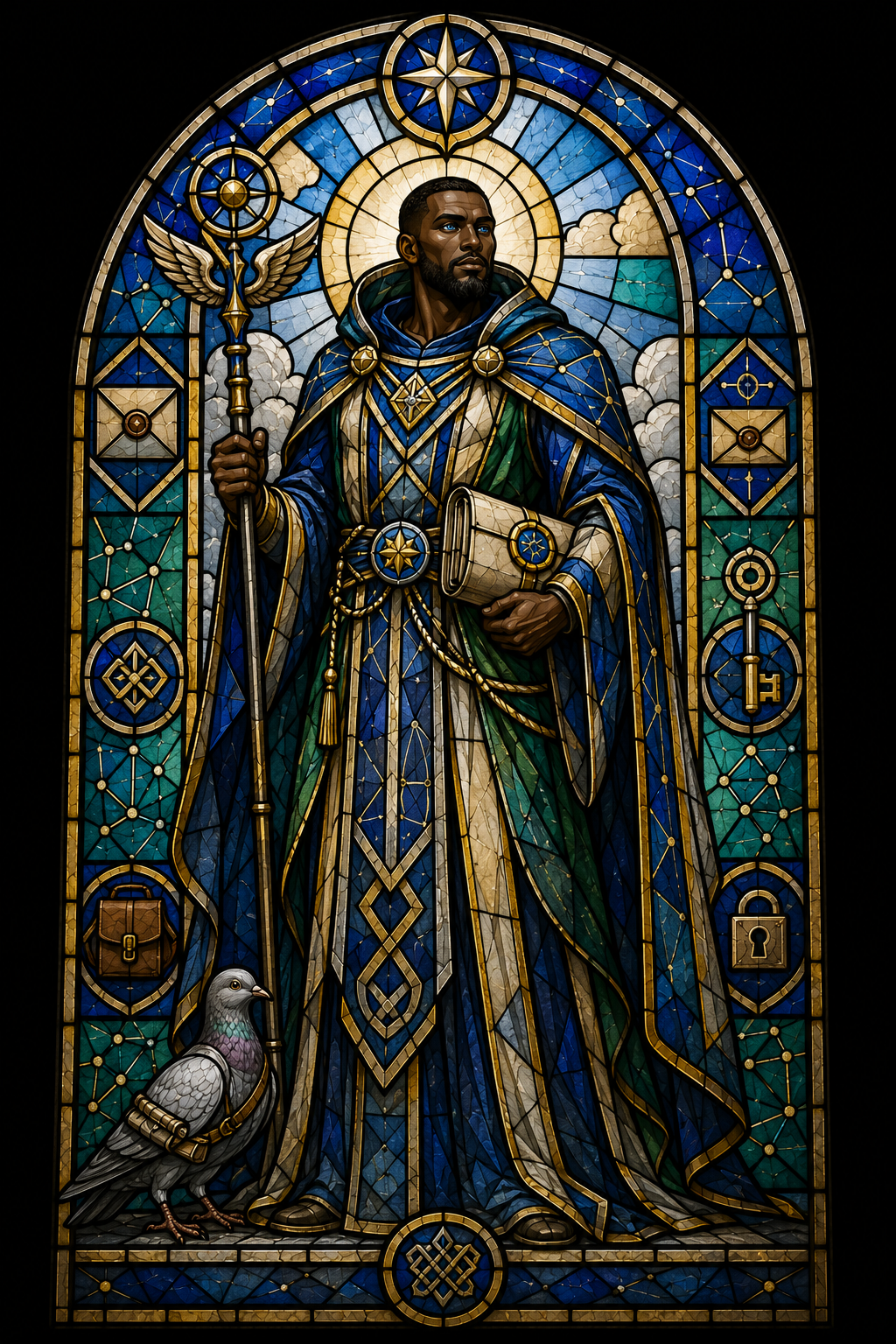
Bateus is most often depicted as a tall, broad-shouldered humanoid man with dark skin, a short well-kept beard, close-cropped hair, and piercing blue eyes. His bearing is calm, formal, and commanding: the presence of one accustomed to being trusted when words must pass safely between powers.
His skin is often shown with a subtle metallic sheen, as though polished bronze or dark steel had been warmed by living light. Sacred artists use this feature to mark him as more than mortal without diminishing the dignity of his mortal-shaped form.
He is usually robed in blue, green, and gold, with garments marked by seals, script, knots, route-lines, oath-marks, and sigils of protected correspondence. His cloak is often hooded, not to suggest secrecy for its own sake, but discretion: the messenger's right to carry what is entrusted without exposing it to every eye along the road.
Bateus is rarely shown in haste. Though his servants and messengers may fly, ride, run, or vanish between distant posts, Bateus himself is usually depicted at the center of motion: receiving, weighing, sealing, witnessing, routing, and dispatching. His divinity is not speed alone, but certainty that the right words reach the right place unchanged.
Preferred Forms
- A tall dark-skinned man in blue and green robes marked with seals and script.
- A winged divine courier carrying a staff, satchel, and sealed scrolls.
- A regal messenger with metallic-sheened skin and piercing blue eyes.
- A hooded dispatcher standing before doors, routes, and sealed archives.
- A calm herald bearing a sealed scroll and a staff of blue light.
Avatar Forms
- A traveling scribe who arrives with the needed document at the needed hour.
- A diplomatic courier carrying sealed letters between hostile courts.
- A road-weary messenger who knows every route and every delay.
- A bank clerk, treaty witness, or notary whose records cannot be altered.
- A herald whose clear voice stills confusion before violence begins.
Identifying Characteristics
- Dark skin with a faint metallic sheen.
- Short, well-kept beard and close-cropped hair.
- Piercing blue eyes associated with clarity and discernment.
- Blue, green, and gold robes marked with script, seals, or oath-marks.
- A staff, sealed scroll, satchel, or locked message case.
- Feathered wings in formal or divine depictions.
- A hooded cloak used as a sign of discretion and protected correspondence.
- Imagery of doors, seals, signal horns, post stations, ledgers, and dispatch routes.
- A calm, authoritative expression suggesting trust, precision, and restraint.
Divine Symbols & Iconography
Bateus's symbol is a Sealed Scroll Crossed with a Messenger's Staff. The sealed scroll represents the integrity of a message entrusted to another. The staff represents the authority and duty of the messenger who bears it across distance, danger, secrecy, and dispute.
He is also associated with quills, inkwells, ledgers, horns, signet rings, satchels, route maps, postmarks, locked message cases, witness seals, and oath-cords. These are supporting motifs rather than separate holy symbols.
His sacred colors are blue, green, and gold. Blue represents clarity and truthful speech, green represents entrusted secrecy and living communication, and gold represents lawful obligation, honored seals, and words given under witness. His sacred animal is the carrier pigeon, honored as a humble bearer of entrusted words, a creature of return and reliability, and a sign that even the smallest messenger may carry matters of peace, law, love, or ruin.
Divine Nature
Origins
Bateus is counted by most temple traditions as one half of the divine charge of communication. He is not merely a swift herald, nor only the patron of couriers and letters, but the power by which meaning may be entrusted to another and carried without corruption.
The oldest Batean accounts say that when speech first became more than sound, Bateus stood at the place where one will gave meaning into another's keeping. In that moment, the message became sacred: something that could be sealed, witnessed, borne, guarded, and received.
Yet few learned priests speak of Bateus without also naming Caneas. She arose from the same mystery, whether as sister, shadow, answer, or adversary depends upon the tradition consulted. If Bateus is the word preserved, Caneas is the word shaped. If Bateus is the seal kept, Caneas is the seal questioned, opened, forged, or broken.
For this reason, common folk pray to Bateus that a message may arrive clear, whole, and true, and name Caneas in the same breath, that she not twist, expose, delay, or sharpen it beyond its purpose.
Divine Disposition
Bateus is calm, formal, precise, and severe in his trustworthiness. He is not cruel, but he is often uncomfortable to those who prefer comfort over clarity.
He values direct speech, exact wording, fulfilled oaths, witnessed declarations, protected messengers, and secrets kept by rightful duty. He is patient with honest confusion, but intolerant of deliberate corruption. A mistake may be corrected; a forgery must be judged.
He is rarely moved by embarrassment, flattery, or social convenience. This is both his strength and his danger. Bateus speaks the truth as though truth itself were a road that must remain unobstructed. Mortals often require Caneas's shadow to remind them that not every truth should be hurled simply because it is true.
Morality & Philosophy
Bateus teaches that communication is a sacred structure built from truth, custody, and trust.
To speak is to send meaning beyond oneself. To listen is to receive what another has entrusted. To carry a message is to bear responsibility for a thing that belongs to neither sender nor bearer alone, but to the bond between them.
Bateus is Lawful Good because he believes peace depends upon truthful communication. Treaties, testimony, law, commerce, confession, apology, warning, and reconciliation all fail when words become unreliable. In his philosophy, falsehood is not merely a personal vice, but a wound in the road between minds.
Yet Bateus also honors secrecy. A secret entrusted in good faith is not a lie, but a protected message whose time, place, and audience have not yet come. To expose every truth to every ear is not clarity; it is another form of violence.
Divine Goals & Aspirations
Bateus seeks to preserve the integrity of communication wherever it is used to sustain peace, trust, justice, and lawful order.
He blesses messages that must arrive unchanged, secrets that must remain protected, testimony that must be heard clearly, and words that may prevent needless violence. He guides messengers, couriers, scribes, judges, diplomats, merchants, and bankers when their work depends upon truth properly carried and properly guarded.
His highest aspiration is not that all beings speak constantly, but that when speech is entrusted, it may be trusted.
Virtues
- Clarity
- Honesty
- Reliability
- Discretion
- Accountability
- Peacekeeping
Flaws & Limitations
- Rigidity
- Bluntness
- Formality
- Inflexibility
- Discomfort with ambiguity
- Truth without tenderness
Favored Virtues
- Honest speech.
- Careful listening.
- Kept confidences.
- Lawful testimony.
- Clear records.
- Messages delivered faithfully.
- Peace preserved through truth.
Abhorred Vices
- Forgery.
- Perjury.
- False witness.
- Broken confidences.
- Corrupted messages.
- Harm to protected messengers.
- Confusion spread for profit.
Speech & Mannerisms
Bateus speaks with deliberate clarity. His words are formal, measured, and exact, rarely embellished beyond necessity. He favors definitions, confirmations, oaths, repeated phrasing, and direct statements.
He does not rush speech. When he pauses, it is often because a word has weight and must be chosen properly. His silence is not uncertainty, but custody. Bateus understands that not every truth belongs to every listener.
In stories, his anger is not loud. It appears as correction, witness, and sentence. He does not shout down falsehood; he names it, seals the record, and lets the truth stand where evasion can no longer move it.
Quotes & Catchphrases
"Let the message arrive whole."
"Truth is not yours once entrusted."
"A sealed word is a sacred weight."
"Speak clearly, or be silent."
"Peace requires words that can be trusted."
"Not every truth is yours to reveal."
"The messenger is not the wound."
"Let truth travel, and let trust endure."
Divine Relationships
Family
Bateus's central familial bond is with Caneas, his sister, rival, and necessary counterpart.
The temples do not agree on whether the word sister should be understood as blood, birth, symbol, or divine ordering. All agree that the two cannot be separated without doing violence to the mystery they govern. Bateus is the word preserved; Caneas is the word shaped. Bateus is the seal kept; Caneas is the seal tested. Bateus is the truth that must be spoken; Caneas is the lie, omission, mask, or mercy by which speech becomes useful, dangerous, or bearable.
This teaching offends some of Bateus's most zealous faithful, who would prefer the God of Messages to stand untouched by the Goddess of Lies. Yet the older scribes answer that Bateus alone would make speech honest, but not always humane; Caneas alone would make speech useful, but not trustworthy.
Bateus does not love Caneas as mortals love a sibling, nor hate her as one hates an enemy. Their bond is of office and essence. Without her, his truth loses trial and context. Without him, her lies lose the very trust they require in order to have power.
Allies
Bateus is most naturally allied with gods whose works depend upon trustworthy speech, stable records, sworn testimony, education, peace, and ordered exchange.
Niuna is often named as one of his closest allies, for education cannot endure where words no longer mean what teachers intend. Records, lessons, histories, and laws require the preservation of meaning from one mind to another.
Phohella is also honored among his allies, especially by couriers, signalers, ship-messengers, and those whose words must cross dangerous distance. Wind carries voices, smoke, flags, sails, birds, and weathered travelers; Bateus gives such movement sacred purpose.
Gods of law, justice, healing, civic order, and peaceful negotiation often rely upon Bateus even when they find him difficult. He is valued not because he is easy, but because his witness cannot be bent. When Bateus confirms a message, the gods trust that it has not been altered for comfort, strategy, fear, or favor.
Rivals & Enemies
Caneas is Bateus's chief rival, though not his enemy in the ordinary sense.
He opposes her distortions, exposed secrets, forged meanings, and weaponized ambiguities, yet he does not seek her destruction. Bateus understands, more than his most zealous followers often do, that communication cannot exist without the possibility of distortion. A truth that could never be hidden, shaded, delayed, or misused would require no courage, judgment, or restraint.
His true enemies are those who destroy communication as a sacred trust: false witnesses, oathbreakers, forgers, corrupt translators, murderers of envoys, betrayers of confidences, and those who profit from confusion that brings suffering.
Bateus is especially severe toward those who claim honesty while using truth as a weapon. A person who speaks a cruel truth only to wound does not stand fully in Bateus's blessing. Such a person has preserved the letter of truth while betraying the purpose of communication.
Relationships with Other Gods
Among the gods, Bateus is respected as a force of order, witness, and necessary discomfort.
He is often called upon when divine words must pass between powers who do not trust one another. A message borne under Bateus's seal may be unwelcome, but it is presumed intact. His presence in divine councils is therefore both reassuring and inconvenient, for he has little patience for evasive language disguised as wisdom.
Many gods love the results of Bateus's work more than the experience of dealing with him. He clarifies promises. He records statements. He repeats words precisely. He refuses to pretend that a contradiction is harmony merely because harmony is desired.
For this reason, even benevolent gods sometimes invoke Caneas alongside him, not to corrupt his message, but to temper its delivery. Divine diplomacy, like mortal diplomacy, often requires truth to be timed, framed, and held until it can be received without ruin.
Relationships with Mortals
Bateus is deeply beloved by mortals, though not always comfortably loved.
Messengers pray to him for safe roads and unbroken dispatches. Scribes pray that records remain clear. Judges pray that testimony be truthful. Diplomats pray that treaties be understood. Merchants and bankers pray that contracts, ledgers, seals, debts, and promises retain their meaning. Ordinary families pray to him before sending letters of apology, warning, confession, or farewell.
Yet few mortals invoke Bateus alone unless they seek absolute truth, sworn witness, or protected delivery. His blessing is powerful, but severe. To invite Bateus fully into a conversation is to invite clarity without flattery, honesty without evasion, and truth without the softening habits by which households, courts, and kingdoms preserve their peace.
Thus, common practice names Bateus and Caneas together. One asks Bateus to keep the message whole, and Caneas not to twist it. One asks Bateus to bless the truth, and Caneas to keep that truth from becoming needless harm. A merchant sealing a bargain, a diplomat entering negotiation, or a lover writing a difficult letter may honor both: Bateus for integrity, Caneas for tact, timing, and survival.
The sternest Bateans call this cowardice. The wiser call it humility.
Worship & Faith
Worshippers
Bateus is worshipped by messengers, couriers, diplomats, merchants, bankers, scribes, and judges.
These professions are not merely associated with writing or travel, but with trust. A messenger must carry what is not theirs. A courier must guard what they may not understand. A diplomat must preserve meaning between hostile powers. A merchant must make promises about goods not yet exchanged. A banker must protect records, debts, deposits, and confidences. A scribe must preserve words beyond the life of the speaker. A judge must distinguish testimony from distortion.
Most of these worshippers also offer some acknowledgment to Caneas, even if quietly. A treaty requires truth, but also timing. A ledger requires accuracy, but also privacy. A message requires delivery, but also protection from those who would exploit it. Bateus is therefore most often invoked as the god who keeps the message whole, while Caneas is named so that the same message is not twisted, exposed, or turned against its sender.
Those who worship Bateus alone are usually those who require absolute clarity: judges before verdicts, scribes copying law, witnesses before testimony, envoys carrying sworn declarations, and penitents making confession.
Major Cults
Bateus has few hidden cults, for his worship favors public oaths, visible seals, open records, and known offices. His organized faith is strongest in courier houses, courts, archives, treaty halls, banks, universities, and official dispatch stations.
The most respected Batean orders are sworn companies rather than secret brotherhoods: bonded messengers, temple notaries, archive-keepers, oath-scribes, translators under seal, and witnesses of law. Their members are honored because they bind themselves to preserve meaning even when accuracy is costly.
Some cities maintain paired shrines to Bateus and Caneas near diplomatic quarters or market districts. The shrine of Bateus is placed openly, where contracts are signed and messages sealed. The shrine of Caneas is often smaller, veiled, or set slightly behind it, acknowledging that every honest exchange also contains things unsaid.
Holy Books & Codes
Bateus's holy book is the Dispatch Codex.
The Dispatch Codex is less a book of stories than a code of custody, testimony, oath, message-bearing, and protected speech. It contains prayers for couriers, laws for sealed messages, standards for scribal copying, forms of witness, rules for translation, and meditations on the difference between secrecy and deceit.
Its most famous teaching is that a message belongs neither fully to sender nor bearer once entrusted. It becomes a sacred obligation moving between them. To corrupt it is theft. To expose it without right is betrayal. To delay it for selfish purpose is violence by silence.
In many temples, passages of the Dispatch Codex are studied alongside selected Canean warnings, not as approval of deception, but as training against it. A messenger who cannot recognize manipulation cannot fully serve Bateus.
Tenets of Faith
- Let Truth Travel
- Speak without corruption.
- Guard entrusted secrets.
- Honor every lawful message.
- Let clarity preserve peace.
Batean tenets are often misunderstood as requiring speech without restraint. His wiser priests reject this. Bateus commands truth, but not careless exposure. He blesses clarity, but not cruelty disguised as honesty. He honors secrets when they are entrusted rightly and kept for just purpose.
The faithful are taught that a word must be true, properly carried, properly received, and properly timed. Bateus governs the first three with absolute severity. The fourth is where even his priests admit the shadow of Caneas cannot be ignored.
Holidays & Holy Days
Bateus's chief holy day is the Day of Clear Words.
On this day, treaties are renewed, public apologies are made, debts are clarified, laws are read aloud, ledgers are reconciled, messengers are honored, and long-delayed letters are sent. Courts often prefer to hear important testimony on this day, believing falsehoods spoken beneath Bateus's attention carry special danger.
In households, the Day of Clear Words is often gentler. Families write letters, settle misunderstandings, name grievances plainly, and ask forgiveness for words misspoken or withheld. Even then, many families leave a small covered dish, folded note, or dark ribbon for Caneas, asking that necessary truths be received with mercy rather than turned into new wounds.
Sacred Sites
Bateus's sacred sites are places where communication is entrusted, preserved, or witnessed.
Post houses, courier stations, archives, treaty halls, courtrooms, banks, scribal colleges, translation chambers, and public proclamation stones often contain shrines to him. A simple sealed scroll above a doorway may mark a place as under his protection.
Roadside shrines to Bateus are common along dangerous routes, especially where messengers have died in service. These are rarely grand temples. More often they are small stone niches holding feathers, string, wax seals, and scraps of undelivered prayers.
The most formal Batean sanctuaries contain quiet rooms where letters may be written under divine witness, messages sealed before clergy, and oaths recorded in temple ledgers.
Religious Practices
Batean practice centers on sealing, witnessing, copying, reciting, and delivering.
Followers seal letters with prayers, mark ledgers with small invocations, touch dispatch satchels before travel, recite oaths before witnesses, and keep careful copies of important words. Messengers often wear a visible sign of Bateus when carrying protected dispatches, announcing that harm to them is not merely a crime, but a sacrilege.
Scribes devoted to Bateus practice ritual correction. When an error is found, it is not hidden; it is marked, witnessed, and amended. Judges invoke him before testimony. Diplomats invoke him before formal declarations. Bankers invoke him before sealing records that others must trust without seeing.
In paired worship, Bateus is invoked first over the integrity of the message. Caneas may then be named in warning: may she not twist the words, may she not expose what is entrusted, may she not sharpen truth beyond its rightful edge.
Forbidden Acts
- Falsifying messages.
- Betraying confidences.
- Harming protected messengers.
- Breaking sworn dispatches.
- Profiting from deliberate confusion.
The greatest Batean sins are not ordinary rudeness or imperfect phrasing, but violations of entrusted meaning. To falsify a message is to corrupt another's will. To betray a confidence is to steal control of a truth not one's own. To harm a protected messenger is to attack the road by which peace might travel.
Bateus is also severe toward those who profit from confusion: corrupt clerks, false translators, fraudulent merchants, oath-twisting advocates, and officials who bury meaning beneath deliberate obscurity. Such people may speak many true words and still be enemies of truth.
Divine Realm
Home Plane
Bateus dwells upon the Elysian Post, the divine plane of communication, correspondence, passage, custody, and transmission.
Though often imagined as the orderly half of the plane, Bateus does not rule the Elysian Post alone. The plane is shared with Caneas, for no message exists apart from the possibility of distortion, secrecy, delay, or misuse. Bateus governs the trustworthy road: the message preserved, sealed, witnessed, and delivered.
Realm
Bateus's realm within the Elysian Post is The Post Office.
The Post Office is the great divine center of lawful dispatch: a vast structure of sorting halls, sealed archives, oath chambers, courier courts, and endless desks where messages are received, weighed, witnessed, routed, and released. It is not sacred because it is grand, but because nothing entrusted there is meant to be forgotten, altered, or delivered to the wrong hand.
Inhabitants
The Post Office is served by divine couriers, oath-scribes, witness-spirits, archivist celestials, bonded messengers, portal-keepers, and quiet clerks who speak only to confirm proper custody or delivery.
Carrier pigeons are especially sacred within the realm. Some appear ordinary; others shine faintly with blue, green, or gold light. They are honored because they return, bearing entrusted words back toward home, duty, and rightful destination.

Artifacts & Relics
Divine Artifacts
Bateus's most famous divine artifact is the Crystal Scroll, a shattered relic said to have once preserved every message placed upon it with perfect clarity. In older myth, the Crystal Scroll could not be altered, misread, forged, or intercepted. A word written upon it reached its proper recipient as intended, neither softened by fear nor sharpened by malice.
The Scroll's shattering is among the central myths of Bateus and Caneas. Its fragments remain holy to both faiths, though for opposite reasons. To Bateus, each fragment represents the sorrow of broken trust and the duty to preserve meaning despite imperfection. To Caneas, each fragment proves that no message is beyond change.
Bateus is also associated with the Messenger's Staff, a symbol of lawful authority granted to those who bear entrusted words. The Staff is said to strengthen a message's clarity, protect its bearer from unlawful obstruction, and mark the carrier as one who travels under divine witness.
The Wordstone is another great relic of his tradition, said to hold the resonance of all spoken and written language. In legend, it allows words to be understood without loss across tongue, script, culture, or species. Batean theologians caution that the Wordstone does not make all speech wise; it only removes the excuse of misunderstanding.
Holy Weapons
Bateus is not commonly associated with holy weapons in the martial sense. His faith does not glorify battle, and his divine authority is more often represented by a staff, seal, ledger, or scroll than by a blade.
When Batean tradition does name a holy weapon, it is usually the Messenger's Staff in its sterner form: a rod of office used to defend protected messengers, break false seals, expose forged documents, and strike those who attack envoys under sacred protection.
Some temple guards and sworn couriers carry staves, short rods, or ceremonial maces marked with Bateus's seal. These are not weapons of conquest. They are reminders that a message of peace may still require protection from those who profit by silence.
Relics of the Faith
Batean relics are usually humble objects made sacred by custody, accuracy, or sacrifice.
Common relics include unbroken seals from treaties that prevented war, satchels carried by messengers who died before surrendering their dispatches, quills used to record just verdicts, ledgers that exposed corruption, and carrier pigeon bands recovered from messages delivered against impossible odds.
Fragments of the Crystal Scroll are the most revered relics of the faith. Even the smallest splinter is believed to strengthen oaths, clarify testimony, and resist deliberate distortion. Such fragments are rarely displayed openly. Most are sealed within temple archives, court chambers, or dispatch houses where truth must be guarded more than admired.
History
Creation & Early History
Bateus is said to have entered the Andórëan Pantheon during the Prehistoric Age, when the peoples of the young world had begun to shape speech into signs, promises, records, warnings, bargains, and law.
The old accounts name Hykteus among those who recognized the need. Thought had begun to pass from mind to mind in ways more lasting than cry, gesture, or command. The world no longer needed sound alone. It needed communication: the message entrusted, the message shaped, the message preserved, and the message received.
Bateus was therefore not first honored as a traveler, herald, or courier, though those offices later became dear to him. He entered divine service as the lawful half of communication itself: the force that keeps meaning intact when it passes through distance, danger, translation, fear, and time.
Even in the oldest traditions, Bateus is rarely spoken of without Caneas. He is the seal; she is the question placed against it. He is the message preserved; she is the message altered, hidden, or used. Their history begins not as a fall from unity, but as a division of sacred office.
Major Deeds
Bateus's greatest deeds are often quiet in comparison to those of warlike or elemental gods.
He is credited with sanctifying the first oaths between peoples, teaching the earliest scribes that copying was a sacred act, and granting divine protection to envoys whose deaths would otherwise have ended peace before speech could begin. The first courier roads, treaty stones, sealed archives, and sworn ledgers are all said to have stood beneath his notice.
The shattering of the Crystal Scroll remains one of the most important myths associated with him. In Batean tradition, the Scroll once represented perfect preservation of entrusted meaning. Its destruction explains why no mortal message is wholly safe from error, delay, distortion, or misuse.
Some traditions place Caneas at the center of that shattering. Others say the Scroll broke because no single artifact could contain the whole burden of communication once mortals began using words for love, trade, law, insult, memory, war, and prayer. Batean priests usually preserve both versions, for each teaches something necessary.
Intervention in Mortal Affairs
Bateus has never been a god of dramatic appearances or grand declarations before armies. His interventions are usually acts of preservation.
A letter arrives despite storm, war, or distance. A witness remembers the exact words spoken. A forged seal fails to take wax. A mistranslated phrase catches in the throat before it can cause bloodshed. A messenger lost in wilderness finds the road again, not by miracle of speed, but by certainty of duty.
Since the age of ancient restraint upon divine action, Bateus is understood to work through omens, dreams, sacred compulsions, sudden clarity, and the stubborn survival of messages that should have been lost. His servants may appear as couriers, scribes, clerks, judges, pigeons, witnesses, or strangers who ask only, "Is this what was said?"
His blessing is most often recognized after the fact, when a message arrives whole and the world realizes how easily it might not have.
Current Circumstances
In the present age, Bateus remains one of the most widely invoked gods in ordinary life, though not always by name alone.
Every signed treaty, sealed confession, legal testimony, diplomatic pouch, bank ledger, courier's satchel, and letter sent across distance falls somewhere beneath his attention. His temples remain important wherever law, trade, diplomacy, scholarship, and family correspondence endure.
Yet his worship is seldom separated completely from Caneas. The wise ask Bateus to preserve the truth of a message, and Caneas not to turn that truth into ruin. This paired invocation is especially common among diplomats, merchants, judges, scribes, and all who know that truthful words may still fail when delivered without tact, timing, or protection.
Thus Bateus's priests teach truth with severity, but not without caution. They honor clarity, while warning against cruelty disguised as honesty. They preserve the message, while admitting that no message survives the world without passing through shadow.
Representation & Legacy
Cultural Importance
Bateus is among the most commonly honored gods in civic life, even where his name is spoken only briefly.
His symbols appear on post houses, court records, treaties, courier badges, bank seals, diplomatic pouches, public proclamations, school tablets, witness stands, and the desks of professional scribes. Cities that depend upon law, trade, diplomacy, and written memory cannot easily separate themselves from him, for all such things require words that can be trusted after they leave the speaker's mouth.
Bateus is beloved because civilization depends upon him. Families need letters to arrive. Judges need testimony to hold. Merchants need contracts to mean what they say. Rulers need envoys to pass safely between hostile borders. Scholars need copied texts to survive without corruption. Even those who do not worship him devoutly usually respect his seal.
Yet his cultural importance is not comfortable. Bateus also represents the stern demand that words mean what they mean. He exposes evasions, clarifies promises, fixes testimony, and leaves little room for the merciful habits by which mortals soften daily life. For this reason, even cultures that revere him often place his shrines near those of Caneas, acknowledging that truth must sometimes be timed, guarded, or carried with care.
Symbolism
Bateus symbolizes the trustworthy passage of meaning.
His sealed scroll represents a message preserved from corruption, while his staff represents the authority of the one who bears entrusted words. Together they signify not merely communication, but custody: the sacred obligation to carry what was given without theft, alteration, or exposure.
His carrier pigeon is one of his most beloved images. Unlike the eagle of older heroic depictions, the pigeon is humble, trained, familiar, and faithful. It returns. It remembers the way home. It carries matters greater than itself without pride or understanding. In this, many Batean teachers find the perfect symbol of mortal service.
His colors also carry layered meaning. Blue is clarity, calm speech, and truth made visible. Green is entrusted secrecy and living communication. Gold is lawful witness, honored seals, and the weight of words given before others.
In paired symbolism, Bateus is the seal and Caneas is the broken edge beneath it. He is the spoken oath; she is the silence that follows. He is the letter sent; she is the question of who else may read it.
Legacy
Bateus's legacy is found wherever people believe that words can bind more strongly than chains.
The laws protecting envoys, the sanctity of sealed correspondence, the authority of written contracts, the reverence given to witnesses, the training of scribes, the keeping of ledgers, and the custom of recording oaths all bear his influence. Even when these practices are purely civil, Batean thought lies beneath them: a message is not merely sound or ink, but a trust.
His temples have preserved treaties, genealogies, confessions, apologies, court records, letters from the dead, and final words that would otherwise have vanished. Many historians owe as much to Bateus as to Niuna, for knowledge that is not faithfully carried becomes rumor before it becomes history.
Bateus's greatest legacy may be that his wisest servants do not pretend his blessing alone completes the art of speech. The older Batean traditions do not deny Caneas. They warn that truth delivered without judgment can become another kind of harm. Thus Bateus leaves the world not only with reverence for truthful speech, but with the burden of using truth rightly.
Notes