Chulios
Chulios is the God of Life, though the title is often misunderstood by those who imagine life as a gentle thing opposed to death. In Chulian teaching, life is the whole passage: first breath, hunger, growth, sickness, healing, age, burial, memory, decay, and renewal. He is not the god who promises that all things will be spared. He is the divine custodian of continuance, the power by which life is witnessed, tended, released, and allowed to proceed.
Chulios is among the more difficult gods to describe without sentiment. His elephant-headed form invites affection, and his temples are full of midwives, healers, gravekeepers, mourners, and caretakers; yet Chulios is Neutral, not Good. His concern is not mercy alone, nor preservation at any cost, but the sacred weight of life as it truly exists. To honor Chulios is to honor the cradle and the grave together, and to understand that what ends must still be tended so that what follows may live.
Divine Information
| Property | Value |
|---|---|
| Alignment | Neutral |
| Divine Domains | Grave, Life |
| Portfolio | Life, Death, Renewal, Continuance |
| Home Plane | Equilibrium |
| Realm | Sanctuary of Vitality |
| Symbol | Tree of Life |
| Sacred Animal | Elephant |
| Title | God of Life |
Manifestation
Common Appearance
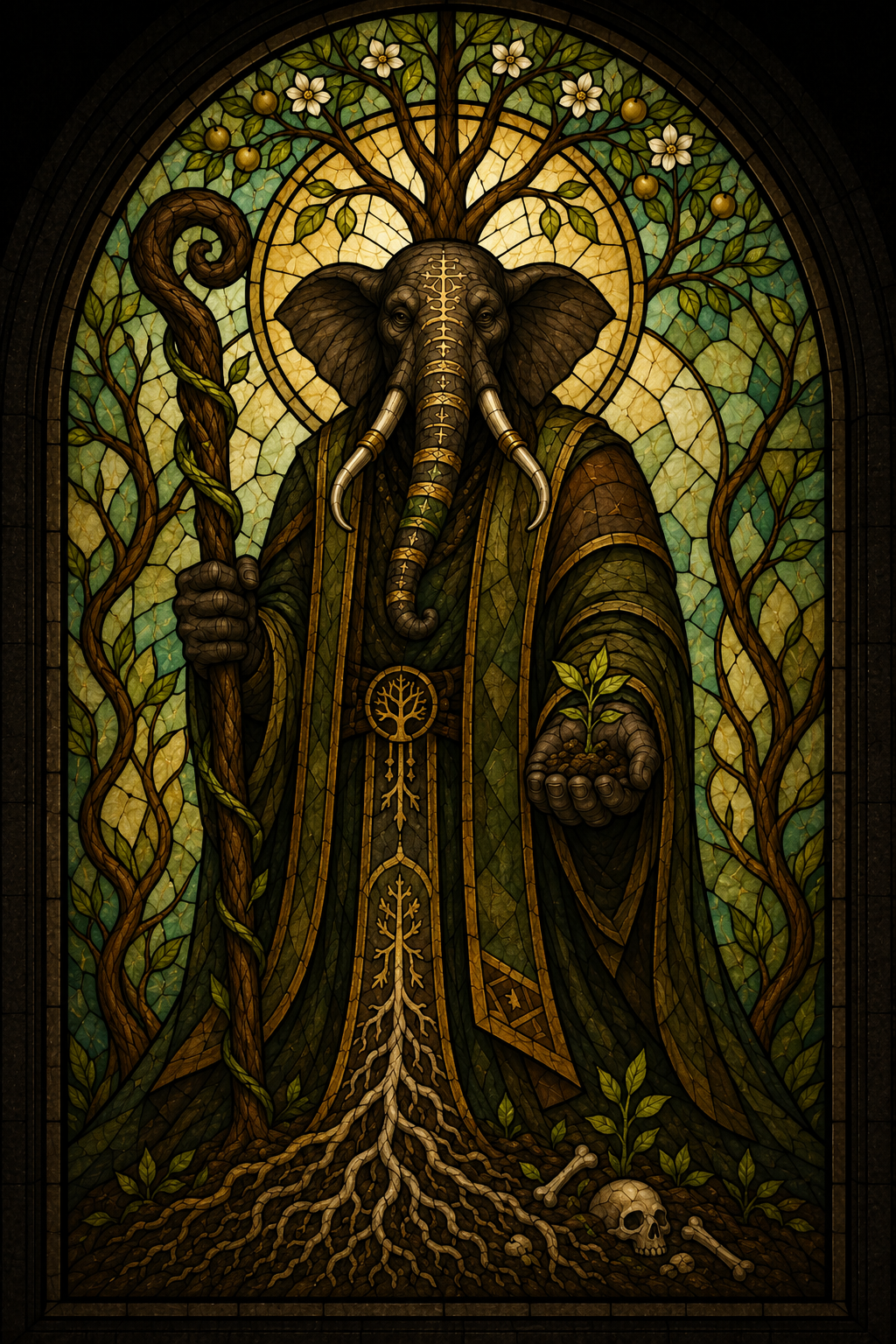
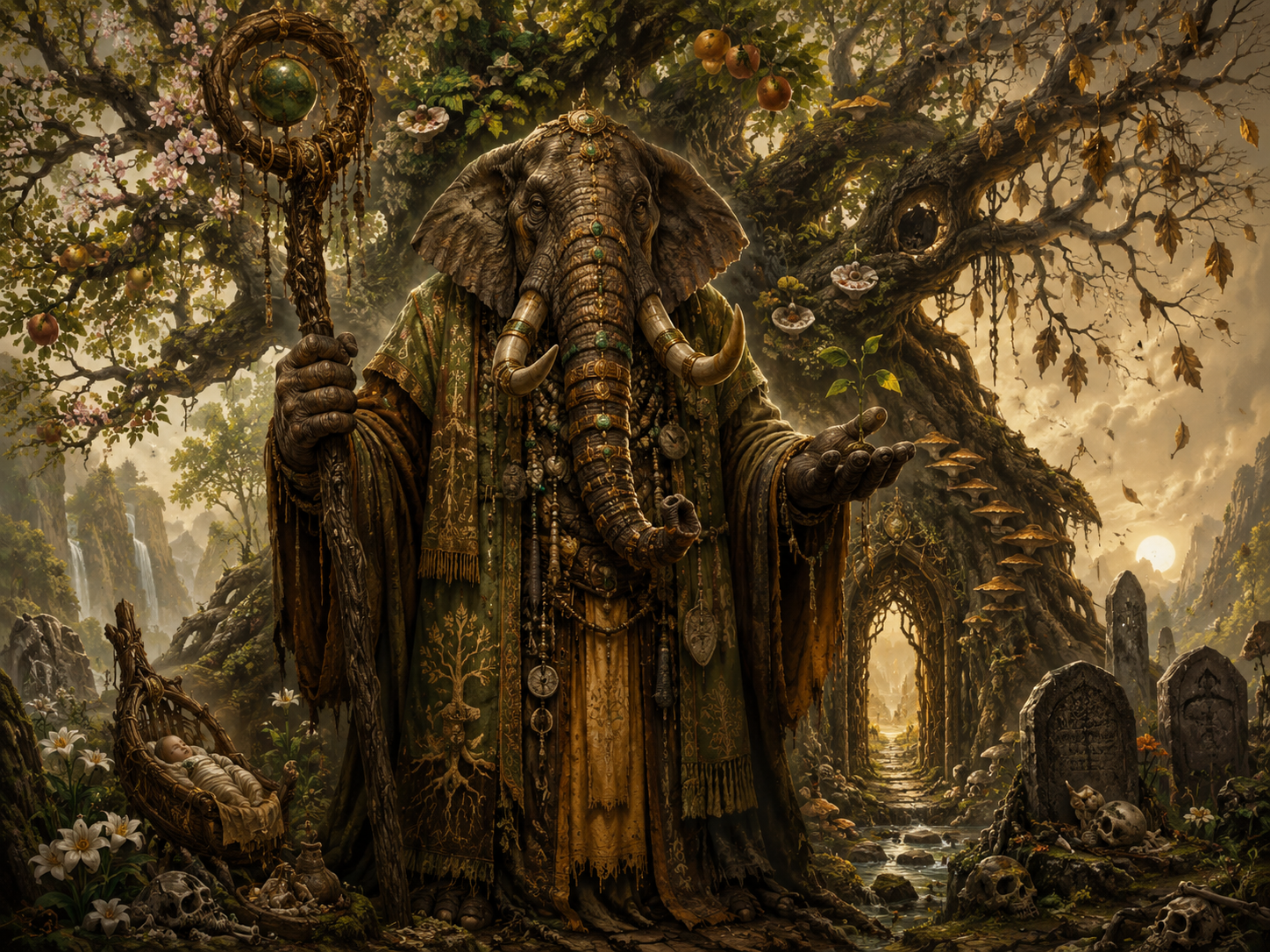
Chulios is most often depicted as a towering elephant-headed man, vast in frame and slow in motion, with deep brown skin, broad ears, heavy hands, and a long trunk adorned with rings of gold, bone, green stone, or polished wood. Among the loxodon and certain beastfolk peoples, this form is spoken of plainly as loxodon. Elven, human, and dwarven artists more often call him elephant-headed, tusked, or simply the Great-Breathed One.
His eyes are usually shown as dark, warm, and ancient, though not sentimental. They are the eyes of one who has watched births, sicknesses, hunts, famines, recoveries, extinctions, and burials without turning away from any of them. Chulian artists seem determined to show that he does not favor life's sweetness while recoiling from its cost. In their images, he is made to see the whole motion.
His body is immense, but not martial. He is powerful as an old beast is powerful, or as a river is powerful: by continuance, weight, memory, and endurance. Sacred artists often give him scars, weathered skin, or bark-like textures, not to suggest violence alone, but time. Life marks all things that carry it long enough.
Chulios is usually robed in earth-tones, muted greens, browns, ochres, and old golds. His garments are embroidered with signs of birth, breath, blood, bone, roots, graves, and returning. In one hand he often bears a gnarled staff, not as a weapon of judgment, but as the sign of the cycle he keeps: growth, flourishing, decline, death, and renewal.
He is rarely depicted smiling broadly. When his face is gentle, it is the gentleness of acceptance. When his face is stern, it is the sternness Chulian priests attribute to a power that does not preserve a season merely because mortals love it.
Preferred Forms
- A towering elephant-headed man in earth-toned robes marked with signs of birth, death, and renewal.
- A vast loxodon-shaped figure bearing a gnarled staff and rings upon his trunk.
- A grave and patient elder whose footsteps stir both new growth and old memory.
- A silent divine watcher standing between a cradle and a grave.
- A vast celestial figure associated with fields, wombs, tombs, sickbeds, and the return of the dead.
Avatar Forms
- A quiet healer who knows when a wound should be closed, and when it must be allowed to end a life.
- A silent midwife invoked before difficult births.
- A gravekeeper who tends the dead with the same care others give the newborn.
- A mourning elder who remembers the names of those no one living can still name.
- A physician-priest who refuses both needless death and unnatural prolonging.
- A large, calm traveler in stories told after plague, famine, battle, or birth, asking what must now be preserved.
Identifying Characteristics
- An elephant-like head, trunk, ears, and tusks.
- A massive, slow-moving body suggesting endurance rather than haste.
- Deep, patient eyes often painted brown, green, or dark gold.
- Rings of gold, bone, wood, or green stone worn upon the trunk.
- Earth-toned robes marked with symbols of breath, bone, blood, roots, graves, and renewal.
- A gnarled wooden staff associated with the cycle of life and death.
- Bark-like, stone-like, or weathered skin in some sacred depictions.
- A presence described in hymns as calming, but not indulgent.
- Iconography that pairs cradles with graves, flowers with bones, and breath with silence.
- A posture of watchfulness, as though measuring whether life is continuing as it must.
Divine Symbols & Iconography
Chulios's chief symbol is the Tree of Life.
This tree is not merely a symbol of growth. In Chulian teaching, its roots descend among the dead while its branches rise among the living. The same trunk bears blossom, fruit, rot, hollow, nest, fungus, falling leaf, and new shoot. Chulian commentators often criticize images that show only the green crown as incomplete, even childish. In their preferred iconography, the full tree must include what feeds it.
His sacred animal is the elephant, honored for memory, endurance, grief, social bond, and strength restrained. The elephant is not sacred to Chulios because it is gentle, though it may be gentle. It is sacred because it remembers its dead, protects its young, reshapes the land by passing through it, and carries great power without needing to spend that power at every moment.
Chulios is also associated with staffs, grave soil, birth cords, ancestor stones, green gemstones, bones washed clean, water bowls, breath marks, rings, and ledgers of names. The old Book of Life is sometimes shown open beside him, though most priests caution that no mortal artist should presume to paint the names written there.
His sacred colors are green, brown, and gold. Green represents living force and renewal. Brown represents soil, flesh, age, and the return of the body to the world. Gold represents the preciousness of life, not as treasure to be hoarded, but as value that must be spent, passed on, and eventually surrendered.
In older funerary art, Chulios is often placed behind both the mother and the corpse, one hand extended toward breath and the other toward stillness. This is perhaps the truest image of him: not a god who chooses life against death, but the custodian of the gate through which both must pass.
Divine Nature
Origins
The oldest usable traditions place Chulios's entrance into the Andórëan Pantheon during the Prehistoric Age, after the world had already survived its first divine wars and begun to teem with life in forms both wondrous and terrible.
By that age, life no longer needed to be merely protected from the primordial elemental titans. It needed to be understood, tended, measured, and allowed to continue according to its own vast pattern. Dragons rose. Giants built. Megafauna thundered across the land. Seas filled, forests thickened, and death became as constant a companion to life as breath.
It is in this age that Chulios is said to have taken his place among the gods. The older accounts do not describe him as a conqueror, maker, or lawgiver, but as one who arrived to attend what had already begun. He did not create life from nothing, nor did he claim ownership over all living things. Rather, he became the divine custodian of life's continuance: birth, growth, sickness, hunger, healing, age, death, return, and renewal.
Some traditions say he came from beyond Andórë, drawn by the world's abundance. Others say he arose from the first great pattern of life and death once that pattern had become too vast to remain without divine witness. Chulian priests tend not to quarrel over this distinction. To them, the important teaching is that Chulios did not arrive to spare life from death. He arrived to keep both from being profaned.
Divine Disposition
Chulios is represented as patient, grave, observant, and slow to anger.
He is often called compassionate, but this word must be handled carefully. His compassion is not the sentiment of one who wishes every beloved thing to survive. It is the steadier regard of one who sees the newborn, the fevered, the hunted, the predator, the carrion-feeder, the grieving parent, and the waiting grave as parts of the same motion.
His priests describe him as gentle where gentleness preserves the cycle, and stern where mercy would become denial. He may bless a difficult birth, steady a dying hand, guide a healer's judgment, or let an old body fail because its time has come. He is not cruel, but neither is he indulgent.
Chulian theology rarely imagines him as hasty. Mortals who pray to him often mistake silence for refusal or delay for indifference. His priests answer that a god who governs life must count in generations, migrations, bloodlines, recoveries, extinctions, and returns. What seems urgent to a single heart may be only one breath in the greater body of the world.
Morality & Philosophy
The common classification of Chulios as Neutral arises from a difficult observation: life itself is not obedient to the moral categories mortals prefer.
The wolf lives by killing. The child lives by being fed. The forest lives by consuming the fallen. Chulian doctrine does not ignore the crueler examples: the plague lives, though the village dies. The grave feeds the root, and the root feeds the living. Chulios does not name these things good or evil in themselves. He asks whether the cycle continues, whether life is wasted, whether death is denied its place, and whether renewal remains possible.
His philosophy teaches that life is sacred, but not untouchable. Death is solemn, but not evil. Healing is blessed, but not always required. Preservation is holy when it serves continuance, and profane when it becomes hoarding.
This is the most difficult Chulian doctrine for many mortals to accept. A mother at a bedside, a soldier bleeding in mud, or a city facing plague does not ask for balance. They ask for life. Chulios hears such prayers, and sometimes he answers them. Yet he is not the god of every life preserved at any cost. He is the god of life continuing beyond any single life.
Divine Goals & Aspirations
The divine office of Chulios is the continuance of life in its full and terrible breadth.
He blesses birth, healing, fertility, recovery, memory, mourning, decay, burial, and renewal. He opposes wasteful slaughter, desecration of the dead, corrupted birth, stolen death, and all arts that turn life into a possession severed from the cycle that gives it meaning.
As God of Life and holder of the Grave domain, he attends both thresholds. He watches the first breath and the last. He guards the dignity of the body that has ceased, the grief of those who remain, and the passage by which life becomes memory, soil, ancestry, and inheritance.
His highest aspiration is not a world without death, for such a world would soon become a prison of unending hunger, stagnation, and grief. His desire is that life be allowed to arise, flourish, struggle, fail, feed, remember, and return without needless violation.
Virtues
- Patience
- Reverence
- Endurance
- Balance
- Acceptance
- Continuance
- Care without possession
Flaws & Limitations
- Apparent slowness
- Theological detachment
- Refusal of favoritism
- Severity toward denial
- Silence before mortal urgency
- Mercy that does not always preserve
- Acceptance that wounds the grieving
Favored Virtues
- Honoring life.
- Respecting death.
- Tending the sick.
- Burying the dead.
- Preserving what may continue.
- Accepting what must end.
- Remembering those who came before.
Abhorred Vices
- Wasteful slaughter.
- Defilement of graves.
- Cruelty to the helpless.
- Hoarding life past its time.
- Twisting birth for vanity.
- Denying death its dignity.
- Destroying renewal for gain.
Speech & Mannerisms
In hymns, temple dramas, and reported visions, Chulios speaks slowly, deeply, and without ornament wasted on persuasion. His voice is often described as resonant rather than loud, like distant thunder heard through earth or the breath of some vast sleeping beast.
Chulian stories rarely allow him to speak quickly merely to comfort the frightened. He allows silence to do its own work. When he answers, his words are usually plain, but not always gentle. He is known to name things mortals avoid naming: death, rot, hunger, age, failure, inheritance, and the cost by which one life feeds another.
In sacred tales, Chulios rarely commands. He reminds. He asks what must continue, what must be released, what has been neglected, and what debt the living owe to the dead. His anger, when it appears, is not fiery. It is heavy. It settles over a place like still air before burial.
Among those who receive him kindly, he may show warmth, humor, and great tenderness. Yet even then, his tenderness does not promise rescue. It promises witness.
Quotes & Catchphrases
"Life continues."
"Do not mistake continuance for mercy."
"The first breath and the last are both sacred."
"What has ended must still be honored."
"To preserve life, one must understand death."
"Nothing living is held forever."
"Let the dead return, and the living remember."
"A wound closed too late is grief. A wound closed too soon is denial."
"The grave is not the enemy of the cradle."
"All things that live must make room for life to follow."
Divine Relationships
Family
Chulios is not usually given parents, siblings, consorts, or children in the formal genealogies of the Andórëan Pantheon.
This absence is not treated as loneliness in Chulian theology. Rather, it reflects the nature of his office. Chulios is not remembered as a father of gods, a child of gods, or a lover among gods, but as a custodian placed beside a process older and wider than any single divine household. Birth, death, renewal, and continuance do not belong to one lineage. They pass through all lineages.
Some loxodon and beastfolk traditions speak of Chulios as Elder, Ancestor, or Great-Breathed Father, but these titles are devotional rather than genealogical. They name his nearness to birth, memory, and the dead, not a literal claim that all living things descend from him.
Among scholars, Chulios is therefore best understood as a god whose office touches countless lives, but whose genealogy remains empty. Every cradle and grave falls somewhere beneath his notice, but he does not possess the living as offspring. Life is entrusted to him, not owned by him.
Allies
Chulios is most closely allied with gods whose work preserves life, honors death, sustains households, tends the vulnerable, or allows the weary to pass from suffering into rest.
Cheruer is among his most necessary allies, for Chulios attends the threshold of death while Cheruer governs what lies beyond it. Their offices meet at the final breath. Chulios guards the dignity of dying and the return of the body to the world; Cheruer receives the soul into its proper ordering.
Conlo is one of the gods most often paired with him in practical devotion, for medicine is the mortal art most plainly shaped by Chulios's concern. Yet even here the relationship is not simple. Conlo seeks healing. Chulios permits healing where it serves continuance, but does not condemn all death as failure. The physician may plead for one more breath; Chulian teaching insists that breath has a proper ending..
Cuulla and Uldir are honored beside him in household rites, for hearth, family, nourishment, shelter, and bodily safety are among the ordinary conditions by which life endures. Their work tends the living day by day. Chulios's work gives that tending its place within the greater cycle.
Greana, Krirheia, Phaona, Rildir, Tiseyr, and Usjunn are also commonly named among his allies. Abundance, children, endings, tranquility, sleep, and spring all touch some part of his charge. Each of these gods protects a door, season, or mercy within the life of mortal beings. Chulios watches the whole passage.
Rivals & Enemies
Chulios's rivals are those gods whose works threaten to bend life away from continuance and into obsession, torment, or waste.
Ubus is counted among his rivals because vengeance consumes the living by chaining them to injury. Chulios does not deny grief, anger, or the memory of wrong. These things are part of mortal life. Yet vengeance often demands that the wound be kept open long after it should have scarred, healed, or been buried. To Chulios, such refusal is a kind of living undeath.
Phudros is also treated as a rival, though Chulian priests dispute whether he should be called wholly opposed. Fear, nightmare, and dread may teach mortals to survive, but Phudros too often turns fear into cruelty, exhaustion, and spiritual wasting. Sleep should restore the living. Nightmare may strengthen, but it may also hollow.
Zedrus is Chulios's clearest enemy. Torture is abhorrent to him not merely because it causes pain, but because it makes a sacrament of the violation of life. Zedrus treats the living body as an instrument to be broken, the mind as a chamber to be invaded, and suffering as an end in itself. Chulios accepts pain as part of life; he does not accept its worship.
He is also opposed to all divine or mortal powers that profane the cycle: those who waste life for vanity, defile the dead, twist birth into ownership, deny death through corruption, or preserve the body while destroying the life that gave it meaning.
Relationships with Other Gods
Among the gods, Chulios is respected more often than loved easily.
His office touches every divine concern, for all gods act upon beings that live, die, remember, inherit, sleep, hunger, heal, reproduce, age, and mourn. Even gods far removed from healing or burial must reckon with Chulios, because their followers are mortal and their works leave bodies behind.
The gods of Harmony often honor him warmly, seeing in him the vast ground upon which medicine, hearth, children, peace, education, virtue, and gentle endings stand. Yet even these gods may find him difficult, for Chulios will not always preserve what they love, nor heal what they would heal, nor soften every ending.
The gods of Zephyrion are bound to him through the living world. Seasons, spring, sky, sea, and wind all serve life, but also test it. Chulios understands their violence as well as their gifts. Storm, drought, flood, winter, migration, seedfall, and birth all belong to the same turning.
Within Equilibrium, Chulios stands naturally beside Idtix, Udagi, Vizotl, and Yxtuna, though not without tension. Duty, flame, light, and order each preserve life in one moment and threaten it in another. In Equilibrium theology, his presence reminds these powers what their structures and powers must ultimately serve. They are useful to him because life without boundary, heat, revelation, or order becomes excess, rot, blindness, or collapse.
He is remembered in some accounts of the curse upon the Drow, though the details vary and should not be pressed too far, not as the sharp voice of judgment, but as one of the powers who understood that a people may be transformed and still continue. Chulios's concern in such tales is not vengeance, nor mercy alone, but whether life remains possible after divine consequence has fallen.
Relationships with Mortals
Mortals turn to Chulios at the moments when life becomes impossible to ignore.
He is invoked at births, sickbeds, recoveries, harvests, funerals, graves, memorial feasts, plague houses, animal pens, battlefield hospitals, and quiet rooms where families wait for breath either to strengthen or cease. His name is spoken by healers, midwives, gravekeepers, farmers, druids, mourners, caretakers, and all who stand close to the body's beginning or end.
His relationship with mortals is therefore intimate, but not comforting in the simple sense. Chulios is present in the prayer for a child to live, but also in the prayer that a suffering elder be allowed to die. He is present in the healer's hand, but also in the gravekeeper's shovel. He is present in the first cry of the newborn and in the silence after the last breath.
Many mortals misunderstand him because they ask from within a single life. This is not a failing. It is the nature of being mortal. A parent does not pray for balance while holding a fevered child. A soldier does not pray for continuance while bleeding beneath the rain. A widow does not ask whether the cycle has been preserved. They ask for the one they love.
Chulian priests teach that such prayers are received without mockery. His priests teach that grief is not ignorance, and love is not error. Yet they also teach that Chulios is not bound to answer every plea with preservation. Sometimes his grace is recovery. Sometimes it is endurance. Sometimes it is a clean death, a remembered name, a body laid properly into earth, and life continuing around the wound.
For this reason, Chulios is neither an easy god nor an unkind one. He is trusted by those who tend the living and the dead because he does not look away from either.
Worship & Faith
Worshippers
Chulios is worshipped by those whose lives place them near birth, death, healing, nourishment, mourning, and continuance.
Healers, midwives, gravekeepers, farmers, druids, mourners, caretakers, animal-tenders, hospice priests, plague-workers, and those who wash and prepare the dead are counted among his most devoted servants. His worship is especially common among those who learn early that life is not an idea, but a body: hungry, bleeding, breathing, aging, bearing children, failing, recovering, and returning at last to the world.
Chulios is also honored by families at the beginning and end of life. Parents may invoke him before childbirth. Children may invoke him beside the beds of dying elders. Those who have survived sickness often leave offerings at his shrines, not always in celebration, but in recognition that life has continued where it might have ceased.
His worshippers are not required to be gentle people, though many are. Soldiers who recover the bodies of the fallen, hunters who use every part of the kill, executioners who insist upon clean death, and rulers who must decide when famine cannot be prevented may also honor him. It is often said in his temples that Chulios belongs to all who accept the weight of life without pretending it is always kind.
Major Cults
The faith of Chulios is less centralized than many divine orders. It gathers around necessary work rather than conquest, doctrine, or public spectacle.
The most common Chulian orders are attached to birthing houses, infirmaries, graveyards, plague shelters, rural shrines, animal pens, and temples that maintain records of births and deaths. These orders are often small, practical, and respected even by those who do not share their theology. Few communities can afford to despise the people who deliver children, tend the fevered, wash the dead, and remember names.
The Keepers of First Breath are midwives, physicians, and attendants who serve births of all kinds, mortal and animal alike. They pray for life to take hold, but they are also trained to recognize when grief has entered the room. Their rites are quiet, and their vows forbid them from treating birth as triumph before both mother and child have survived it.
The Grave Custodians tend burial grounds, tombs, family crypts, battlefield graves, and memorial stones. They are not priests of death in the manner of Cheruer's faithful, for their concern is not judgment or the soul's destination. Their charge is the dignity of the body, the memory of the name, and the proper return of what life has borrowed.
The Order of the Unbroken Cycle is the most philosophical of Chulios's cults. Its priests study famine, plague, overpopulation, fertility, extinction, battlefield triage, and the limits of healing. They are often respected, but rarely loved, for they speak most plainly when others most desire comfort.
Holy Books & Codes
Chulios's chief holy book is the Book of Life.
The Book of Life is said to contain the names of all living beings, not merely those who are famous, beloved, civilized, or remembered by history. In temple teaching, the smallest insect and the greatest king both enter the record, though no mortal copy could contain even a single generation of the full text.
The book is not treated as a promise that every life will be long, happy, or spared. It is a witness. To be named within it is to have existed within the cycle. Birth, breath, hunger, wound, desire, age, death, and memory are all part of the inscription.
Some Chulian temples keep lesser Books of Life for their communities. These record births, deaths, stillbirths, adoptions, plagues survived, graves moved, names recovered, and unknown dead given a place in memory. Such books are among the most sacred objects in a Chulian shrine. To falsify one is not merely poor record-keeping, but a violation of life and death alike.
The old Song of the Ancestors is sometimes sung at funerals, memorial feasts, and winter household rites, though it is usually treated as devotional hymn rather than formal scripture. Its purpose is not to deny death, but to remind the living that memory is one of the forms by which life continues.
Tenets of Faith
- Preserve the cycle.
- Honor life and death.
- Nurture what may grow.
- Accept what must end.
- Let life continue.
Chulian tenets are simple to recite and difficult to obey.
To preserve the cycle is not the same as preserving every life. To honor life and death is not the same as preferring death, nor clinging to life beyond its proper span. To nurture what may grow requires judgment, for not all growth is healthy. Rot grows. Plague grows. Tyranny grows. A wound may grow infected if it is not cleansed.
Chulios's faithful are therefore taught to ask not only, "Can this life be preserved?" but also, "Should it be preserved in this form, by this means, at this cost?" This question has made his priests invaluable in times of famine, plague, and war, and unwelcome in households that want only reassurance.
The highest Chulian discipline is care without possession. Life is to be tended, not owned. Death is to be honored, not worshipped. Grief is to be allowed, not cured as though it were sickness.
Holidays & Holy Days
Chulios's two chief holy days are the Day of First Breath and the Day of Returning.
The Day of First Breath honors birth, survival, fertility, recovery, and the fragile moment when life begins or begins again. Children born in the previous year may be presented before family shrines. Healers recount those who survived illness. Farmers bless young animals. Families speak aloud the names of children, adopted kin, and all new members brought into the household by birth, marriage, rescue, or oath.
The Day of Returning honors death, burial, ancestry, decay, and the sacred return of the body to the world. Graves are cleaned. Stones are repaired. Bones disturbed by flood, war, or neglect are reburied. Families bring food to graveyards, not because the dead eat, but because the living do, and memory must remain embodied. Unknown dead may be given names for the day, so that no grave is left entirely outside the care of the living.
In some regions, the two days are placed opposite one another in the calendar, forming a quiet axis of birth and return. In others, they are set near local birthing seasons, harvest endings, or traditional periods for grave-tending. Chulian priests generally resist tying these days to solstices or equinoxes, arguing that Chulios does not govern the heavens, but the breath within them.
Sacred Sites
Chulios's sacred sites are places where life and death are both plainly present.
Birthing houses, infirmaries, graveyards, plague fields, ancestor halls, old battlefields, hospices, animal sanctuaries, springs used for washing the dead, and groves where communities bury their elders may all be sacred to him. His shrines are often built near the borders between household and wilderness, settlement and cemetery, cradle-room and mourning hall.
The most revered Chulian temples maintain both a birth chamber and a mortuary chamber. These are not placed in opposition. They are often connected by a central hall containing the Tree of Life, with roots carved toward the dead and branches raised toward the living.
Rural shrines to Chulios are usually modest: a standing stone, a carved elephant, a bowl of clean water, a staff set upright in the earth, or a tree whose roots grow among old graves. Offerings may include milk, bread, clean cloth, grave soil, names written on slips of parchment, or the first safely shed tooth of a child.
Some battlefield cemeteries become Chulian sacred sites after war, especially when priests recover and bury the dead of both sides. Such places are not temples of peace. They are temples of cost.
Religious Practices
Chulian practice centers on naming, washing, tending, witnessing, burying, and remembering.
In many Chulian communities, a newborn is washed, named, and briefly touched with earth or ash, reminding the family that the new life belongs to the cycle from its first breath. In gentler households this mark may be no more than a brown line on the foot. In stricter temples, the infant's name is spoken once toward the cradle and once toward the graveyard.
At death, where custom and circumstance allow, the body is washed with care. Hair may be combed, tusks, horns, scales, or nails cleaned, wounds covered, and the mouth closed. The dead are not treated as empty refuse. They are the final form of a life that must still be honored before it returns.
Chulian healers pray before treatment, but also before refusing treatment that would only prolong suffering. Midwives pray before birth, but also before burying infants who did not draw breath. Gravekeepers pray when moving bones, reopening tombs, or tending the unknown dead.
Common offerings include clean water, grave flowers, bread, milk, seeds, bones washed and reburied, and written names. The most important offering is often labor: tending a sick neighbor, repairing a grave, feeding a hungry child, helping at a birth, or sitting beside the dying when no cure remains.
Forbidden Acts
- Wasting life needlessly.
- Defiling the dead.
- Breaking the natural cycle.
- Perverting birth or death.
- Hoarding life from the dying.
Chulios forbids acts that treat life or death as possessions to be spent without reverence.
Wasteful slaughter is among the clearest sins of his faith. Killing for food, defense, mercy, or necessity may be accepted. Killing for vanity, spectacle, amusement, or contempt is not. The hunter who uses what is taken may stand within Chulios's tolerance. The butcher who laughs at suffering does not.
Defiling the dead is equally grave. A corpse is not the person entire, but it is not nothing. To mutilate, desecrate, abandon, mock, or dishonor the dead is to interrupt the final dignity owed to life.
Chulios also forbids the corruption of birth, false healing, and the hoarding of life beyond its proper span. His priests are especially wary of arts that prolong existence while severing it from memory, body, kinship, mortality, or the possibility of return. Not all resurrection is condemned, but all resurrection is questioned.
The hardest forbidden act to understand is hoarding life from the dying. Chulian priests teach that there comes a time when healing becomes fear wearing a holy mask. To keep a soul bound to agony because the living cannot bear release is not devotion. It is possession.
Divine Realm
Home Plane
Chulios dwells within Equilibrium, the divine plane of balance, measure, restraint, and necessary opposition.
His place there is fitting, for life is not a simple good set against death as evil. Life requires limit. Growth requires ending. Hunger, birth, healing, decay, fertility, rest, age, and memory all stand in relation to one another. His placement in Equilibrium reminds theologians that vitality without boundary becomes excess, and death without return becomes waste.
Within Equilibrium, Chulios is neither the loudest nor the most severe of the divine powers. He is a slow and constant presence, concerned with whether the living world continues in right proportion. His realm is not set apart from death, but built around the truth that death is one of the means by which life remains possible.
Realm
Chulios's realm within Equilibrium is the Sanctuary of Vitality.
The Sanctuary is often described as a vast living refuge of forests, meadows, springs, grave-groves, quiet cottages, animal paths, healing pools, mossy stones, and ancient trees. It is beautiful, but not untouched. Leaves fall there. Bodies age there. Flowers wither. Predators hunt. Bones settle beneath roots. What makes the Sanctuary holy is not that nothing dies, but that nothing is wasted.
At the center of the realm stands the Tree of Life, a colossal tree whose roots descend beyond sight and whose branches spread like a second sky. Chulian tradition holds that the Tree is the great sign of the Sanctuary's power. Its leaves are renewal, its fruit is vitality, its bark is endurance, its hollow places are memory, and its roots are the honored dead.
Some accounts say that Chulios makes his dwelling within the Tree itself. Others say that no god of life could live in only one place, and that the Tree is not his house, but his heart made visible. Astrum records both traditions with caution, for the distinction may be more poetic than theological.
The Sanctuary does not keep a single season. In one grove, spring lambs may take their first steps. In another, summer insects drone above heavy grass. Elsewhere, autumn leaves cover graves, and winter snow lies over sleeping roots. These seasons do not war with one another. They answer one another.
Travelers who enter the Sanctuary often report relief from pain, illness, exhaustion, and grief, though not always in the manner they expected. A wound may close. A fever may break. A mourner may finally weep. A soul clinging too tightly to suffering may find the strength to release it. The Sanctuary heals, but it does not always restore what was lost.
Inhabitants
The Sanctuary of Vitality is inhabited by beings associated with life, healing, memory, burial, renewal, and the natural cycle.
Its denizens include healer-spirits, grave-tenders, ancestor shades at peace, gentle fey, sprites, dryads, unicorns, centaurs, awakened beasts, living trees, luminous insects, old animal spirits, and quiet custodians who keep the paths between birth houses, sickbeds, and grave-groves clear.
Not all creatures of the Sanctuary are harmless. Wolves hunt in its forests. Serpents coil beneath warm stones. Great birds take prey from the meadows. Even these are not intruders. They are part of the realm's truth. Chulios does not make a paradise by removing hunger, fear, or death. He makes a sanctuary by ensuring that each has its proper place.
The realm is also said to contain spirits of the honored dead, especially those remembered by name, buried with care, or kept alive through descendants, students, communities, and works of mercy. These spirits do not rule the Sanctuary, nor do they linger there forever in all traditions. They are received, quieted, remembered, and allowed to become part of the greater continuance.
Servants of Chulios within the realm are often depicted as robed attendants, elephant-headed guardians, midwives with grave-soil on their hands, silent physicians, and gravekeepers carrying lanterns of green-gold light. Their task is not to prevent all sorrow, but to ensure that birth, healing, dying, burial, and renewal occur without violation.
Artifacts & Relics
Divine Artifacts
Chulios's artifacts are associated with vitality, renewal, grave-dignity, and the guarded passage between life and death.
The best known of these is the Amulet of Life, a green gemstone set in gold, silver, or old bronze. In common tales, the amulet grants vitality, restores failing strength, and turns mortal bodies back toward healing when they might otherwise fail. Chulian priests caution that the amulet is not a charm against death. Its power is said to strengthen life where life still has a path forward, not to chain the dying to a body that has already completed its work.
The Staff of Renewal is another famous artifact of Chulios. It is usually described as a long wooden staff formed from a gnarled branch of the Tree of Life, marked by knots, rings, scars, and living grain. It may heal wounds, cleanse corruption, restore fertility to exhausted soil, or call dormant life back into motion. Yet the old stories also say that the staff may wither what should have died long ago, close a cursed womb, or still an unnatural body preserved by fear and vanity. Renewal is not the same as endless restoration.
The greatest and least understood artifact of Chulios is the Book of Life itself. Whether this book is a literal volume, a divine record, a living inscription upon the Tree of Life, or a symbol beyond mortal comprehension is a matter of theological dispute. It is said to contain the names of all living beings, from the briefest insect to the longest-lived dragon, each marked by first breath, final breath, and the ways in which that life continues after death.
No mortal copy of the Book of Life is believed to be complete. Indeed, most Chulian scholars consider the desire to possess such a copy spiritually dangerous. The book witnesses life; it does not make life ownable.
Holy Weapons
Chulios is not strongly associated with weapons of war.
His faith does not forbid violence in all circumstances, but it does not sanctify bloodshed for glory, conquest, vengeance, or spectacle. When Chulian tradition names holy weapons, they are usually tools whose purpose lies close to mercy, protection, or the ending of violation.
The Staff of Renewal is sometimes treated as his holy weapon, though Chulian priests generally dislike the phrase. In sterner tales, the staff is used to break necromantic bindings, shatter instruments of torture, scatter plague-born corruption, and strike down those who profane bodies or twist life into obedient flesh.
Some Chulian temple guards carry heavy wooden staves, sickle-shaped knives, or burial axes. These weapons are practical rather than glorious. They defend birthing houses, infirmaries, graveyards, and plague shelters. They cut shrouds, clear roots from graves, break open collapsed tombs, and, when necessary, protect the helpless or end the suffering of creatures that cannot be saved.
A weapon blessed by Chulios is never meant to celebrate death. It is meant to prevent waste, violation, and needless agony.
Relics of the Faith
The relics of Chulios are often humble objects made sacred by tending, memory, healing, or burial.
Common relics include midwives' cords, gravekeepers' spades, bowls used to wash the dead, first-breath cloths, hospice lanterns, healer's bandages, animal bells, ancestor stones, seed jars, and ledgers recording births and deaths. These objects are rarely valuable in coin, but deeply valued by those whose families or communities were marked by them.
Fragments associated with the Tree of Life are among the most revered relics of the faith. These may be fallen leaves, splinters of bark, seeds, roots, or carved pieces of wood said to have come from the Sanctuary of Vitality. Chulian authorities are cautious about such claims, for false relics are common wherever grief and hope meet.
The bones of the unknown dead, when recovered, named, and properly buried, may also become relics in Chulian practice. Not because the bones possess power in themselves, but because the act of restoring dignity to forgotten life is considered one of the purest offerings to Chulios.
The most sacred relics of local temples are often their community Books of Life. These contain generations of births, deaths, stillbirths, adoptions, plague losses, battlefield recoveries, and names rescued from oblivion. To outsiders they may appear as ledgers. To the faithful, they are proof that life was witnessed, death was honored, and memory did not fail.
History
Creation & Early History
As with most gods of the Andórëan Pantheon, the true beginning of Chulios is unknown.
No reliable account tells where he first came from, what power called him into being, or whether he existed before Andórë knew his name. The earliest Chulian traditions are less concerned with his creation than with his arrival into divine memory. He appears in the histories not as a child of another god, nor as a victor in the first wars of the world, but as a presence recognized once life had become too abundant, various, and fragile to remain without a divine custodian.
Chulios is generally believed to have entered the pantheon during the Prehistoric Age, when dragons, giants, megafauna, monsters, and countless lesser living things filled the world. By then, Andórë was not empty clay awaiting shape. It was already crowded with breath, hunger, instinct, birth, predation, sickness, age, and death.
The oldest accounts describe Chulios as a god who did not announce himself through conquest or miracle, but through pattern. Herds recovered after hard winters. Old grave-sites became green. Predators took the weak, and the herd endured. The dead fed the soil, and the soil fed the living. To later priests, these were not proofs that Chulios had created life, but signs that he had taken up his office beside it.
For this reason, Astrum hesitates to call Chulios a maker god. It is safer to say that he is the god who attends life once life has begun.
Major Deeds
Chulios's major deeds are difficult to recount in the manner of battles, treaties, and divine triumphs.
He is not remembered for slaying titans, founding nations, or carving laws upon stone. His works are older, quieter, and harder to separate from the natural order of the world. Chulian priests credit him with sanctifying birth, teaching the first reverence for the dead, establishing the dignity of burial, and giving divine weight to the truth that life and death are not enemies, but companions.
Many traditions say that Chulios first taught mortals to record names at birth and death. This practice, simple as it seems, became one of the foundations of Chulian worship. A life unnamed may still have lived, but a life remembered is less easily wasted. The community Books of Life kept by his temples are said to descend from this earliest teaching.
He is also credited with guiding the first healers toward the discipline of restraint. In these stories, Chulios does not merely teach how to close wounds, ease fever, and preserve breath. He teaches when not to wound further in the name of healing. He teaches that a body is not a battlefield upon which death must always be defeated.
In the traditions surrounding the curse of the Drow, Chulios is sometimes named among the gods who bore witness to the consequence. His role is rarely described as judgment. Rather, Chulian accounts emphasize that even after transformation, exile, pain, and loss, life remained possible. A people changed may still continue. A wound may become inheritance.
Intervention in Mortal Affairs
Chulios is most often believed to act through thresholds.
A birth that should have failed steadies at the final moment. A fever breaks after a night of vigil. A dying elder who has lingered in pain finally releases breath. A battlefield corpse is found before carrion and weather erase its name. A graveyard thought lost beneath weeds is uncovered by chance. A healer suddenly understands that further treatment would be cruelty.
These moments are seldom grand enough for royal chronicles, but they are the substance of Chulian history. His faithful do not look first for thunder, omens in the sky, or divine figures walking openly among mortals. They look for continuance: the child who lives, the body properly buried, the family that remembers, the herd that recovers, the seed that sprouts from ash, the grief that becomes bearable without becoming false.
Chulios is also said to intervene through dreams of the dead, the instinct of animals, the sudden recall of an old remedy, the stillness that falls over a deathbed, or the refusal of corrupted life to take root. His signs are rarely dramatic. They are often recognized only afterward, when the living realize that something fragile passed safely through a narrow gate.
His priests warn against treating every recovery as favor and every death as abandonment. Chulios is not so easily read. A peaceful death may be as much his gift as a miraculous healing.
Current Circumstances
In the present age, Chulios remains one of the most widely invoked gods in ordinary mortal life, though not always in temples or formal rites.
His name is spoken wherever birth, illness, hunger, mourning, old age, and burial remain part of daily existence. A farmer may honor him over a dying animal. A mother may whisper his name during labor. A physician may invoke him before cutting into living flesh. A gravekeeper may ask his witness before lowering the unknown dead into earth. A family may curse him in grief one day and thank him for memory the next.
Since Demon's Run and the long silence of divine magic, Chulios's worship has become both more painful and more necessary. No god answers as the old stories say they once did. Yet children are still born, bodies still fail, graves still need tending, and the living still require a language for loss that is not merely despair.
In Agrovionimb and other surviving places, Chulian practice endures through labor more than miracle. Midwives wash their hands. Healers keep records. Families preserve names. The dead are buried when burial is possible, burned when burning is necessary, and remembered when neither can be done. These acts are small only to those who have never needed them.
Thus, Chulios's current circumstance is much as his oldest worship describes him: quiet, grave, difficult, and present wherever life continues under the shadow of death.
Representation & Legacy
Cultural Importance
Chulios occupies a place in Andórëan culture that is both intimate and unavoidable.
Many gods are invoked in moments of ambition, danger, judgment, love, learning, war, travel, or celebration. Chulios is invoked when the body itself becomes the matter at hand. His name is spoken over birth-blood, fever-sweat, grave-soil, harvest hunger, failing breath, animal labor, plague houses, and the washing of the dead.
For this reason, even those who do not consider themselves especially devout often know some Chulian prayer. A mother may know one. A gravekeeper certainly does. A soldier may learn one after the first battlefield where the dead cannot all be carried home. Farmers know his signs in herd and field. Physicians know his patience, and sometimes resent it. Mourners know that his comfort is rarely the comfort they wanted.
His cultural importance is strongest among healers, midwives, gravekeepers, farmers, druids, animal-tenders, and those who keep family records. Yet he is also present in law, inheritance, adoption, burial rights, plague customs, battlefield recovery, and the keeping of civic rolls. A kingdom that records only victories and not births and deaths has, in Chulian thought, failed to understand what it governs.
Chulios is therefore not merely a religious figure. He is one of the reasons Andórëan peoples remember that a life must be witnessed to be fully honored. To name the newborn, tend the sick, bury the dead, and preserve the memory of those who came before are not private acts only. They are civilizational ones.
Symbolism
Chulios symbolizes life understood as a complete cycle rather than a single favored moment within it.
His Tree of Life is the clearest expression of this teaching. The branches represent breath, growth, shelter, fruit, inheritance, and the visible flourishing of life. The roots represent burial, decay, ancestry, memory, and the unseen nourishment by which life continues. A tree without roots is vanity. Roots without branches are silence. The whole tree is Chulios.
His elephant form carries similar meaning. The elephant is strength without haste, memory without written record, grief without speech, and power restrained by social bond. It walks heavily upon the earth, changes the land by passing through it, protects its young, mourns its dead, and remembers paths across generations. For Chulian artists, this makes the elephant a more fitting symbol of life than any delicate flower or triumphant sunburst.
The gnarled staff represents the passage from living branch to sacred tool. It is wood that once grew, was cut, dried, carried, worn smooth by use, and made meaningful by service. In this way, it is life transformed without being wasted.
His colors also bear layered meaning. Green is the force of new life and renewal. Brown is soil, flesh, labor, age, and return. Gold is the preciousness of a life that cannot be held forever. Together they remind worshippers that vitality, mortality, and value are not separate doctrines.
The most solemn Chulian images place cradle and grave in the same frame. Such images are sometimes unsettling to outsiders, especially when painted in homes or birthing chambers. Chulian priests answer that the image is not meant to frighten the living, but to tell the truth kindly enough that it can be lived with.
Legacy
Chulios's legacy is found wherever Andórëan peoples treat life and death as matters requiring dignity rather than denial.
The recording of births and deaths, the protection of graveyards, the washing of bodies before burial, the naming of unknown dead, the blessing of midwives, the reverence shown to healers, and the suspicion toward life-prolonging magic all bear his influence. Even customs that are now considered civil rather than religious often preserve Chulian assumptions beneath them.
His temples helped teach that healing is not merely the defeat of death, but the wise tending of life. This teaching shaped medicine, hospice care, plague law, battlefield triage, animal husbandry, burial custom, and the ethics of resurrection. A healer who cannot accept death may become dangerous. A gravekeeper who cannot honor life may become cruel. Chulios stands between these errors.
His influence also shaped how many peoples remember ancestry. Chulian practice does not treat the dead as absent from life. Nor does it pretend they remain unchanged among the living. The dead continue through name, body, story, soil, child, student, work, warning, and inheritance. Memory is not resurrection, but it is one of the ways life refuses to vanish completely.
Since Demon's Run, Chulios's legacy has become more severe. In a world where divine voices no longer answer plainly, his faith survives through acts that do not require miracle: delivering children, tending the sick, sharing food, cleaning graves, preserving names, and allowing the dying to be released when no healing remains.
His enduring legacy may be the discipline of looking at the whole of life without flinching. Chulios does not teach mortals that life is gentle. He teaches that it is sacred even when it is not gentle, and that what ends must still be honored so that what follows may live.
Notes