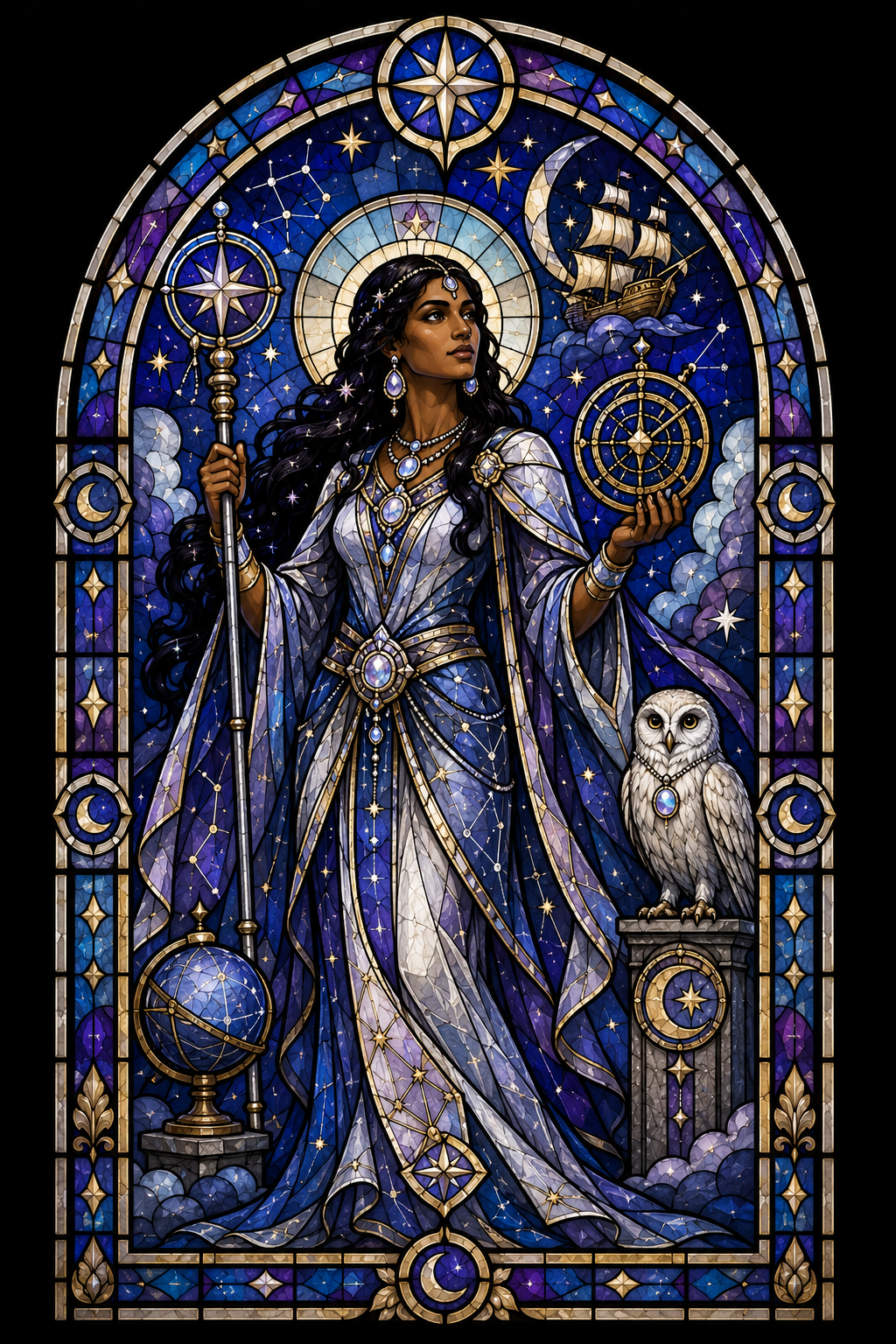
Greluna
Greluna is the Goddess of the Stars, divine patron of exploration, discovery, magic, and the courage to cross beyond the known. Born mortal as Gauri Lakshmi Devi, she looked upon the moons of Andórë not as unreachable omens, but as destinations, and by craft, spell, calculation, and will built the Bastion of Discovery to reach them.
Her ascension marks one of the great transformations in the history of the Andórëan Pantheon: a mortal explorer raised into divinity without surrendering the memory of mortal fear, failure, wit, and wonder. Beside Hykteus, she helped shape Arcanum Celestia, and her faith teaches that the unknown is not a wall, but a road awaiting those brave enough to mark the first step.

Divine Information
| Property | Value |
|---|---|
| Alignment | Lawful Neutral |
| Divine Domains | Arcana, Knowledge |
| Portfolio | Stars, Magic, Exploration, Discovery |
| Home Plane | Arcanum Celestia |
| Realm | The Stellar Shipwright |
| Symbol | Moonlit Ship Beneath a Star |
| Sacred Animal | Owl |
| Title | Goddess of the Stars |
Manifestation
Common Appearance
Greluna is most often depicted as a dark-skinned Human woman with features associated with the ancient northwestern peoples of the Giant's Hammer continent: black hair, dark eyes, graceful bearing, and ornaments of silver, moonstone, and starlit blue. Though divine radiance surrounds her, sacred art usually preserves her mortal inheritance rather than replacing it.
She is commonly shown with long black hair, either loose like a night sky in motion or arranged in elaborate braids threaded with silver, moonstone, pearls, or tiny star-shaped ornaments. Her eyes are dark in mortal form, but in divine depictions they often reflect points of silver-blue light, as though stars were caught within them.
Greluna's clothing varies between the practical and the celestial. In some images she appears as an explorer-scholar, wearing travel robes, artificer's tools, star charts, and a staff of pale light. In others she is robed in flowing garments of blue, silver, violet, and white, with fabric painted or embroidered in constellations, lunar phases, arcane formulae, and routes through the heavens.
Unlike many gods, Greluna is rarely shown as wholly removed from mortality. Her divinity is radiant, but not erasing. Sacred artists often preserve signs of the woman who became the goddess: the hand that built, the eye that measured, the courage that launched, and the mortal face that first looked at the moons and chose to go there.
Preferred Forms
- A dark-skinned human woman robed in starlight and moonlit blue.
- A celestial explorer carrying charts, tools, and a staff of pale light.
- A luminous artificer-scholar with black hair, dark eyes, and moonstone ornaments.
- A star-marked traveler standing beneath the moons with a map in one hand.
- A radiant woman in flowing blue, silver, and violet garments patterned with constellations.
Avatar Forms
- A wandering explorer who appears at crossroads, ports, observatories, and forgotten ruins.
- A moonlit scholar whose questions lead mortals toward hidden paths.
- A celestial cartographer carrying maps of places no mortal has yet reached.
- An artificer with travel-worn tools, star charts, and impossible designs.
- A kind stranger beneath the night sky, pointing toward the road that must be taken.
Identifying Characteristics
- Dark skin and features preserved from her mortal people.
- Long black hair associated with night, stars, and celestial motion.
- Dark eyes that may shine with silver or blue starlight in divine depictions.
- Moonstone jewelry, especially necklaces, circlets, earrings, or brow ornaments.
- Garments of silver, blue, violet, and white.
- Star charts, lunar diagrams, celestial maps, and arcane navigational tools.
- A staff, compass, astrolabe, telescope, or artificer's instrument.
- Imagery of ships, moons, stars, open roads, and distant horizons.
- A visible mingling of mortal warmth and divine radiance.
Divine Symbols & Iconography
Greluna's symbol is a Moonlit Ship Beneath a Star. The ship represents the Bastion of Discovery and the courage to cross beyond the known world. The moon recalls Achipheus, where mortal ambition met divine transformation. The star represents the destination not yet reached: discovery, magic, and the heavens calling mortals onward.
She is also associated with moonstones, star charts, telescopes, astrolabes, maps, books, open doors, and celestial vessels. These are supporting motifs rather than separate holy symbols.
Her sacred colors are silver, blue, and violet. Her sacred animal is the owl, honored as a creature of night, perception, wisdom, and silent passage through darkness.
Divine Nature
Origins
Greluna was born Gauri Lakshmi Devi, a mortal human of a culture now largely lost to history. That people arose in the northwestern reaches of the Giant's Hammer continent, long before Rihian custom became the dominant inheritance of humankind. By the age in which this account is written, their language, dress, rites, and names survive only in fragments, family traditions, scholarly records, and small communities folded into the broader Rihian world.
For this reason, depictions of Greluna preserve more than the memory of one mortal woman. They preserve the image of a human people whose own stars have nearly vanished from the mortal record.
Unlike most gods of the Andórëan Pantheon, Greluna was not divine from the first ages. She remembers mortality. She remembers the limits of the body, the terror of distance, the hunger to know what lies beyond the horizon, and the stubborn pride of building with mortal hands what others believed impossible.
This mortal origin remains central to her nature. Greluna is not only the Goddess of the Stars; she is the proof that a mortal mind may look beyond the world and be answered by the heavens.
Divine Disposition
Greluna is curious, daring, clever, and restless.
She is not restless in the manner of one who is dissatisfied, but in the manner of one who has seen the horizon move. To Greluna, every answer reveals a farther question, every map implies an unmapped edge, and every locked gate invites the making of a key.
Where Hykteus embodies the discipline by which knowledge becomes reliable, Greluna embodies the courage by which knowledge is sought at all. She favors the first step into darkness, the launch into uncertain sky, the expedition beyond the last charted shore, and the mind that says, with fear still present, “go.”
Because she was once mortal, her myths preserve more warmth than those of many gods. She is often represented as patient with fear, fond of wit, and sympathetic toward failure, provided that failure came from honest seeking rather than carelessness or vanity.
Morality & Philosophy
Greluna teaches that the unknown is not an enemy.
The dark between stars, the sea beyond the harbor, the ruin beneath the hill, the locked archive, the forgotten road, and the unanswered spell are not to be worshipped as mysteries forever. They are to be approached with courage, preparation, humility, and wonder.
Her philosophy is lawful, but not static. She honors knowledge, maps, records, methods, and careful preparation, yet she rejects the belief that wisdom means remaining where one is safe. A chart is sacred because it allows the next traveler to go farther, not because it forbids departure.
To Greluna, discovery carries obligation. The explorer who returns must speak. The scholar who learns must teach. The navigator who finds the passage must mark the way for those who follow.
Divine Goals & Aspirations
- To guide seekers beyond the familiar and into the unknown.
- To preserve the stars, moons, and heavens as objects of study, wonder, and navigation.
- To encourage the responsible use of magic in exploration and discovery.
- To protect travelers, explorers, scholars, and those lost between known places.
- To ensure that discovery is shared rather than hoarded.
Virtues
- Curiosity
- Courage
- Ingenuity
- Wonder
- Perseverance
- Generosity
Flaws & Limitations
- Restlessness
- Recklessness
- Overconfidence
- Impatience with fearfulness
- Fascination with dangerous mysteries
- Difficulty accepting that some journeys must wait
Favored Virtues
- Seeking knowledge beyond familiar boundaries.
- Sharing maps, records, and discoveries with others.
- Preparing carefully before entering the unknown.
- Carrying light, guidance, and memory into dark places.
- Continuing after failure without falsifying what was learned.
Abhorred Vices
- Abandoning the lost.
- Hoarding discoveries.
- Destroying maps or charts.
- Refusing safe passage to seekers.
- Using knowledge to close the way for others.
- Calling fear wisdom when it is only refusal.
Speech & Mannerisms
Greluna's sayings are often preserved as invitations, blessings, travel maxims, and questions spoken beneath open sky. Her voice in myth is gentler than Hykteus's and less severe, but no less demanding. She does not mock fear; she asks what one intends to do while afraid.
She is commonly depicted looking upward or outward rather than directly at the viewer, as though her attention has already found the next road. When shown speaking, she is often pointing toward a star, opening a map, marking a path, or placing a light in the hand of another.
Her humor is warmer than Hykteus's and more playful. Riddles, wordplay, and misdirection appear often in stories of her guidance, not to confuse the worthy, but to teach that a path may be hidden by the assumption that it must be straight.
Quotes & Catchphrases
"The unknown is not a wall, but a door without a handle."
"May the stars guide you."
"A map is a promise to the next traveler."
"Fear is not failure. Refusal is."
"What has not been found is not therefore forbidden."
"Carry light into the dark, and bring back what you learn."
"The road does not end at the horizon."
"The stars are not distant lights, but invitations."
"If I can see it, I can find a way there."
Divine Relationships
Family
Greluna has no known divine parents, siblings, or children within the Andórëan Pantheon.
She was born mortal as Gauri Lakshmi Devi, and for that reason her family is remembered differently from the families of the gods who were divine from the first ages. Her mortal kin belonged to a human culture now largely lost, its memory preserved in fragments of name, custom, ornament, and story. Some traditions claim descent from her mortal line, though such claims are difficult to prove and are often treated more as devotional inheritance than genealogy.
Her closest divine bond is with Hykteus. Mortal language most often names him as her consort, mate, or husband, but such terms only partly describe what they became after her ascension. Hykteus recognized in Greluna the mortal expression of inquiry carried to its furthest daring: a woman who saw the moons of Andórë and chose to reach them.
Together, Greluna and Hykteus are understood as paired principles: discovery and method, voyage and proof, wonder and calculation, the star and the instrument by which it is charted.
Allies
Greluna's chief ally is Hykteus, with whom she shares Arcanum Celestia. His Nexus of Illumination and her Stellar Shipwright stand as paired expressions of the same divine pursuit: the universe understood and the universe entered.
She is also regarded favorably by several gods whose domains touch knowledge, passage, courage, memory, protection, or the guidance of mortals. Hoslous, Greana, Krallene, Cheruer, Grixdite, and Chulios are all described in various traditions as holding positive regard for her. These relationships rarely take the form of formal alliances, but rather mutual recognition. Greluna is valued as a guide, traveler, discoverer, and keeper of paths between known and unknown places.
Her connection with Cheruer is of particular note, for some traditions give Greluna a small but meaningful role in guiding souls toward the afterlife. She is not the judge of the dead, nor mistress of death, but the star over the dark road: a light by which the lost may orient themselves.
Conlo, another ascended mortal, is said to seek her counsel more often than most gods do. This is unsurprising. Among the ascended, Greluna is one of the clearest examples of mortal limitation transformed into divine purpose without being wholly forgotten.
Rivals & Enemies
Greluna has few true enemies. Her nature is not conquest, judgment, or dominion, but exploration, discovery, and the carrying of knowledge beyond familiar shores.
Her most notable rivalry is with Adite, who views Greluna as a rival over arcana. This rivalry is not usually described as hatred, but as a dispute over the meaning and rightful use of magical knowledge. To Adite, arcana may be guarded, claimed, perfected, or possessed. To Greluna, magic is a road, a vessel, and a horizon. What is discovered must not be hoarded so completely that no one else may follow.
Greluna is opposed to those who abandon the lost, destroy maps, hoard discoveries, or use knowledge to close the way for others. Such opposition is not always expressed as wrath. More often, Greluna's myths turn such figures into warnings: the navigator who burns the chart and is never found, the scholar who hides the passage and dies alone before crossing it, the mage who seals the door and forgets which side she stands upon.
Relationships with Other Gods
Among the gods, Greluna is unusual because she remembers mortality.
This memory shapes how other divine powers regard her. To some, she is a reminder that mortal striving may reach heights the gods themselves did not command. To others, she is proof that divinity need not erase origin. She stands within the pantheon as both goddess and precedent: the mortal explorer who crossed the boundary between aspiration and ascension.
Her relationship with Hykteus defines much of her place among the gods, but it does not diminish her. Hykteus embodies the structure by which discovery becomes knowledge; Greluna embodies the outward motion by which knowledge seeks new worlds. Where he asks how the universe works, she asks where understanding may carry those brave enough to follow it.
With gods such as Hoslous, Greana, Krallene, Cheruer, Grixdite, and Chulios, Greluna is generally remembered with respect or affection. She is not central to every divine council, nor does she seek to govern the actions of others. Her influence is quieter: the opened way, the recovered path, the star seen in time, the old map found before hope fails.
Relationships with Mortals
Greluna is especially beloved by explorers, astronomers, wizards, scholars, navigators, artificers, adventurers, and cartographers.
Unlike many gods who were divine from the beginning, Greluna is believed to speak more readily through divine communion. She does not simply hand answers to her followers, nor does she spare them the labor of seeking. Yet she is more likely than many gods to answer with words, questions, riddles, warnings, or remembered experience.
A sailor praying beneath unfamiliar stars may hear the correction of a course. A wizard lost in a spell may dream of a missing symbol. A traveler trapped beyond known roads may receive not rescue, but orientation. A grieving scholar may be asked, gently and terribly, whether the work is truly finished.
Greluna's guidance is rarely the end of a journey. It is the next bearing.
Her faithful often say that she does not remove the dark, but teaches mortals how to travel through it. This is why she is invoked at launches, departures, expeditions, first voyages, dangerous research, night travel, and the opening of sealed places. She is not merely the goddess of stars in the sky, but of every distant light that makes a mortal say: there is a way.
Worship & Faith
Worshippers
Greluna is worshipped by explorers, astronomers, wizards, scholars, navigators, artificers, adventurers, cartographers, sailors, travelers, and those who seek knowledge beyond familiar boundaries.
She is especially beloved in the Rihian Republic, where the four ascended mortal gods, Greluna, Cuulla, Uldir, and Conlo, hold an importance far greater than their formal portfolios alone might suggest. To many Rihians, their ascension is a source of immense cultural pride: proof that mortals, and humans in particular, may rise to divine significance.
This sentiment is sometimes called Human Exceptionalism, though the term is not always used kindly. Greluna's faithful are divided on the matter. Some celebrate her as evidence of human greatness. Others, especially among explorers and scholars, insist that such a view misunderstands her entirely. Greluna did not ascend because she was human, but because she sought the unknown with courage, discipline, and wonder.
Greluna herself is not believed to favor human pride over other mortal seeking. Her stars shine over every road, sea, desert, ruin, tower, and open sky. Those who follow the path are hers, whatever bloodline first set their feet upon it.
Major Cults
Greluna has no major cults in the ordinary sense.
Her worship is organized instead through observatories, navigators' lodges, wizard colleges, expeditionary societies, cartographers' guilds, moonlit shrines, and the crews of vessels that travel by sea, sky, or Aether. These groups may preserve their own rites and local customs, but few claim exclusive authority over her faith.
In the Rihian Republic, some temples and scholarly orders devote themselves to all four ascended mortal gods together. Greluna is honored there as the starward path: the one who looked beyond the world and proved that the heavens were not only to be admired, but reached.
Holy Books & Codes
Book of the Moon
Greluna's holy book is the Book of the Moon.
It preserves the story of Gauri Lakshmi Devi's mortal life, her studies, her construction of the Bastion of Discovery, her voyage to Achipheus, and her ascension into divinity. It is not only a book of doctrine, but a book of roads: part sacred biography, part star chart, part traveler's meditation, and part warning against both cowardice and reckless pride.
The Book of the Moon teaches that discovery requires courage, but not carelessness; preparation, but not paralysis; wonder, but not delusion. Its most copied passages are often those dealing with fear, for Greluna's faithful do not believe fear must vanish before the journey begins.
Tenets of Faith
Greluna's faith is built around five central tenets:
- Seek the unknown.
- Let wonder guide inquiry.
- Carry knowledge beyond familiar shores.
- Share discoveries with those who follow.
- The stars are not distant lights, but invitations.
These tenets are understood as both spiritual instruction and practical discipline. A follower of Greluna is expected to go, to learn, to return when return is possible, and to leave behind some sign by which others may travel farther.
Holidays & Holy Days
Lunar Festival
The Lunar Festival is Greluna's chief holy day. It is observed beneath the light of the moons, especially by those preparing for journeys, voyages, expeditions, or difficult studies. Worshippers gather for stargazing, music, lantern-light processions, readings from the Book of the Moon, and the blessing of maps, instruments, ships, spellbooks, and traveling gear.
Among explorers, the night is often marked by the recitation of intended journeys. Some announce voyages to distant lands. Others name smaller thresholds: a first apprenticeship, a dangerous thesis, a long-delayed departure, or the courage to step beyond a life that has grown too small.
Festival of Discovery
Greluna shares the Festival of Discovery with Hykteus, though her faithful observe it differently.
Where Hyktean rites emphasize experiments, proofs, inventions, and formal demonstrations, Grelunan observances favor returned expeditions, new maps, recovered histories, celestial observations, accounts of strange lands, and the first public telling of what has been found beyond the known road.
The shared festival reflects the bond between the two gods. Hykteus teaches that discovery must be tested. Greluna teaches that it must first be dared.
Sacred Sites
Greluna's worship is rarely confined to temple walls. Her sacred places are thresholds: observatories, moonlit roads, harbor mouths, watchtowers, libraries, ruins, mountain passes, cartographers' halls, and the decks of vessels departing under starlight.
Shrines to Greluna are often small and portable. A map case, a moonstone charm, an owl feather, a silver compass, or a lantern hung beneath the night sky may serve where no formal shrine exists.
Religious Practices
Grelunan practice centers on departure, orientation, record-keeping, and return.
Her faithful bless maps, copy star charts, mark safe roads, maintain travel journals, teach navigation, repair old waystones, and preserve accounts of journeys that might otherwise vanish. Expeditions often begin with an invocation to Greluna, asking not for an easy road, but for a true bearing.
Divine communion with Greluna is more conversational than with many gods, though never casual. She may answer through dreams, riddles, remembered words, sudden orientation beneath unfamiliar stars, or a question that forces the seeker to name what they are truly pursuing.
Offerings to Greluna are often records of discovery: a completed map, a corrected chart, a journal from a difficult road, a drawing of an unknown ruin, or the first written account of something no one had named before.
Forbidden Acts
Greluna's forbidden acts are:
- Abandoning the lost.
- Hoarding discoveries.
- Destroying maps or charts.
- Refusing safe passage to seekers.
- Using knowledge to close the way for others.
These prohibitions are taken seriously among her faithful. To abandon the lost is to betray the star that guides the traveler. To destroy a map is to darken the road for all who come after. To hoard discovery is to mistake wonder for possession.
Greluna does not forbid danger, distance, or uncertainty. She forbids closing the horizon behind oneself.
Divine Realm
Home Plane
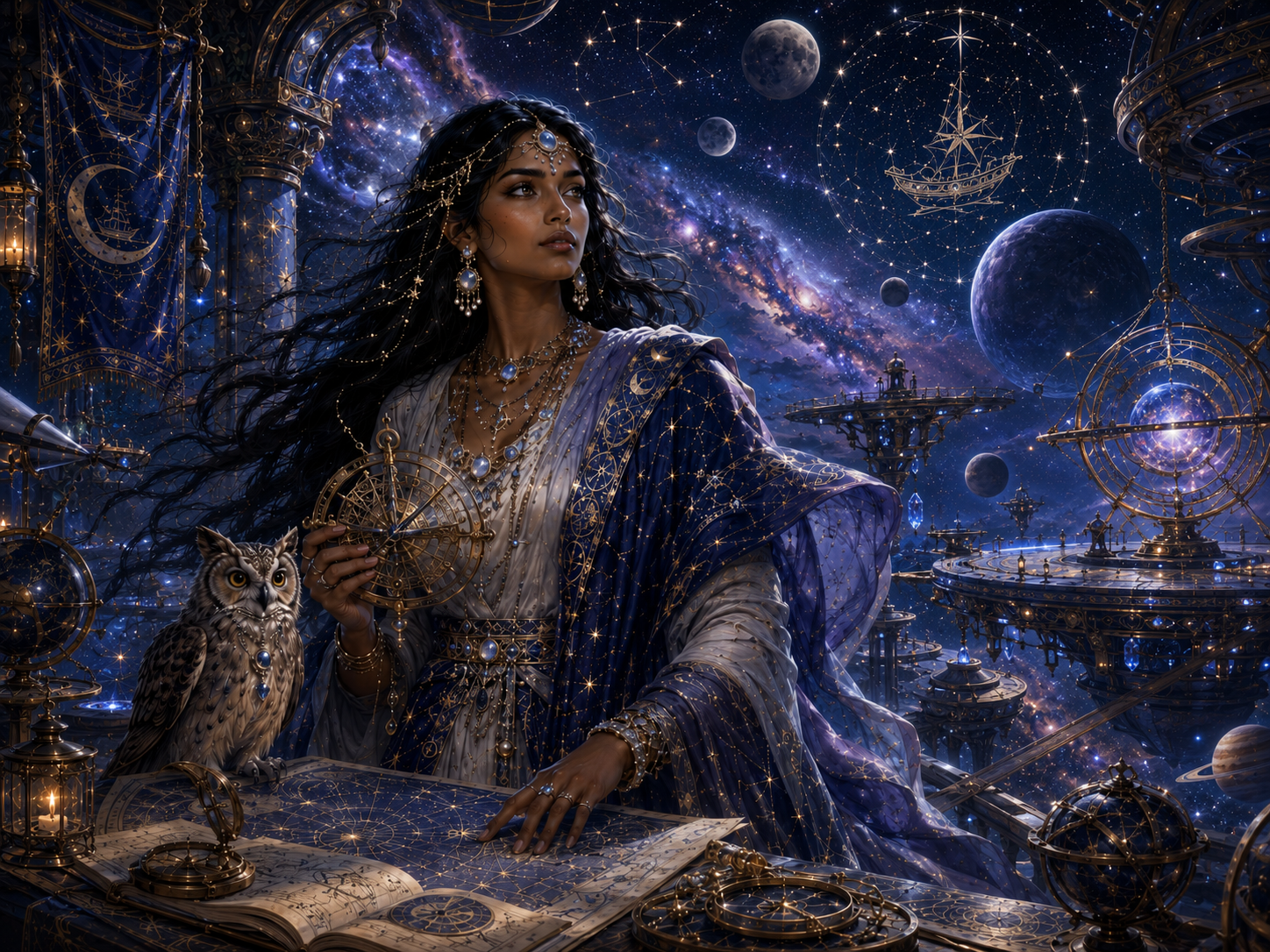
Greluna dwells in Arcanum Celestia, the plane of arcane knowledge, celestial wonder, and cosmic inquiry. The plane appears as a vast and ever-expanding cosmos filled with stars, nebulae, celestial bodies, arcane currents, and phenomena that defy mortal comprehension.
Arcanum Celestia is shared by Greluna and Hykteus. It was not the realm of either god from the beginning, but a divine work shaped after Greluna's ascension. Older traditions say that Hykteus once possessed a colder and more solitary realm of calculation and ordered light, but that he relinquished it when Greluna rose beside him. Together, they made something greater: a realm where knowledge is not only preserved, but launched outward.
Within Arcanum Celestia, Hykteus's Nexus of Illumination and Greluna's Stellar Shipwright stand near the Astral Spire, joined by a shared purpose. The Nexus asks what may be known. The Shipwright asks where that knowledge may carry those brave enough to depart.
Realm
Greluna's realm within Arcanum Celestia is The Stellar Shipwright, a celestial shipyard, observatory, archive, and launch-haven devoted to exploration beyond the known.
The Stellar Shipwright is described as a vast complex of silver docks, moonlit gantries, crystalline workshops, starforges, chart halls, and open platforms suspended above an endless cosmic expanse. Its dry docks hold vessels of many forms: slender scoutcraft, moon-sailing skiffs, great astral galleons, mobile observatories, research vessels, and ships whose designs are still being tested by minds that no longer fear failure.
The Shipwright is not merely a place where vessels are built. It is a place where journeys are conceived. Celestial cartographers chart unknown regions from observatory balconies. Artificers test hulls woven with spellwork and starlight. Navigators compare impossible maps. Scholars preserve the records of those who went farther than expected, and artisans build the next vessel from what the last voyage learned.
At the heart of the realm lies the First Dock, where the memory of the Bastion of Discovery is preserved. Traditions differ on whether the original vessel remains there, restored beyond mortal recognition, or whether the dock holds only its perfected image. In either case, the First Dock is treated as one of the holiest places in Greluna's faith: the place where mortal ambition became divine vocation.
Inhabitants
The Stellar Shipwright is inhabited by explorers, celestial shipwrights, navigators, cartographers, artificers, astral scholars, luminous attendants, and mortal souls drawn to Greluna's service.
Many of its inhabitants are not idle petitioners, but workers of the divine harbor. Some design vessels. Some copy maps. Some teach the newly arrived how to read stars that do not exist in mortal skies. Others depart on expeditions through Arcanum Celestia and beyond, returning with records of strange worlds, lost lights, and questions worthy of Hykteus's laboratories.
Celestial beings, archons, arcane scholars, constructs, familiars, owls, arcane drakes, starwhales, and other creatures of the plane may be found in or near the Shipwright. Constructs are common, though they tend to be more practical than ornamental: dock-servitors, measuring engines, chart-keepers, hullwright assistants, lantern-bearers, and devices built to test whether a vessel may survive what waits beyond the next star.
Mortal souls associated with Greluna are often explorers, sailors, wizards, astronomers, scholars, artificers, navigators, adventurers, and cartographers. They are not imagined as resting forever in stillness. In Grelunan tradition, the worthy dead continue onward: sailing farther, mapping more truly, guiding those behind them, and learning at last how large the heavens always were.
Artifacts & Relics
Divine Artifacts
The Bastion of Discovery
The greatest artifact associated with Greluna is the Bastion of Discovery, the Aetheric vessel she built as a mortal and used to reach Achipheus.
In mortal history, the Bastion was a ship, though not in any ordinary sense. It was a union of engineering, wizardry, mathematics, navigation, and audacity: a craft built not merely to cross water or air, but to leave Andórë itself. Its construction is remembered as the clearest proof of Greluna's mortal genius and the act that first drew Hykteus's full attention.
The Bastion crashed upon Achipheus and should have become her tomb. Instead, it became the broken threshold between mortality and divinity. Grelunan tradition treats the vessel not as a failure, but as the holiest kind of failed experiment: one that reached farther than wisdom permitted, broke upon the unknown, and still changed the shape of creation.
Some traditions claim that the original Bastion was restored in Arcanum Celestia and now rests within the First Dock of the Stellar Shipwright. Others teach that only its perfected image remains there, a divine pattern from which all celestial vessels in Greluna's realm descend.
The Moonstone Lens
The Moonstone Lens is a divine instrument associated with Greluna's ascension and with the mapping of paths through darkness.
It is described as a circular lens of pale moonstone set into silver, sometimes worn as a pendant and sometimes mounted within an astrolabe, spyglass, or navigational frame. Through it, the faithful say, one does not see what is near, but what may be reached.
In myth, the Moonstone Lens reveals roads hidden by distance, fear, ignorance, or despair. It may show the next star to follow, the safe passage through a ruin, the lost trail beneath snow, or the one honest route through a problem that seemed impossible.
Holy Weapons
Greluna has no true holy weapons.
She ascended long after Tuulla's law against direct divine intervention had shaped the conduct of the gods, and her divine nature was never expressed through conquest or war. Though she was present for later calamities such as The Descent of the Drow, the traditions do not describe her as a warrior-goddess or the bearer of a sacred armament.
In those accounts, Greluna watches, learns, warns where warning is permitted, and preserves what may later be understood. Some later poets describe her in such moments as a divine apprentice among older powers: not powerless, but newly divine, observing the terrible weight of godhood under laws she had not helped make.
Her faithful therefore do not look to her for blessed blades, spears, or engines of destruction. Her weapons are maps, vessels, records, lanterns, questions, and the courage to go where ignorance says one must not.
Relics of the Faith
Fragments of the Bastion
Fragments believed to come from the Bastion of Discovery are the most treasured relics of Greluna's faith. Most are slivers of silvered metal, cracked crystal, scorched wood, or Aether-scarred plating, though many such relics are impossible to authenticate.
True or symbolic, these fragments are kept in observatories, navigators' lodges, wizard colleges, and expeditionary shrines. They are reminders that a broken vessel may still mark the beginning of a greater voyage.
Moonstone Charms
Moonstone charms are common among Greluna's faithful. They are carried by sailors, travelers, scholars, and explorers who must move by night or depart without certainty of return.
A moonstone charm is not believed to guarantee safety. Rather, it is a devotional reminder to keep one's bearing, record one's path, and leave signs for those who may come after.
Star Charts of Return
The Star Charts of Return are maps created after dangerous journeys, especially those from which the traveler was not expected to survive. Some are ordinary charts marked by hand. Others are enchanted diagrams that shift beneath moonlight or reveal hidden routes only under particular stars.
Such charts are often copied and donated to temples, libraries, ports, and waystations. Among Greluna's faithful, returning with knowledge and refusing to share it is considered a grave failure of devotion.
Lanterns of the Open Road
Lanterns blessed in Greluna's name are carried by explorers, pilgrims, night travelers, and those entering ruins or unknown lands. Their light is usually silver-blue or violet, and many are engraved with her symbol: a Moonlit Ship Beneath a Star.
These lanterns symbolize her most common blessing. Greluna does not promise that the road is safe. She promises that the road may be seen.
The First Failure Pages
Among artificers and wizards devoted to Greluna, preserved records of failed attempts may become minor relics. A ruined diagram, a torn map, a cracked focusing crystal, or the first flawed design of a vessel may be honored if it led to a later discovery.
This practice is shared in spirit with Hyktean tradition, but its emphasis differs. Hykteus honors the failed experiment for the truth it reveals. Greluna honors it for the road it opens.
History
Creation & Early History
Greluna was not created as a goddess.
She was born mortal as Gauri Lakshmi Devi during the Age of Growth, in a human culture of the northwestern Giant's Hammer continent now largely lost beneath the later spread of Rihian custom. The details of her mortal life are preserved unevenly, for the people who first knew her did not survive as a great power into the present age. Yet all major traditions agree on the central truth: before she was divine, Greluna was a scholar, artificer, wizard, engineer, and explorer.
She lived in an age when mortal magic and invention were advancing, but when the heavens remained almost entirely beyond reach. The moons of Andórë were objects of wonder, omen, and study, but not destinations. Greluna refused that distinction. Where others saw distant lights, she saw distance, force, material, Aether, trajectory, and possibility.
Her greatest mortal work was the Bastion of Discovery, an Aetheric vessel built to leave Andórë and reach the heavens. The attempt was either madness, genius, or both. It succeeded far enough to change the world, and failed violently enough to change Greluna.
Major Deeds
Greluna's first and greatest deed was the construction and launch of the Bastion of Discovery.
With that vessel, she became the first known mortal of Andórë to reach one of the moons. The Bastion crashed upon Achipheus, and by every ordinary measure the voyage should have ended in death, silence, and a cautionary tale against mortal ambition. Instead, it became the beginning of her divinity.
Hykteus, God of Science, recognized in Greluna a mortal expression of his own domain carried beyond the safety of theory. She had not merely studied the heavens. She had built a way to them, risked the crossing, survived the failure, and stood where no mortal of Andórë had any right to stand. He offered her a portion of his divine power, and Greluna accepted.
By that act, Gauri Lakshmi Devi became Greluna, Goddess of the Stars.
Her second great deed came after her ascension. Of the four ascended mortal gods, Greluna alone participated in the creation of the plane that would become her divine home. Conlo, Cuulla, and Uldir shaped realms within the Plane of Harmony, which already existed. Greluna, together with Hykteus, helped bring Arcanum Celestia into being.
This made her ascension unlike the others. She did not merely receive a divine office and carve out a place within an established plane. She helped create a new celestial order: a plane where arcane knowledge, cosmic wonder, invention, exploration, and divine inquiry could exist together.
Within that plane she shaped the Stellar Shipwright, the heavenly shipyard from which celestial vessels are built and launched into the unknown. It is the divine answer to the Bastion of Discovery: not one mortal craft reaching desperately toward a moon, but an eternal harbor from which the next impossible voyage is always being prepared.
Greluna was also present for the Descent of the Drow, though traditions do not place her among the chief divine actors of that tragedy. She was newly divine compared to the eldest powers, and later accounts often describe her role as one of witness, study, warning, and preservation. Some poets call her a divine apprentice in those days, watching older gods act beneath ancient restraints and learning the terrible limits placed upon divine power.
Intervention in Mortal Affairs
Greluna's interventions are most often subtle, but more conversational than those of many gods who were divine from the beginning.
She does not simply answer questions, reveal destinations, or spare mortals the labor of discovery. Yet her followers believe she is more willing than many gods to speak through divine communion, especially to those who are lost, afraid, preparing for departure, or standing at the edge of something no map yet names.
Her guidance may come as a dream beneath unfamiliar stars, a remembered phrase at the moment of fear, a sudden understanding of a chart, a correction of a course, or a question that reveals the seeker's true purpose. She is known to answer with riddles, warnings, encouragement, and practical bearings, but rarely with complete solutions.
Greluna's signs are associated with orientation. A traveler finds the one star still visible through cloud. A sailor realizes the current is wrong before disaster strikes. A wizard sees the missing mark in a failed spell diagram. An explorer discovers an old waystone beneath moss. A grieving soul on the road to the afterlife sees a distant light and understands which way to walk.
Her faithful say that Greluna does not remove the journey. She gives the next direction.
Current Circumstances
In the present age, Greluna remains one of the most beloved of the ascended mortal gods, especially within the Rihian Republic.
Her popularity there is tied not only to her portfolio, but to her humanity. Along with Cuulla, Uldir, and Conlo, she is often invoked as proof that mortals may rise to divine significance. Among some Rihians, this belief hardens into Human Exceptionalism, though Greluna's own faith rejects the idea that her ascension proves human superiority. To her truest followers, the lesson is not that humans are greater, but that mortal courage, discipline, wonder, and generosity may matter on a cosmic scale.
She continues to dwell in Arcanum Celestia, within the Stellar Shipwright, beside Hykteus and his Nexus of Illumination. Their shared plane remains a testament to what their union represents: knowledge measured and knowledge pursued, the law of the cosmos and the voyage into it.
Greluna's faithful still look upward and outward. Her shrines mark harbors, observatories, libraries, roads, wizard colleges, and expeditionary halls. Her name is spoken before voyages, dangerous research, first departures, and final crossings.
She is remembered as the mortal woman who looked upon the moons of Andórë and refused to let distance be the end of wonder.
Representation & Legacy
Cultural Importance
Greluna holds a singular place among the gods of the Andórëan Pantheon.
She is one of the four ascended mortal gods, and among them she is unique for having helped create the divine plane she inhabits. Conlo, Cuulla, and Uldir shaped realms within the already-existing Plane of Harmony, but Greluna joined Hykteus in the making of Arcanum Celestia itself. For this reason, her ascension is often treated not merely as elevation, but as expansion: a mortal life widened until it required a new heaven to contain it.
In the Rihian Republic, Greluna is especially beloved. She is honored not only as Goddess of the Stars, but as one of the great proofs that mortal striving may reach divine consequence. This devotion sometimes becomes entangled with Human Exceptionalism, particularly among those who treat the ascended mortals as evidence of human superiority. Greluna's own traditions reject that narrow reading. Her story does not teach that humans alone are worthy of greatness. It teaches that the unknown answers courage, discipline, wonder, and the refusal to let fear define the edge of the possible.
She also preserves the memory of a human culture otherwise nearly lost. In sacred art, names, ornaments, and fragments of old custom, Greluna carries forward the image of a people whose mortal nations vanished but whose daughter reached the stars.
Symbolism
Greluna symbolizes exploration, discovery, celestial wonder, and the courage to cross beyond the known.
Her primary symbol, a Moonlit Ship Beneath a Star, gathers the central truths of her faith into one image. The ship recalls the Bastion of Discovery and the act of departure. The moon recalls Achipheus, where failure became transformation. The star represents the next destination: not merely a light to admire, but a point by which to steer.
Her moon imagery should not be mistaken for dominion over nature's cycles in the manner of Tuulla's children. For Greluna, the moon is not primarily harvest, tide, or season. It is the first impossible destination made real. The moon is proof that distance may be measured, crossed, survived, and understood.
Her owl represents wisdom in darkness, silent passage, and the ability to perceive what others miss. Her colors, silver, blue, and violet, signify starlight, moonlight, arcane depth, and the luminous edge between knowledge and wonder.
Above all, Greluna represents the horizon as invitation. Where others see the end of the map, she sees the place where the next map begins.
Legacy
Greluna's legacy is found wherever mortals refuse to mistake distance for impossibility.
Her mortal life reshaped the meaning of exploration on Andórë. Before Gauri Lakshmi Devi, most mortals treated the heavens as things to study, praise, fear, or interpret. After her, they could never again be only that. They were destinations. Her construction of the Bastion of Discovery proved that magic, invention, mathematics, and courage could carry mortal ambition beyond the world itself.
Her ascension reshaped the pantheon. She became a divine bridge between mortal striving and cosmic knowledge, between Hykteus's disciplined inquiry and the living hunger to go farther. In helping create Arcanum Celestia, she left a legacy not only in temples and stories, but in the structure of the planes.
Among explorers, Greluna is remembered as the patron of the first step. Among scholars, she is the reminder that knowledge must travel. Among navigators, she is the star that gives direction without shortening the road. Among the lost, she is the distant light that says there remains a way.
Her legacy is often summarized in a single teaching:
"The stars were not placed above us to remain untouched."
Notes