Krallene
Krallene, Goddess of Loyalty, is the divine embodiment of duty, steadfastness, and sacred obligation. She teaches that civilizations endure only because people keep their promises: soldiers stand beside their comrades, rulers protect their people, and oaths remain unbroken.
Though counted among the goddesses of war, Krallene does not glorify conquest or victory. To her, war is the ultimate test of loyalty, revealing who will stand firm in the face of hardship and who will abandon their duties when it matters most.
Divine Information
| Property | Value |
|---|---|
| Alignment | Lawful Neutral |
| Divine Domains | Order, War |
| Portfolio | Loyalty, Duty, Oaths, Service |
| Home Plane | Aralonia |
| Realm | Krallia |
| Symbol | ⚔️🛡️Crossed swords over a shield |
| Sacred Animal | Giant Bearded Vulture |
| Title | Goddess of Loyalty |
Manifestation
Common Appearance
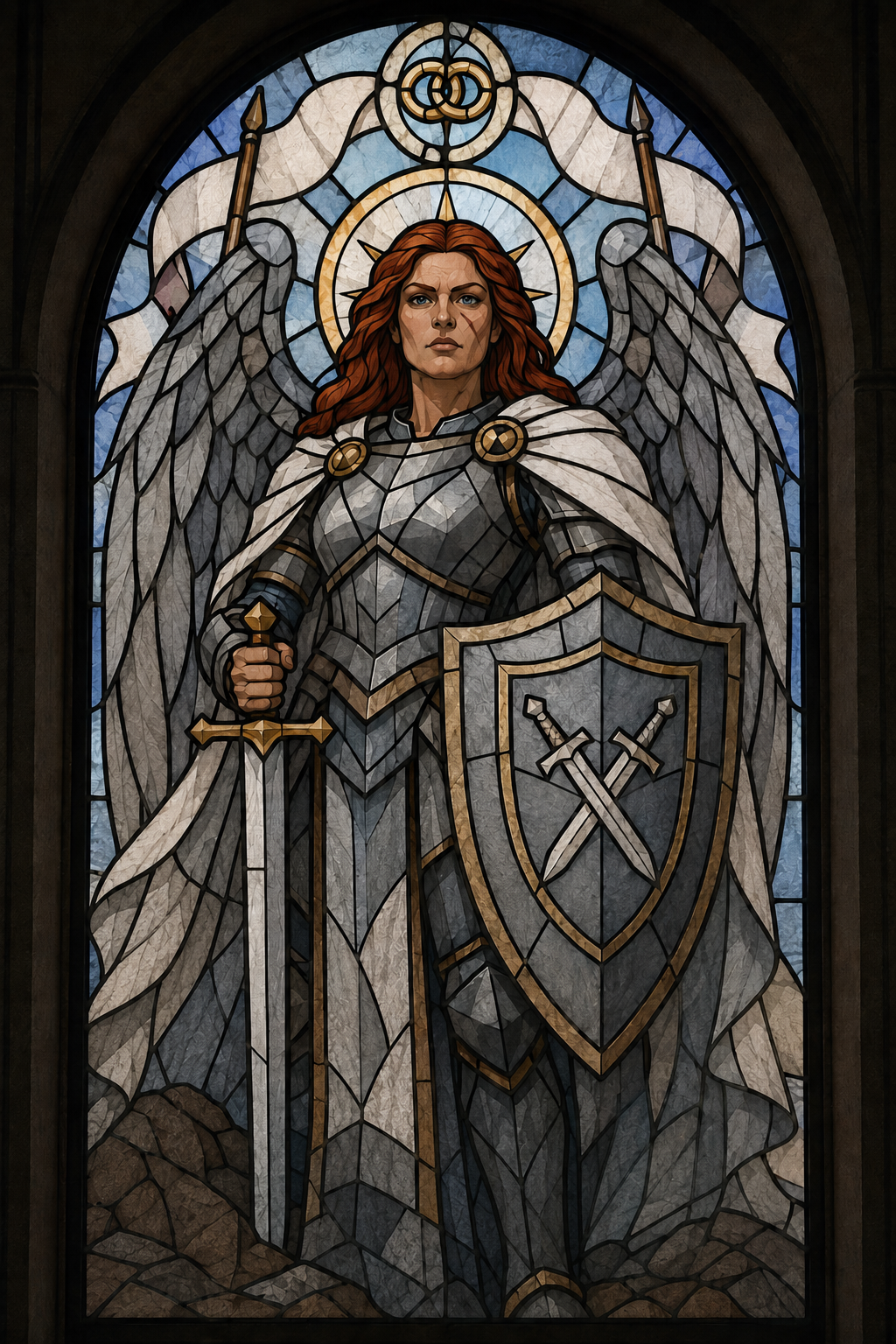
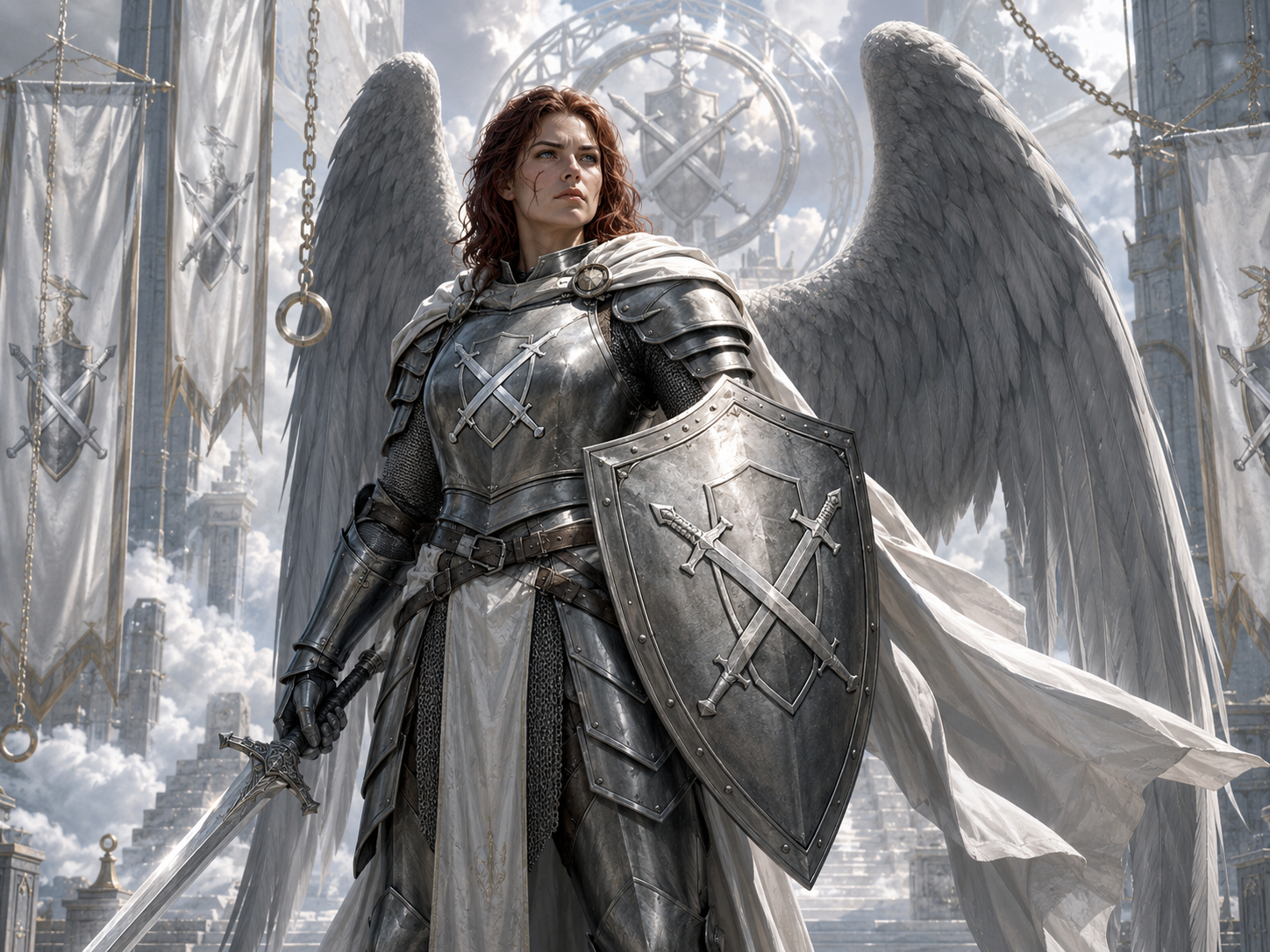
Krallene most commonly appears as a tall and imposing winged woman of extraordinary strength and presence. She possesses deep auburn hair that falls in loose waves to her shoulders, piercing blue eyes that seem to measure the resolve of all who stand before her, and fair skin marked only by a single scar upon her right cheek.
Though undeniably beautiful, her beauty is stern and martial rather than delicate. She is broad-shouldered and powerfully built, with the physique of a veteran warrior and commander. Her arms and hands bear the strength of one accustomed to carrying shield and sword, and she stands with the unwavering posture of a soldier on parade.
Her great wings are pale grey, like clouds gathering before a storm or banners faded by countless campaigns.
Krallene most often wears a suit of magnificent grey iron armor. Though forged of divine materials, it resembles the practical plate and mail worn by common soldiers and officers throughout history rather than the resplendent regalia of queens and conquerors. Its surfaces are polished but unadorned, emphasizing utility, discipline, and endurance over grandeur. A white cloak often hangs from her shoulders, its hem stirring as though caught in an eternal wind.
She is frequently depicted carrying a longsword of shining silver-white steel and a large shield bearing her sacred symbol of crossed swords over a shield.
Though capable of assuming any form she desires, this stern angelic commander is the image by which mortals throughout Andórë most often depict the Goddess of Loyalty.
Preferred Forms
- A winged woman clad in grey iron armor.
- A veteran commander inspecting their troops.
- A common soldier standing watch.
- A standard-bearer carrying a battle-worn banner.
Avatar Forms
Krallene's avatars most often appear during times of war, siege, or great hardship. They are usually seen as heavily armored warriors, officers, or standard-bearers who inspire steadfastness and courage in those around them.
Legends tell of mysterious commanders who appear amidst desperate battles, restoring order to broken lines and rallying soldiers who had all but given up hope. Such figures rarely claim divine origin and often disappear once their duty is fulfilled.
Identifying Characteristics
- Deep auburn hair and piercing blue eyes.
- Pale grey wings resembling storm clouds.
- A diagonal scar across her right cheek.
- Broad shoulders and the powerful build of a seasoned warrior.
- Grey iron armor and a white military cloak.
- An unwavering, watchful expression.
Divine Symbols & Iconography
The most common symbol of Krallene's faith is a pair of crossed swords set before a shield, representing the bonds of loyalty that unite soldiers and the duty to defend those who stand beside them.
She is also frequently depicted with:
- A white military banner, symbolizing service and steadfastness.
- Grey iron armor, symbolizing discipline and endurance.
- A sword and shield, symbolizing duty and protection.
- A ring or chain, symbolizing oaths and sacred bonds.
- Her faithful companion Gyrfalke, representing vigilance, memory, and loyalty to the fallen.
Divine Nature
Origins
Little is known of Krallene's existence before she became one of the gods of the Andórëan Pantheon. Ancient myths claim that she came from beyond the world alongside her sisters, already embodying the ideals of loyalty, duty, and sacred obligation.
The earliest indisputable accounts of Krallene place her during the Age of Monsters, when the world was consumed by the Dragon-Giant War. Like her sisters Ara and Earae, and alongside Nudite, she was drawn to Andórë by the scale of the conflict and the suffering it inflicted upon mortals.
When Tuulla forbade the war goddesses from intervening, Krallene obeyed without hesitation. To her, fidelity to one's sworn obligations and respect for legitimate authority are sacred virtues, even when obedience demands painful sacrifice.
The lesson of that age—that duty sometimes requires endurance rather than action—would shape her teachings for all ages to come.
Divine Disposition
Krallene is disciplined, steadfast, and immensely patient. She possesses the calm certainty of a veteran commander who has witnessed countless hardships and emerged unshaken.
Though often stern and reserved, she is not cold. She deeply values companionship, camaraderie, and the bonds forged through shared struggle. She is known to show great tenderness toward those who faithfully fulfill difficult duties and profound grief toward those who die in service to others.
She rarely displays anger openly. Betrayal, however, can provoke a terrible and icy fury.
Morality & Philosophy
Krallene teaches that civilization exists only because people honor their obligations to one another.
A ruler must protect their people.
A soldier must stand beside their comrades.
A parent must care for their children.
A friend must remain faithful in times of hardship.
To her, loyalty is not blind obedience, nor is it mere affection. It is the conscious choice to remain steadfast when keeping one's word becomes difficult or costly.
She believes that duty often requires sacrifice and that true character is revealed not by what one does when circumstances are easy, but by what one endures for the sake of others.
To Krallene, loyalty is not merely a virtue. It is the foundation upon which all relationships and civilizations are built.
Divine Goals & Aspirations
- Preserve the bonds that hold societies together.
- Inspire loyalty, service, and self-sacrifice.
- Ensure that oaths and promises retain their sacred meaning.
- Teach mortals to place duty above selfish desire.
- Foster cooperation and unity in times of hardship.
Virtues
- Loyalty
- Duty
- Reliability
- Self-sacrifice
- Discipline
- Perseverance
Flaws & Limitations
- Can place excessive value upon obedience and duty.
- Sometimes struggles to understand those who abandon obligations for personal fulfillment.
- May expect self-sacrifice to a degree that exceeds mortal limitations.
- Finds betrayal deeply personal and rarely forgives it.
- Can remain loyal to people, institutions, or causes long after others would abandon them.
This last flaw is particularly interesting because it distinguishes her from Ara. Ara asks, "Is this just?" Krallene asks, "What is my duty?"
Favored Virtues
- Keeping one's promises.
- Loyalty to comrades and family.
- Enduring hardship without complaint.
- Fulfilling obligations despite personal cost.
- Service to community and nation.
- Honoring the memory of the fallen.
Abhorred Vices
- Betrayal.
- Desertion.
- Oathbreaking.
- Treachery.
- Abandoning those who depend upon you.
- Selfishness that places personal gain above duty.
Speech & Mannerisms
Krallene speaks in a calm, measured voice that carries the authority of long experience.
She rarely wastes words.
When listening, she gives her complete attention and never interrupts.
When disappointed, she often falls silent rather than expressing anger, and many claim that her silence is far more unsettling than her wrath.
She frequently rests one hand upon the pommel of her sword or folds her hands behind her back like a commander inspecting her troops.
When speaking of the dead, she instinctively lowers her head in respect.
Quotes & Catchphrases
"Loyalty is proven only when it becomes difficult."
"A promise is a burden willingly carried."
"Stand your post."
"Duty rarely asks whether we are ready."
"Civilization is built upon obligations kept."
"The fallen are owed remembrance."
"A single act of betrayal can undo a lifetime of trust."
"You are not measured by what you would die for, but by what you are willing to live for."
"Hold the line."
"No one carries their burdens alone."

Divine Relationships
Family
Krallene is one of the three divine sisters of war, alongside Ara, Goddess of Honor, and Earae, Goddess of Triumph. Though each sister embodies a different aspect of conflict and duty, their bond is among the strongest relationships within the Andórëan Pantheon.
Of the three, Krallene is often regarded as the most steadfast and dependable. Where Ara serves as the conscience of the sisters and Earae their fiery spirit, Krallene is their foundation. Her sisters know that once she gives her word, it will never be broken.
She shares a particularly close bond with Ara. Though they occasionally disagree on matters of justice and pragmatism, their values are deeply compatible. Ara teaches that one must do what is right; Krallene teaches that one must remain faithful to those who depend upon them. The two frequently reinforce one another's teachings.
Her relationship with Earae is considerably more complicated. Krallene admires her sister's courage, ambition, and love of glorious achievement, but often worries that Earae's pursuit of victory can encourage recklessness, pride, and the abandonment of obligations. Despite their disagreements, the sisters love one another deeply, and Krallene has never failed to answer Earae's call for aid.
Allies
Krallene's closest divine ally is Idtix, Goddess of Duty. The two share an almost perfect philosophical alignment, believing that responsibility, discipline, and service are the foundations of civilization. They are often invoked together by soldiers, administrators, and those who bear heavy burdens.
She also enjoys a close friendship with Nudite, Goddess of Victory. Though Krallene does not seek victory for its own sake, she believes that loyalty and sacrifice deserve to be rewarded. In her eyes, victory attained through steadfastness is among the noblest of triumphs.
Krallene greatly respects Greluna, Goddess of Stars. The orderly movements of the heavens represent the very principles that Krallene values most: constancy, reliability, and eternal duty. She frequently points to the stars as an example of the universe fulfilling its obligations.
She likewise values Hykteus, God of Science and Knowledge. Though the two approach the world from different perspectives, she admires his rationality, his dedication to truth, and his tireless pursuit of understanding.
Rivals & Enemies
Krallene's greatest divine rival is Earae. Though their love as sisters remains unquestioned, their philosophies often place them at odds. Earae values glory and victory; Krallene values loyalty and obligation. One seeks greatness; the other seeks steadfastness.
Her greatest enemy is Caneas, Goddess of Lies and Messages. To Krallene, lies are the first step toward betrayal, and betrayal is among the gravest sins imaginable. She views Caneas as a direct threat to the bonds of trust that hold societies together.
She also despises Ubus, whose selfishness and elevation of personal gain above communal responsibility stand in direct opposition to her teachings. To Krallene, Ubus represents the abandonment of duty.
While she opposes Zedrus, God of Torture, she does so less out of moral outrage than her sister Ara. Krallene believes torture inevitably corrupts loyalty and creates obedience through fear rather than devotion, making it a fundamentally unstable and dishonorable practice.
Relationships with Other Gods
Krallene is widely respected among the gods because she is utterly dependable. Even deities who disagree with her philosophy know that she keeps her promises and fulfills her obligations.
She is often called upon to witness oaths, mediate disputes, and guarantee agreements between gods who otherwise distrust one another.
The events of the Dragon-Giant War left a profound impression upon her. Unlike some of the gods, she never questioned Tuulla's command that the war deities remain uninvolved. To Krallene, obedience to legitimate authority was itself a sacred duty. The lesson that even the gods must sometimes endure hardship without intervention became central to her faith.
Many gods consider Krallene the pantheon's anchor—the deity who can always be relied upon when difficult burdens must be carried.
Relationships with Mortals
Krallene loves mortals because they are capable of loyalty despite hardship.
She pays particular attention to:
- Soldiers who refuse to abandon their comrades.
- Parents who sacrifice for their children.
- Friends who remain faithful in difficult times.
- Leaders who place duty above personal ambition.
- Ordinary people who quietly fulfill their responsibilities every day.
She has little interest in fame, greatness, or heroism for their own sake. A farmer who faithfully cares for their family may earn her favor more readily than a conquering king.
Tales often speak of mysterious soldiers, officers, or standard-bearers who appear in moments of despair and inspire exhausted defenders to stand firm one final time. Such figures are commonly believed to be avatars of the Goddess of Loyalty.
Of all mortal failings, betrayal wounds her most deeply. A murderer may repent, a coward may find courage, and even a tyrant may seek redemption. But one who knowingly betrays those who placed their trust in them is said to earn the coldest judgment of the Goddess of Loyalty.
Yet she is also remarkably compassionate toward those who fail their duties despite sincere effort. She understands exhaustion, grief, fear, and impossible burdens. To stumble is mortal; to abandon one's obligations willingly is another matter entirely.
For this reason, her priests often teach:
"The Goddess of Loyalty does not ask that you never fall. She asks only that you rise and return to your post."
Worship & Faith
Worshippers
Krallene is primarily worshipped by soldiers, guards, knights, officers, veterans, civic leaders, judges, and all those who bear responsibility for the welfare of others.
She is also revered by ordinary people who value steadfastness, reliability, and devotion to family and community. Parents, teachers, healers, and public servants frequently invoke her blessings, seeing loyalty and service as sacred obligations.
Though particularly beloved by military organizations, Krallene's teachings appeal to anyone who believes that promises matter and that societies are built upon mutual trust and duty.
Major Cults
Krallene possesses few independent cults, as her worship is almost universally integrated into the broader practices of the Andórëan Pantheon.
Military orders, knightly brotherhoods, veterans' associations, and organizations dedicated to public service frequently place themselves under her patronage, though few exist solely to worship the goddess herself.
Many armies maintain shrines to Krallene, and it is common for military units, city watches, and civic institutions to invoke her blessings when swearing oaths, appointing officers, or reaffirming their duties.
Holy Books & Codes
The Covenant of Banners
The principal devotional text associated with Krallene, the Covenant of Banners is a collection of military histories, parables, philosophical teachings, and recorded oaths concerning loyalty, duty, service, and sacrifice.
The Covenant teaches that no society can endure unless its members remain faithful to one another and that leaders owe duties to their followers just as followers owe duties to their leaders.
Particular emphasis is placed upon the sacredness of promises, the responsibilities of command, and the belief that one's character is revealed by what one is willing to endure for the sake of others.
Tenets of Faith
- Loyalty above self.
- Keep your oaths.
- Stand by your comrades.
- Fulfill your duty.
- Honor the fallen.
Holidays & Holy Days
Day of Remembrance
A solemn holy day shared by all four war goddesses, dedicated to honoring those who have died in war, service, and sacrifice. Memorial services, the reading of names, and the placing of flowers and banners upon graves are common observances.
Day of Banners
A celebration of loyalty, fellowship, and shared duty. Military companies renew their oaths, veterans gather to remember old comrades, and communities reaffirm their commitments to one another. Families often display ancestral banners, standards, or symbols of service on this day.
Sacred Sites
No major pilgrimage sites are universally associated with Krallene.
Instead, her faithful often regard battlefields, memorials, military cemeteries, and places where great oaths were sworn as sacred ground.
Shrines dedicated to Krallene are common in forts, barracks, civic halls, and places of public service.
Religious Practices
The faithful of Krallene place great importance upon ritual oaths and acts of remembrance.
Common practices include:
- Swearing important promises before her symbol.
- Maintaining memorials to the fallen.
- Sharing meals among comrades and companions.
- Carrying tokens gifted by loved ones or fellow soldiers.
- Offering prayers before assuming positions of responsibility.
- Renewing vows of service on the Day of Banners.
Priests of Krallene frequently act as witnesses to oaths, military chaplains, custodians of memorials, and mediators in disputes involving questions of loyalty and obligation.
Forbidden Acts
Among the gravest sins in Krallene's faith are:
- Betrayal of those who trust you.
- Breaking solemn oaths and promises.
- Deserting companions in their hour of need.
- Abandoning duties willingly accepted.
- Using loyalty as a tool for exploitation or personal gain.
- Forgetting or dishonoring the sacrifices of the fallen.
Divine Realm
Home Plane
Like her sisters and closest companion, Krallene dwells within Aralonia, the divine realm of the war goddesses. The plane is a place of beauty, balance, and celestial harmony, shaped by the differing philosophies of war embodied by its four rulers.
Though each goddess governs her own province, the realm remains united, reflecting the belief that honor, loyalty, triumph, and victory are all inseparable aspects of conflict and civilization.
Realm
Krallene presides over Krallia, the Province of Loyalty.
Krallia is a realm of rolling grasslands, fertile river valleys, and gently winding hills. Unlike the imposing mountains of Aranor or the harsh wastelands of Earaeth, Krallia possesses a quiet and enduring beauty. Its fields are perpetually bountiful, its weather mild and predictable, and its settlements orderly and prosperous.
The province is shaped by the principles that Krallene embodies. Strong communities, mutual trust, and enduring bonds are the foundations upon which all of Krallia rests. The land itself seems to encourage cooperation and fellowship, and visitors often speak of an unusual sense of belonging and companionship while within its borders.
At the heart of the province stands the Citadel of Loyalty, an immense stronghold of stone, banners, and gardens. Unlike the fortresses of mortal rulers, the citadel serves less as a seat of power and more as a place of gathering, remembrance, and counsel.
Its halls are decorated with countless banners, standards, and memorials commemorating acts of loyalty, sacrifice, and service. Here, Krallene receives celestial visitors, counsels mortal champions, and honors those who have faithfully upheld their duties.
Inhabitants
Krallia is inhabited primarily by celestial beings who embody the virtues of loyalty, service, and steadfastness.
Among its inhabitants are:
- Angels, particularly Planetars and Devas who serve as guardians, messengers, and commanders.
- Couatls, who often act as advisors and keepers of sacred oaths.
- Unicorns, which roam the meadows and river valleys and are regarded as symbols of purity and fidelity.
- Mortal heroes who have earned Krallene's favor through extraordinary acts of loyalty and self-sacrifice and who now dwell in her province as celestial servants and companions.
The people of Krallia are said to know neither loneliness nor abandonment. Every inhabitant has a place, every duty is valued, and no burden is borne alone.
The province is also home to Krallene's faithful companion, Gyrfalke, the great bearded vulture who serves as her messenger, scout, and constant companion.
Artifacts & Relics
Divine Artifacts
Unlike several other gods of the Andórëan Pantheon, Krallene is not associated with a singular legendary artifact or divine weapon.
The faithful often consider this fitting. Loyalty, they teach, is not found in a magical blade or a mighty crown, but in the bonds between people and the promises they keep.
Many stories instead speak of sacred banners, shields, and tokens of remembrance that Krallene has blessed throughout history, though no single artifact is universally recognized as her supreme relic.
Holy Weapons
Krallene is most commonly depicted bearing a simple longsword and a large shield emblazoned with her holy symbol of crossed swords over a shield.
Neither weapon possesses a universally recognized name, and theologians frequently argue that this anonymity is intentional. To Krallene, weapons are tools placed in service to others, not objects of personal glory.
Consequently, the sword and shield carried by her depictions are symbols of duty and protection rather than artifacts to be sought or possessed.
Relics of the Faith
Relics associated with Krallene are typically humble and deeply personal in nature.
Among the most revered are:
- Battle standards carried by companies that refused to break.
- Weapons borne by heroes who sacrificed themselves for their companions.
- Fragments of banners recovered from famous last stands.
- Rings, medals, and insignia exchanged as symbols of sworn loyalty.
- Memorial stones bearing the names of the fallen.
Many shrines dedicated to Krallene preserve such relics, not because of any inherent magical power they possess, but because they embody the virtues of loyalty, sacrifice, and service that the goddess holds sacred.## History
History
Creation & Early History
Little is known of Krallene's existence before she became one of the gods of the Andórëan Pantheon. Ancient myths claim that she came to Andórë alongside her sisters Ara and Earae, already embodying the principles of loyalty, duty, and sacred obligation.
The earliest reliable accounts of Krallene place her during the final centuries of the Dragon-Giant War. Drawn by the scale of the conflict and the suffering it inflicted upon mortal life, she and the other war goddesses watched the struggle from afar.
When Tuulla forbade the war goddesses from intervening, Krallene accepted the decree without hesitation. To her, obedience to rightful authority and fidelity to one's obligations are sacred virtues, even when they demand painful restraint.
This lesson—that duty sometimes requires endurance rather than action—would profoundly shape her faith and teachings in all the ages that followed.
Major Deeds
Unlike many gods, few myths speak of great battles fought personally by Krallene or of mighty monsters slain by her hand.
Instead, her greatest deeds are said to be quieter and more enduring.
She is credited with teaching mortals the sacred nature of oaths and service, inspiring the creation of countless military orders, knightly brotherhoods, and institutions dedicated to public duty and remembrance.
Many legends also attribute to her the establishment of the first formal rites honoring the fallen and the practice of swearing solemn promises before witnesses.
Throughout history, countless armies and kingdoms have claimed that their codes of honor and service were inspired, directly or indirectly, by the teachings of the Goddess of Loyalty.
Intervention in Mortal Affairs
Krallene intervenes in mortal affairs sparingly and with great care.
She rarely grants victory, wealth, or power. Instead, she offers strength to endure burdens, courage to remain faithful, and comfort to those who fear they can no longer carry their responsibilities.
Her avatars most often appear during desperate sieges, doomed last stands, and moments when individuals must choose between loyalty and self-preservation.
Stories frequently tell of mysterious officers, standard-bearers, or common soldiers who appeared when all hope seemed lost, restored order among frightened defenders, and then vanished once the danger had passed.
Priests of Krallene teach that she walks closest to mortals not in moments of triumph, but in moments when duty becomes almost impossible to bear.
Current Circumstances
In the present age, Krallene remains one of the most widely respected members of the Andórëan Pantheon.
Though rarely the object of passionate devotion, she is invoked wherever people swear oaths, accept burdens of responsibility, or promise to protect one another.
Her teachings continue to shape military traditions, legal institutions, and countless social customs throughout Andórë.
The Goddess of Loyalty remains steadfast in her eternal purpose: to preserve the bonds of trust and obligation that allow civilizations to endure.
For as long as mortals continue to stand beside one another in times of hardship, her work will never truly be finished.
Representation & Legacy
Cultural Importance
Though she is counted among the war goddesses, Krallene's influence extends far beyond battlefields and armies.
Her teachings touch nearly every aspect of civilized life. Every oath sworn, every promise kept, and every duty faithfully fulfilled falls within her divine purview.
Rulers invoke her when taking the throne. Soldiers pray to her before battle. Judges swear by her when rendering difficult decisions. Parents quietly embody her teachings every day through their devotion to their children.
For this reason, many philosophers argue that Krallene is one of the hidden pillars of civilization itself. Laws, governments, armies, and even friendships exist only because individuals trust one another to fulfill their obligations.
Her faith is particularly strong among:
- Soldiers and veterans.
- Guards and watchmen.
- Public servants and administrators.
- Judges and magistrates.
- Parents and caregivers.
- Communities shaped by hardship and mutual dependence.
In many cultures, breaking an oath is not merely considered dishonorable—it is regarded as an offense against Krallene herself.
While other gods may inspire greatness, ambition, or glory, Krallene inspires something quieter and far more enduring: reliability.
Symbolism
Krallene embodies the virtues that allow individuals and societies to endure.
She represents:
- Loyalty over convenience.
- Duty over selfish desire.
- Endurance over surrender.
- Service over personal glory.
- Trust over suspicion.
- Remembrance over forgetting.
Her symbol of crossed swords before a shield carries multiple meanings.
The swords represent individuals standing together in common purpose.
The shield represents the protection that such bonds provide.
Together they symbolize the truth at the center of her faith:
No one survives alone.
Her white banner symbolizes steadfast service.
Her grey armor symbolizes discipline and reliability.
Her scar represents the burdens willingly borne in service to others.
Even her companion, the great vulture Gyrfalke, symbolizes memory and vigilance, reminding mortals that loyalty extends even beyond death and that the fallen deserve remembrance.
Legacy
Krallene's greatest legacy is not a kingdom, a conquest, or a legendary artifact.
Her legacy is trust itself.
Throughout history, countless empires have risen and fallen, but every lasting civilization has depended upon the virtues she embodies. Armies hold their lines because soldiers refuse to abandon one another. Families endure because parents place duty above comfort. Nations survive because ordinary people continue to fulfill unremarkable obligations every day.
Her influence can be found wherever people:
- Keep their promises.
- Stand beside their companions.
- Honor the sacrifices of those who came before them.
- Continue their duties despite hardship and fear.
Many theologians teach that the world would collapse into chaos not because evil became stronger, but because people ceased to trust one another.
In this sense, Krallene is not merely the Goddess of Loyalty.
She is the divine embodiment of the invisible bonds that make civilization possible.
Her faithful often summarize her teachings with a simple saying:
"She is the reason people continue to stand beside one another when circumstances become difficult."
Notes