Agrovionimb
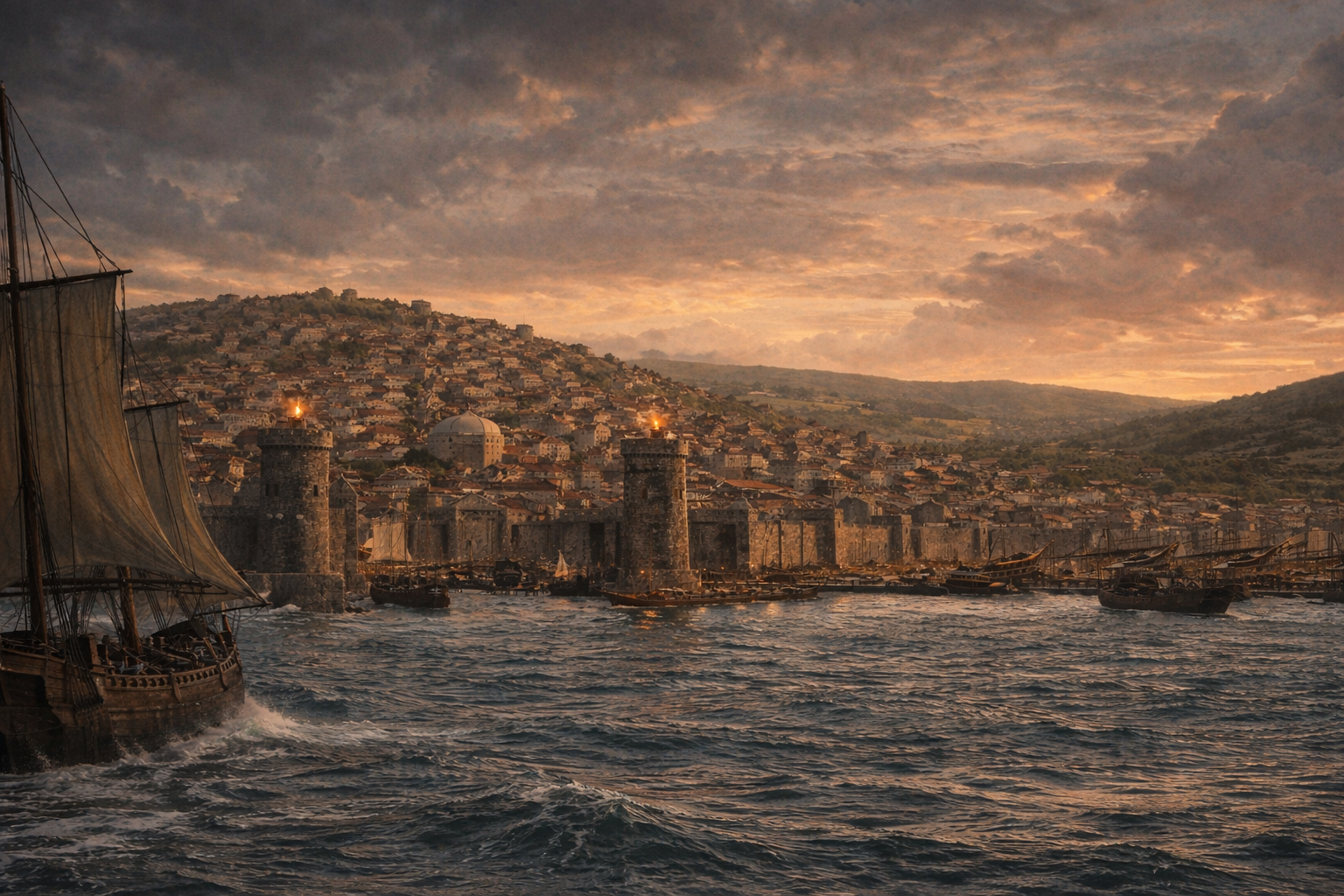
Agrovionimb is the final surviving city of civilization. For more than 1,137 years, it has endured after demons overran the mainland and destroyed nearly every known nation.
Long before the Fall, the island of Agrovionimb was part of the Kingdom of Druvavarbia, a maritime nation consisting of four great islands: Agrovionimb, Andavum, Marate, and Porduroria. These islands formed a prosperous trade network linking the sea peoples and coastal civilizations of the world.
Today, Agrovionimb stands alone. The other islands fell silent after the demon invasion. The city that once served as a minor trading port is now the last refuge of civilization, its harbor filled with the descendants of refugees from every surviving culture.
The sea protects them. Demons cannot create—and therefore cannot build ships.
Across a thousand years of survival, the people of Agrovionimb have preserved knowledge, rebuilt society, and continued a singular act of defiance: they build ships and send them back into the demon-ruled world in the hope that something, somewhere, might still survive.
Known Inhabitants
The following residents of Agrovionimb have appeared in or been referenced during the campaign.
Council of Thirteen
Ird Ragescream | Kuserlion Faewen-FairyMaiden | Onzuigse Mudfoot
Covenant of the Last Dawn
Alar Nughelath | Araroris Calaarauth | Belaia Bhovunath | Bugdurash Stormcaller | Domitila Quintana | Durgat Stormbringer | Duzus Calafin-LightHair | Kelnelis Calafin-LightHair | Soledad Leon | Varan Sylael-ForestBeauty | Vilston Murnraulfen | Whulehyn Rviaath | Zondos Soversath
Shipbuilders
Brodon Sivmil | Kipnottin Murnwarrgar | Nelldove Sivmil
Tidewardens
Bor Thunderroar | Lilwyn Warrtur | Ulam Bonechewer
Other Residents
Asnyn Galalynith | Marnfrid Deepdelver | Zlog Bonegrinder
Demographics
Agrovionimb has a population of approximately 5,700 permanent residents, making it a small but dense maritime city. Over the past 1,137 years it has absorbed refugees from many cultures and species. Intermarriage over centuries has resulted in most residents being of mixed ancestry, though individuals typically identify with the species of their most dominant heritage.
Approximate population composition:
- Triton (26.82%)
- Sea Elf (20.35%)
- Dwarf (8.34%)
- Gnome (8.25%)
- Halfling (5.68%)
- Human (5.52%)
- Elf (4.63%)
- Dragonborn (4.59%)
- Yuan-Ti (4.44%)
- Drow (4.26%)
- Orc (3.09%)
- Hobgoblin (1.61%)
- Bugbear (1.38%)
- Goblin (1.05%)
The population is unusually stable, with slow growth due to limited land and resources. Long-lived species such as sea elves and gnomes often hold positions of institutional knowledge for centuries.
Most families have lived in the city for dozens of generations, and family reputation plays a major role in politics and employment.
Government
Agrovionimb is currently ruled by an elected Council of Thirteen. The councilors hold 5 year terms, and there are no term limits. Two councilors are replaced or re-elected every year.
Current Councilors:
- Merla Vetchvine, 87-year-old female halfling.
- Eldonel Vetchvine, 70-year-old male halfling.
- Osbornel Vetchvine, 28-year-old male halfling.
- Lindalo Vetchvine, 133-year-old male halfling.
- Portiaelle Zestbrew, 138-year-old female halfling.
- Ykegs Ragescream, 28-year-old male goblin.
- Wialras Gorgefiend, 30-year-old male goblin.
- Totbuild Brinehand, 30-year-old male bugbear.
- Truirrertai Brinehand, 27-year-old female bugbear.
- Eerels Brinehand, 28-year-old female bugbear.
- Onzuigse Mudfoot, 19-year-old female goblin.
- Ird Ragescream, 18-year-old male goblin.
- Kuserlion Faewen-FairyMaiden, 646 year old male sea elf.
Defences
Agrovionimb’s greatest defense is geography.
Demons cannot cross the ocean because they cannot create vessels, meaning the island has remained unreachable to them for over a millennium.
However, the city still maintains significant defenses against:
- sea monsters
- potential infiltrators from the mainland
Harbor Defenses
The harbor is protected by:
- Three stone breakwater towers
- Ballista platforms
- Signal beacon towers
- Heavy harbor chains that can be raised across the entrance
City Guard
The Tidewardens serve as the primary law enforcement and defensive force.
Estimated strength:
- ~120 full-time guards
- ~80 auxiliary militia members
Many members of the Vetchvine family traditionally serve in the guard.
Watch Towers
Six coastal watch towers circle the island and maintain signal fires to alert the city of approaching vessels or threats.
Industry & Trade
Useful Shops
Blacksmiths
- The Masculine Whore Blacksmith (Great)
- Elk Smithing (Average)
- The Enlarged Staff Blacksmith (Good)
- Staff Smithing (Good)
- The Skilled Stool Blacksmith (Average)
- The Zylfin-ShadowHair Blacksmith (Average)
- The Sparkling Blacksmith (Average)
- Merchant Smithing (Poor)
- The Intelligent Blacksmith (Average)
Jewelers
- Honorary Pearls (Poor)
- The Ornate Tome Jeweler (Average)
Stock/Stables
- The Kalmecac Stable (Average)
- The Green Bard Stock (Average)
- The Shining Griffon Stock (Good)
- The Enormous Willow Stock (Poor)
Tailor
- The Beautiful Tailor (Good)
- Wealthy Pleat (Average)
- Adarsath's Tailor (Great)
- The Impeccable Favor Tailor (Good)
- The White Tailor (Average)
General Store
- Ughorath's General Store
- The Splendid General Store
- The Supine Fey General Store
- The Golden Spirit General Store
- The Elgath General Store
- The Dhamarath General Store
- The Superior Baking Supplies
- The Glorious Warchief General Store
- Prestigious Provisions
- The Expert Boot General Store
- Exquisite Baking Supplies
Fletcher
- The Forgeblade Fletcher (Average)
- The Filthpaw Fletcher (Poor)
Weapon Smith
- The Intelligent Weapon Maker (Poor)
Tanner
- Grandiose Hair (Average)
- Wealthy Shavings (Good)
- The Hungry Tanner (Average)
- The Menarath Tanner (Good)
- The Gedemnath Tanner (Average)
- The Good Tanner (Average)
Leather Armourer
- White Hide (Average)
- Honorary Boot (Average)
- The Honored Leather Works (Great)
- The Nughagath Leather Works (Average)
- The Common Monk Leather Armourer (Poor)
Heavy Armourer
- None
Tavern
- The Practicing Labyrinth (Quiet, Low-key bar)
- The Hound and the Earth (Quiet, Low-key bar)
- The Acclaimed Thief (Members only)
- The Goblin and Blacksmith (Tavern)
- The Water and Ladle (Tavern*)
- The Sumptious Scabbard (Brothel)
- The Luxurious Man (Quiet, Low-key bar)
- The Pantry and Pony (Raucous dive)
- The Toad's Devil (Raucous dive)
- The Widowed Bone (Brothel)
- The Ogre and the Gold (Raucous dive)
- The Pork's Meal (Casino)
- The Warden and the Rat (Upper class dining club)
- The Honored Rat (Quiet, Low-key bar)
- The Glamorous Sacrifice (Quiet, Low-key bar)
- The Forest's Monument (Tavern*)
- The Princess' Soldier (Quiet, Low-key bar)
- The Elegant Elm (Quiet, Low-key bar)
Inn
- The Barbarian and the Scabbard
- The Saddle and Axe
- The Ignorant Hawk
- The Minotaur and Silverbranch
- The Chieftain's Son
Infrastructure
Despite its small population, Agrovionimb maintains sophisticated infrastructure preserved from centuries of survival.
Harbor Infrastructure
The harbor is the heart of the city and contains:
- The Superior Shipyard (Building #678)
- cargo piers and drydocks
- ropeworks and sail lofts
- pitch furnaces
- navigation crystal workshops
The shipyard is currently constructing The Dawn Seeker, the newest expedition vessel.
Water Systems
Fresh water is supplied by:
- underground cisterns
- rain capture systems
- two freshwater springs in the island interior
Food Production
The island supports agriculture through:
- terrace farming
- seaweed cultivation
- shellfish beds
- fishing fleets
Food production remains tightly regulated due to the limited land available.
Roads
The city uses a network of narrow stone streets designed for pedestrians and carts.
Major roads connect:
- the harbor
- the council
- market squares
- residential wards
Districts
Agrovionimb is divided into six primary districts. Over centuries of use, many districts have shortened or corrupted versions of their original names. The older forms are still known in official records and among historians, but most citizens use the modern names.
Because the city has grown slowly over more than a thousand years, the districts are dense, compact, and walkable, with narrow stone streets and multi-story buildings.
Ashrack
(Originally “Ash Track”)
Ashrack occupies the waterfront and industrial shoreline of the city. The district takes its name from the black ash and charcoal that once coated the stone road used to haul timber and ship parts between the forests and the harbor shipyards.
Over centuries the name shortened to Ashrack.
This district contains:
- The Superior Shipyard where expedition vessels are constructed
- Ropewalks and sail lofts
- Tar and pitch furnaces
- Drydocks and repair slips
- Cargo warehouses
- Fishermen’s piers
Ashrack is loud, smoky, and constantly busy. Workers begin before dawn and continue late into the night during major ship construction projects.
Most residents here are:
- shipwrights
- dockworkers
- sailors
- riggers
- carpenters
The smell of pitch, saltwater, and smoke hangs permanently in the air.
Crosstead
(Originally “Crossroad Homestead”)
Crosstead grew around a historic intersection where the island’s earliest trade roads met. Over centuries, “Crossroad Homestead” gradually shortened to Crosstead.
Today it serves as one of the city’s primary market districts.
The district contains:
- open-air markets
- merchant stalls
- food vendors
- trade guild houses
- caravan yards
Crosstead also includes large areas of lower- and middle-class housing, where merchants, craftsmen, and laborers live above their shops.
It is one of the busiest parts of the city during the day and one of the loudest at night.
Spellcross
(Originally “Spell Crossroad”)
Spellcross formed at the intersection of two historic magical trade routes used by scholars and artificers centuries ago.
The name shortened over time to Spellcross.
Though it once held magical academies, today Spellcross functions primarily as:
- a secondary market district
- a hub for arcane craftsmen
- a neighborhood of inexpensive housing
Residents include:
- scribes
- navigators
- mapmakers
- crystal cutters
- arcane artisans
Turnpike Lane
Turnpike Lane developed along the old road connecting the harbor to the inland farms and terraces of the island.
Originally a simple trade road, it gradually filled with:
- roadside markets
- inns
- wagon yards
- supply depots
Today Turnpike Lane is a dense commercial strip lined with small shops and warehouses.
Most residents are lower-class workers employed in:
- shipping
- transportation
- food markets
- small trade businesses
Santade
(Originally “Pleasant Parade”)
Santade began as a planned residential district known as Pleasant Parade, where early civic leaders built wide streets and modest townhomes.
Over centuries the name softened into Santade.
Today it is primarily a residential district containing:
- lower-class housing
- middle-class townhouses
- small neighborhood markets
- taverns and bakeries
The district has a reputation for being lively and crowded but friendly.
Many city guards, dockworkers, and craftsmen live here with their families.
Oldton
(Originally “Old Town”)
Oldton is the oldest surviving district of Agrovionimb.
It occupies the original settlement that formed when refugees first arrived more than eleven centuries ago.
The district contains:
- ancient stone buildings
- narrow winding streets
- historic civic halls
- long-established family homes
Most residents are middle-class families who have lived in the city for generations.
Many of Agrovionimb’s oldest political families maintain residences here.
Several council members maintain homes in Oldton, including members of the Vetchvine and Brinehand families.
Guilds and Factions
Agrovionimb is a small and tightly interconnected city. Over eleven centuries of survival, the population has developed a culture that values stability, civic duty, and cooperation over factional rivalry.
As a result, there are very few formal guilds or political factions. Most influence is held by:
- long-standing family networks
- the Council of Thirteen
- the city’s economic institutions
The only widely recognized guild operating within the city is The Loan Guild.
History
Before the Fall, Agrovionimb was part of the Kingdom of Druvavarbia, a maritime nation formed by four major islands:
- Agrovionimb
- Andavum
- Marate
- Porduroria
Trade between these islands formed a powerful naval kingdom that dominated regional sea routes.
Marate served as the capital and cultural center of the kingdom, while Agrovionimb was a minor port used primarily as a research outpost for studying the island’s anomalous swamp.
Rumors also circulated of hidden underwater cities built by Tritons and Sea Elves, said to exist beneath the surrounding seas. These cities were believed to be self-sufficient and protected by powerful magic that prevented outsiders from entering. Their existence was never officially confirmed.
When demons overran the mainland, chaos spread across the kingdom. Trade collapsed, cities fell, and most of the islands were abandoned.
Andavum proved too harsh to survive without constant trade support. Marate and Porduroria disappeared from contact entirely.
Agrovionimb survived largely due to its defensible harbor and the arrival of refugees from across the collapsing world.
Over centuries the city transformed from a small research port into the last surviving civilization.
The Exploration Ships of Agrovionimb
Recorded in the Archives of the Settlement Hall
Beginning in 103 AoD, the Council of Thirteen established the tradition of sending ships beyond the horizon to seek knowledge of the world destroyed during the Age of Demons. These expeditions sail beyond the fifteen-mile horizon of Agrovionimb’s shores into seas from which no messenger has yet returned.
Though none of the ships have come back, the tradition continues as a duty to memory, knowledge, and hope.
| Year (AoD) | Ship | Notes | Destination |
|---|---|---|---|
| 103 | First Light | The first expedition sent after the Fall. Crewed largely by refugees who had once sailed the seas before the demons came. | Beastlands |
| 178 | Wandering Star | Carried the first dedicated scholars tasked with recording whatever remained of the world. | Beastlands |
| 246 | Emerald Wake | Named in remembrance of the forests of the lost mainland. | Oreinerius |
| 322 | Far Horizon | The first expedition tasked specifically with charting seas beyond sight of land. | Marate |
| 401 | Silver Tide | Built with stronger hull timbers after storms destroyed earlier vessels during sea trials. | Dragonlands |
| 478 | Green Promise | Commissioned during a period when the council debated abandoning the tradition. | Rihia |
| 553 | Morning Gale | The fastest ship built by Agrovionimb’s shipwrights up to that time. | Velhelsin |
| 627 | Aurora’s Path | Sent westward in hopes of reaching lands marked on surviving pre-Fall charts. | Kan'tas |
| 703 | Bright Venture | Carried experimental navigational instruments crafted in the city. | Dragonlands |
| 782 | Enduring Wave | Named to reflect the city’s determination to continue the tradition despite centuries of silence. | Oreinerius |
| 861 | New Horizon | The largest expedition attempted up to that time. | Beastlands |
| 946 | Starlight Voyager | Departed during an unusually calm season believed by some to be an omen. | Velhelsin |
| 1024 | Hope of the Deep | Carried envoys tasked with making peaceful contact with any survivors that might be found. | Beastlands |
| 1119 | Last Beacon | The most recent ship before the current commission. Its departure was witnessed by nearly the entire city. | Marate |
Current Vessel
1137 AoD — Dawn Seeker
The newest ship commissioned by the Council of Thirteen to continue the ancient tradition.
Points of interest
- Settlement Hall (Town Hall)
- Pagoda of Ara (Temple to the Gods)
- The Superior Shipyard
- Dobermann School
- The Pristine School
- Agrovionimb Market (Open aired market in a square, held on the 2nd day of the week)
- The Loan Guild Headquarters (Merchant's guild)
Tourism
In the modern era, travel outside the city is extremely dangerous. Nevertheless, several landmarks remain culturally important:
- The Grand Harbor and shipyards
- Temple Row
- The ancient archives of the old research station
- Coastal watchtowers overlooking the open sea
The swamp itself remains largely unexplored and is considered hazardous.
Architecture
Agrovionimb architecture reflects centuries of adaptation to survival on a limited island.
Materials
Common materials include:
- basalt stone
- timber
- coral brick
- slate roofing
Many buildings incorporate materials salvaged from wrecked expedition vessels.
Building Style
Structures tend to be:
- narrow
- multi-story
- tightly packed
Most homes include rooftop rain collectors and storage cisterns.
Harbor Structures
Shipyard structures are enormous compared to the rest of the city.
Towering scaffolds, cranes, and timber frames dominate the harbor skyline.
The unfinished hull of The Dawn Seeker currently rises above the shipyard like a wooden cathedral.
Geography
The island of Agrovionimb covers approximately 2,500 square miles and lies near the southern edge of the Dragon’s Maw, a turbulent region of ocean currents and shifting sea lanes.
The island’s geography is divided into three distinct regions:
Northern Forests
Dense temperate forests covering rolling highlands. These provide most of the island’s timber.
Central Swamp
A vast wetland occupying the center of the island. Its existence defies normal climate and hydrological expectations, making it one of the greatest unsolved mysteries of the old kingdom.
Southern and Western Coasts
Rocky coastal cliffs broken by natural coves and one major harbor.
The city of Agrovionimb itself sits along the western coast, where a deep natural harbor allows safe anchorage for large vessels.
Climate
Agrovionimb experiences a maritime temperate climate influenced heavily by surrounding ocean currents.
Typical conditions include:
- mild summers with steady sea winds
- cool, wet winters
- frequent coastal fog
- powerful seasonal storms
The surrounding ocean prevents extreme temperatures but creates unpredictable weather patterns.
The swamp region tends to be significantly warmer and more humid than the rest of the island.
Natural Resources
Agrovionimb’s resources are limited but carefully managed.
Primary resources include:
Timber
Harvested from northern forests for construction and shipbuilding.
Fish and Marine Life
The city’s main food supply.
Kelp and Seaweed
Used for food, rope fiber, fertilizer, and alchemical ingredients.
Stone
Quarried from coastal cliffs.
Freshwater Springs
Provide drinking water for the city.
The swamp itself is rarely harvested due to its unpredictable terrain.
Referenced by
- Agrovionimb Island
- Alar Nughelath
- Anchor Buhralmath
- Andórë Today
- Araroris Calaarauth
- Ashes of Andórë Campaign
- Asnyn Galalynith
- Belaia Bhovunath
- Brodon Sivmil
- Campaign Rules and House Rules
- Commissioning of the Exploration Galley Dawn Seeker
- Corq Ironhide
- Council of Thirteen
- Covenant of the Last Dawn
- Domitila Quintana
- Dreadmist Swamp
- Durgat Stormbringer
- Duzus Calafin-LightHair
- Kanaeda Acayara Sindh-Pandaya
- Kelnelis Calafin-LightHair
- Kipnottin Murnwarrgar
- Lilwyn Warrtur
- Marnfrid Deepdelver
- Meeting with Anchor Buhralmath
- Nelldove Sivmil
- Pethi Meeting with the Celestials
- Pethi Wiselander
- Soledad Leon
- The Custody of the Uncollected, Part 1: Introduction
- The Custody of the Uncollected, Part 2: The Report
- The Custody of the Uncollected, Part 3: The Witnesses
- The Custody of the Uncollected, Part 4: The Council
- The Custody of the Uncollected, Part 5: The Places Beyond the Island
- The Troll of Dreadmist
- Ulam Bonechewer
- Varan Sylael-ForestBeauty
- Venathrax
- Wrenn Radishnicker
- Xam Xam'dar
- Zlog Bonegrinder
- Zondos Soversath