Sedarr
Sedarr is the God of the Sea, the divine guardian of tides, ocean currents, marine life, reefs, depths, shoals, and the living abundance beneath the waves. He is not the storm that breaks the mast, nor the wind that drives a ship from its course; those belong to Oxdros and Phohella. Sedarr is the pull beneath the hull, the unseen road of the current, the silver flash of fish in the deep, and the ancient patience of the tide returning to shore. Sailors, fisherfolk, navigators, coastal communities, merfolk, and tritons honor him not because the sea is safe, but because it is alive, vast, and never truly theirs to command.
Among the gods, Sedarr is known for patience that seems endless until it is not. He does not delight in shipwrecks, drownings, or hungry waters, but neither does he soften the sea for those who ignore its laws. His blessings are understood through full nets, favorable currents, safe harbors, clear tide signs, and the sudden appearance of life where hope seemed lost. His warnings are read in receding tides, silent waters, circling gulls, exposed reefs, and the deep unease every sailor learns to trust. To honor Sedarr is to understand that the sea provides, the sea protects, and the sea will not apologize for being the sea.
Divine Information
| Property | Value |
|---|---|
| Alignment | Chaotic Neutral |
| Divine Domains | Nature, Tempest |
| Portfolio | Sea, Tides, Ocean Currents, Marine Life |
| Home Plane | Zephyrion |
| Realm | Abyssal Depths |
| Symbol | Spiral Wave |
| Sacred Animal | Sea Turtle |
| Title | God of the Sea |
Manifestation
Common Appearance
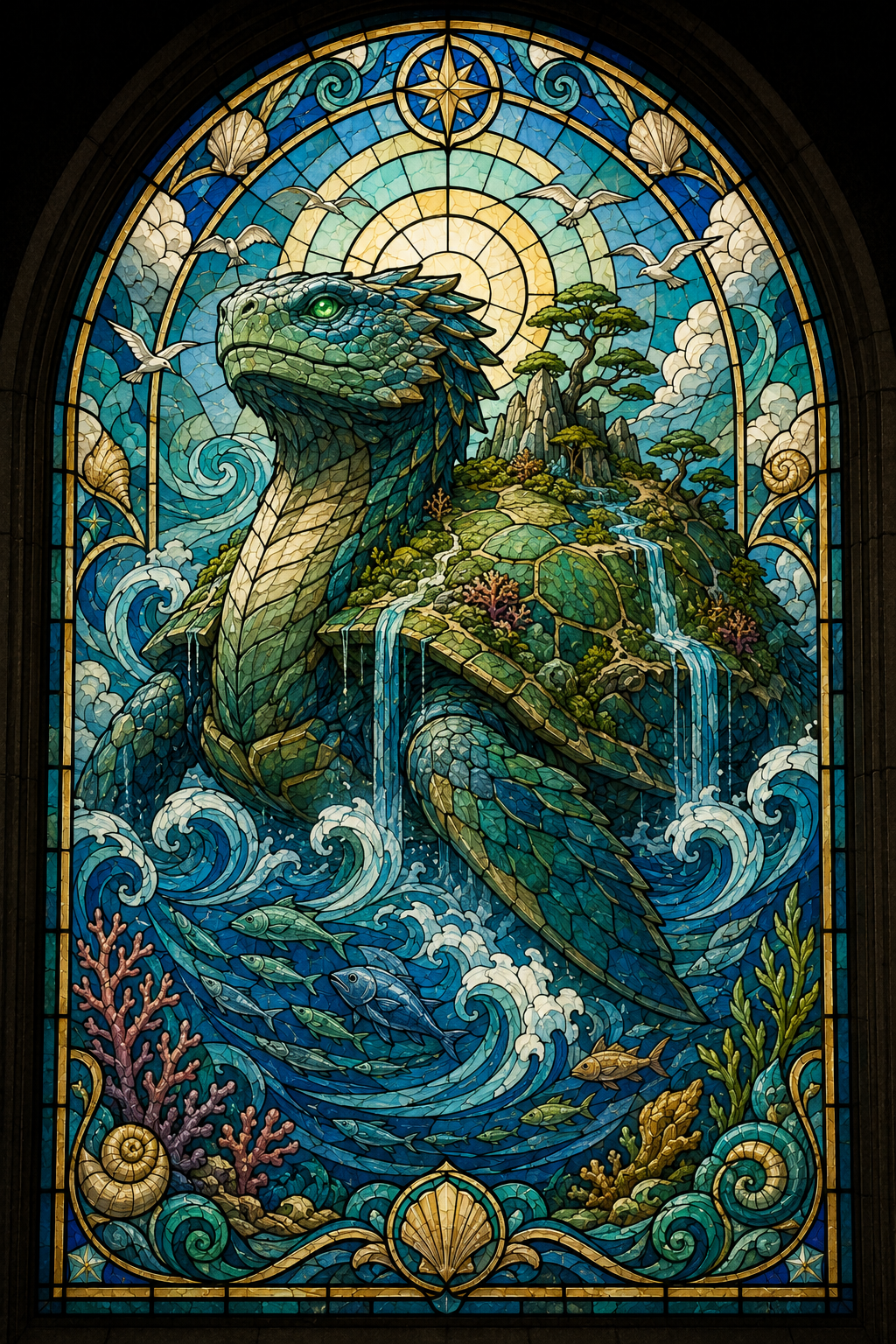
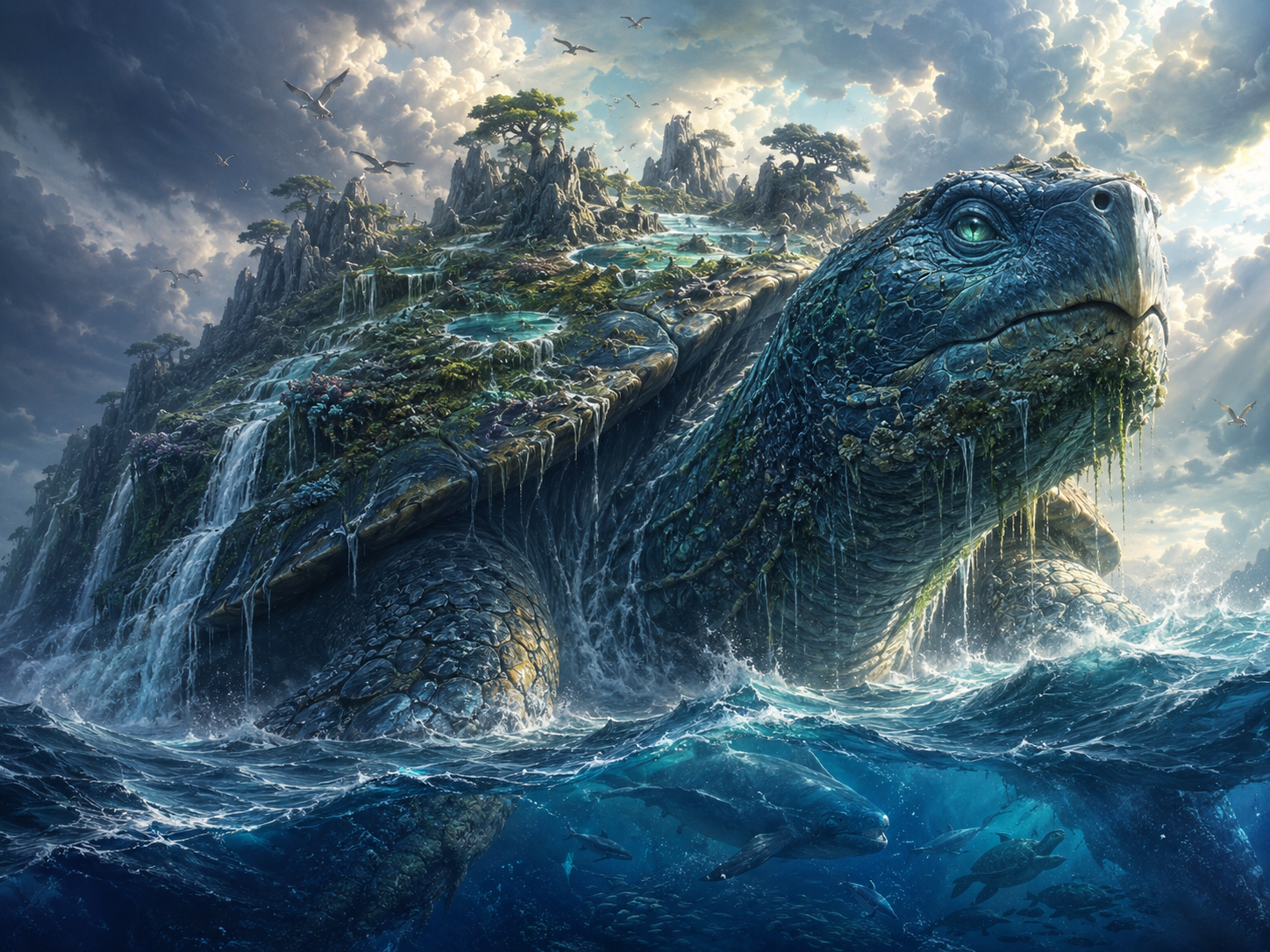
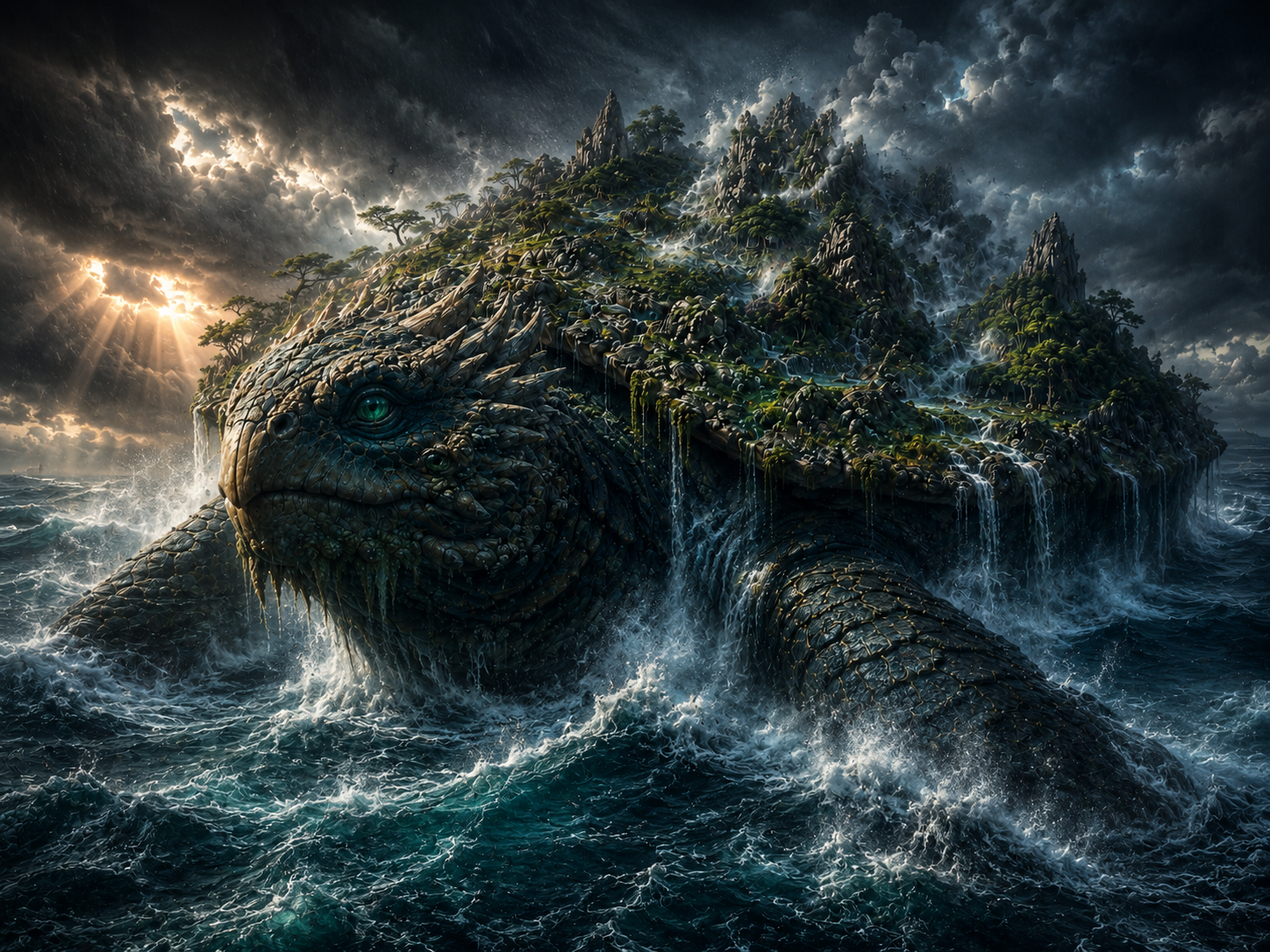
Sedarr most commonly appears as an immense dragon turtle of impossible size, so vast that entire forests, reefs, and freshwater springs grow upon his shell. In many ancient myths, sailors unknowingly landed upon his back believing it to be an island, only to awaken the slumbering god when they lit their campfires.
His shell resembles a weathered coastline, covered in moss, coral, and hardy trees bent by sea winds. Waterfalls spill from its edges into the sea below, and seabirds nest among its rocky ridges. His head is broad and ancient, with scales the color of deep ocean waters and eyes of sea-green that shine like sunlight beneath the waves.
When Sedarr rises from the depths, entire fleets have mistaken him for a moving continent. Though capable of terrible wrath, there is an undeniable gentleness to his presence, like the calm of a sheltered bay at low tide.
To behold him is to understand the age, vastness, and enduring patience of the sea itself.
Preferred Forms
- An island-sized dragon turtle whose shell bears reefs and forests.
- A colossal sea turtle carrying an entire ecosystem upon its back.
- A massive sea serpent swimming through the deepest oceans.
- A broad-shouldered sailor of indeterminate race, weathered by wind and salt.
Avatar Forms
- An elderly fisherman mending his nets upon a pier.
- A weathered sailor with salt in his beard and a knowing smile.
- A lighthouse keeper who always seems to know when the tide is about to turn.
- A wandering triton carrying a lantern and a conch shell.
- An old captain who knows every reef, current, and hidden shoal.
Identifying Characteristics
- The scent of salt and sea air accompanies him wherever he appears.
- Seabirds and marine creatures are unnaturally calm in his presence.
- His eyes possess the shifting colors of shallow tropical waters.
- Shells, coral, and small barnacles often grow upon his body or clothing.
- The sound of distant waves can sometimes be heard when he speaks.
- Sea turtles instinctively gather nearby.
- His footprints briefly fill with seawater, even far inland.
- During moments of strong emotion, the rhythmic sound of crashing surf seems to echo around him.
Divine Symbols & Iconography
- A spiral wave.
- An island resting upon the back of a great turtle.
- A sea turtle carrying a coral reef.
- Concentric circles spreading across calm water.
- A shell enclosing a pearl.
- A lighthouse standing against the sea.
- Fish swimming in a great circular current.
Divine Nature
Origins
Sedarr was born when Tuulla reshaped Andórë and called forth her first children to help guide the great forces of the young world. As Usjunn tended the renewal of life and Oxdros opened the skies, Sedarr descended into the vast oceans and gave order to their hidden motion. The tides began to breathe. The currents found their paths. Fish, whales, turtles, coral, and countless stranger things filled the deep places of the world.
In the earliest age, Sedarr did not create the sea so much as teach it how to live. He guided the flow of nutrients through the waters, carried life from coast to coast, and guarded the creatures that made their homes beneath the waves. Where mortals later saw only danger, Sedarr saw a living body of currents, migrations, feeding grounds, spawning seasons, reefs, trenches, and fragile balances.
During the Primordial Age, Sedarr stood with the Divine Alliance against the elemental titans. He commanded the aquatic forces at the Battle of Elemental Convergence and later faced Pyrothar, the Eternal Blaze, answering the titan's fire with the full force of the sea.
Divine Disposition
Sedarr is ancient, patient, protective, and slow to forgive arrogance.
He is not easily impressed by mortal confidence, especially when that confidence involves poorly built boats, reckless fishing, overloaded ships, ignored weather signs, or the belief that prayer can replace basic seamanship.
Despite this, Sedarr is not cruel. His nature is guardianship: the preservation of the sea, its creatures, and those who have learned to live within its limits. His irritation comes not from contempt, but from the endless repetition of mortal arrogance before a force they cannot command.
His anger is slow to rise but immense when awakened. Sedarr may tolerate foolishness, arrogance, and ignorance for a time, but he does not tolerate exploitation, waste, or needless harm to the living sea.
Sedarr's moods are vast and difficult to predict because the sea itself is vast and difficult to predict. A current may hold steady for a century, then shift away from a harbor that depended upon it. Fish may return to the same waters for generations, then vanish when the reef is poisoned or the balance of the deep changes. Mortals often read such turns as sudden, emotional, or wildly disproportionate. Sedarr's faithful understand them as the sea answering according to its own living rhythms.
Morality & Philosophy
Sedarr believes the sea is neither enemy nor servant.
It is a living force, older and greater than mortal ambition, and it must be respected as such. Mortals may sail upon it, fish from it, dive beneath it, and build their homes beside it, but they do not own it.
To Sedarr, survival depends upon humility. The wise sailor studies the tides. The wise fisher takes only what the shoal can spare. The wise ruler does not treat the sea as a road, a mine, or a dumping pit.
He does not promise safety. The sea is not safe. It is generous, dangerous, beautiful, indifferent, and alive.
Mortals often mistake the sea's indifference for judgment. A reckless child may survive the surf while a proud captain vanishes beneath calm waters. A poor village may draw fish from generous shoals for seven seasons, only for the currents to shift and leave their nets empty. Sedarr's faithful believe his mercy is real, but not dependable in the way mortals wish it to be. It moves through tides, currents, migrations, instincts, dreams, and omens, not through open intervention. Like the sea, he gives, withdraws, shelters, and destroys according to rhythms too vast for mortal law.
Sedarr's philosophy can be summarized simply:
The sea will provide, but it will not be commanded.
Divine Goals & Aspirations
- To keep the oceans alive, changing, and unconquered.
- To guide the tides, currents, migrations, and hidden rhythms of the sea.
- To protect marine life from needless destruction.
- To teach mortals humility before forces greater than themselves.
- To watch over those entrusted to the sea, even when they make that difficult.
Virtues
- Patience
- Endurance
- Stewardship
- Vigilance
- Restraint
- Practical wisdom
Flaws & Limitations
- Exasperation
- Stubbornness
- Slow to explain himself
- Prone to letting consequences teach what warnings did not
- Protective to the point of possessiveness
- Unmoved by mortal entitlement
- Prone to sudden, disproportionate responses
Favored Virtues
- Respect for the sea.
- Care for those under one's protection.
- Skill earned through experience.
- Taking only what is needed.
- Courage tempered by caution.
- Patience in the face of vast forces.
Abhorred Vices
- Wastefulness
- Needless cruelty
- Arrogance before nature
- Exploitation of the vulnerable
- Abandoning those in peril
- Treating the sea as property
- Certainty before the unknown
Speech & Mannerisms
Sedarr speaks slowly, deeply, and with the weight of tides moving beneath the world. His voice is rarely loud, but it carries like sound across open water.
He often answers questions with weary patience, as though explaining a truth that should have been obvious. When irritated, he becomes blunt rather than wrathful. When truly angered, his silence is more frightening than any shout.
In mortal guise, Sedarr often appears as an old sailor, fisherman, or lighthouse keeper who gives practical advice no one wants to hear until it is too late. He favors warnings, dry observations, and long pauses filled with the distant sound of waves.
At times, Sedarr seems to answer questions that were not asked, or refuses to answer questions whose answers seem obvious to him. His thoughts follow the paths of currents rather than roads, circling back after long silences or changing direction without warning. Those who speak with him often leave with advice they did not seek and warnings they do not understand until much later.
He does not posture. He does not boast. He has no need to.
The ocean is already behind him.
Quotes & Catchphrases
"The tide was not late. You were early."
"I did not sink your ship. You sailed it where it should not have gone."
"The wind is Phohella's. The storm is Oxdros's. The reef was plainly marked."
"Take what you need. Leave enough for tomorrow."
"The sea forgives many things. It does not forget them."
"A calm sea is not a harmless one."
"If you must test the deep, at least learn to swim first."
"I guard the sea. I do not make it convenient."
"The sea does not owe you the same answer twice."
"I warned your grandfather. That was recent enough."
"Mercy is not a schedule."
"The current changed. So should you have."
Divine Relationships
Family
Sedarr is one of Tuulla's first three children, born alongside the great shaping powers of Andórë's natural world. Where Usjunn tends renewal and Oxdros opens the restless sky, Sedarr keeps the seas, tides, currents, and the countless lives hidden beneath the waves.
To Sedarr, Tuulla is the first shore: the boundary that gives the sea meaning without making it small. Her law is not a chain to him, but the coastline against which his tides may speak. He observes the limits placed upon divine intervention because a sea without shores is not freedom, but ruin.
Sedarr and Usjunn are joined by the cycle of renewal. Rivers feed the sea, the sea feeds clouds, and the turning of water sustains the return of life. Their kinship is not sentimental, but ecological: spring depends upon water in motion, and the sea depends upon life returning to it.
Sedarr and Oxdros are bound by the meeting of sea and sky. Their domains touch constantly, and mortals often confuse one for the other. Oxdros brings storms and thunder; Sedarr bears the waters beneath them. This overlap creates tension between neighboring powers, not rivalry.
Allies
Sedarr's closest allies are Usjunn, Phohella, and Chulios.
Sedarr and Usjunn are allied through the renewal of life. Spring rain, river floods, spawning seasons, thawing waters, and returning migrations all join their domains. Usjunn brings renewal upon the land, while Sedarr bears the waters that carry life outward and receive it back again.
Sedarr and Phohella are allied through the meeting of wind and sea. Phohella's winds move over Sedarr's waters, stirring waves across the surface while his deeper currents continue their older paths below. Their domains are often mistaken for one another by mortals, which Sedarr endures with visible patience and private irritation.
Sedarr and Chulios are allied through the preservation of living things. The sea is not empty water, but a vast body of life: fish, turtles, whales, coral, kelp, mollusks, unseen deep creatures, and entire hidden ecosystems. Chulios's concern for life and Sedarr's guardianship of marine abundance naturally reinforce one another.
Rivals & Enemies
Sedarr has no formal rivals or enemies.
This does not mean he is agreeable, gentle, or easy to satisfy. The sea does not need enemies in order to be dangerous. Sedarr may clash with other gods when their domains brush against his, especially when mortals confuse sky, wind, storm, wave, tide, and current. Yet these tensions are not true rivalries.
Oxdros is not Sedarr's enemy. Phohella is not Sedarr's rival. Storms, winds, and waves may trouble the sea, but they are part of the larger natural order. Sedarr's irritation usually falls not upon the gods themselves, but upon mortals who blame him for powers outside his charge.
Relationships with Other Gods
Sedarr's place among the gods is defined by proximity rather than politics. He is one of Tuulla's first children and one of the great natural powers that helped shape Andórë into a world capable of sustaining life.
He is not especially concerned with divine courts, hierarchies, or disputes beyond his domain. The sea does not campaign. It surrounds, receives, erodes, nourishes, and endures.
Among the pantheon, Sedarr is regarded as ancient, difficult to move, and difficult to argue with. He listens longer than he speaks, and when he does speak, his judgments tend to arrive like tides: slow, inevitable, and inconvenient to those who expected a different answer.
The gods understand that Sedarr's patience is vast, but not infinite. He does not claim authority over the wind, the storm, the hearth, the harvest, or the dead. But when the sea, its creatures, its currents, or its ancient balances are treated as lesser things, Sedarr becomes immovable.
Relationships with Mortals
Sedarr is one of the gods most commonly invoked by those who live near the sea, though not always accurately.
Sailors pray to him for safe passage. Fisherfolk thank him for full nets. Navigators look to his tides and currents. Coastal communities honor him at harbors, reefs, lighthouses, and places where the sea gives life or takes it away.
Sedarr accepts such prayers with long patience, but he is famously weary of mortals who blame him for every danger upon the water. Wind belongs to Phohella. Storms belong to Oxdros. A badly maintained ship belongs to its captain. A reef marked on every chart is not an act of divine malice.
Among sailors, this has produced several common sayings:
"Do not blame Sedarr for Oxdros's thunder."
"The tide warned you. The wind betrayed you. The captain ignored both."
"Sedarr keeps the sea. He does not steer your ship."
Sedarr's faithful believe his presence is read through tides, currents, migrations, dreams, omens, and the instincts of sea creatures. A strange current, a turtle beside a boat, a sudden absence of fish, an exposed reef, or a pod of whales changing course may be understood as signs of his attention.
He does not promise safety. The sea remains dangerous because the sea is itself. Sedarr's faith teaches mortals to respect that danger, to prepare honestly, to protect those entrusted to them, and to stop mistaking survival for mastery.
Worship & Faith
Worshippers
Sedarr is worshipped by those whose lives depend upon the sea. Sailors pray to him before voyages, fisherfolk honor him before and after the catch, and navigators look to his tides and currents when charting safe passage. Coastal communities often keep his small shrines near docks, harbors, fish markets, and seawalls, not because they believe the sea can be made harmless, but because they know it must be respected.
Among merfolk and tritons, Sedarr is honored as the guardian of the deep places, the keeper of currents, and the divine patron of the living sea. His worship is rarely ornate. It is practical, habitual, and often quiet: a word before launching a boat, a shell left beside the tide, a first catch returned to the water, or a lantern lit for those who have not come home.
Major Cults
Sedarr has no major cults. His faith does not gather easily into great temples, rigid hierarchies, or centralized movements. The sea is too wide, and those who serve it are too scattered.
Instead, his worship is local. A fishing village, a harbor district, a triton enclave, or a ship's crew may each preserve its own customs. These traditions differ from coast to coast, but all share the same basic understanding: Sedarr is not a god to be commanded. He is honored through respect, restraint, preparedness, and care for the sea's living abundance.
Holy Books & Codes
The primary holy text of Sedarr's faith is the Songs of the Deep. It is less a single fixed scripture than a collection of sea songs, prayers, warnings, tide-lore, fishing wisdom, mourning chants, and stories passed between sailors, fisherfolk, merfolk, and tritons.
Some copies are written as books. Others are memorized as songs. In coastal villages, fragments of the Songs of the Deep may be known by children before they can read. Among people who live beneath the waves, portions are preserved in older forms: shell-carving, coral markings, whale-song, and ritual chant.
The Songs of the Deep teach that the sea gives life, but never submits to ownership.
Tenets of Faith
- Respect the sea and its creatures.
- Take only what you need.
- Endure the changing tides.
- Protect those entrusted to your care.
- Accept that not all things can be controlled.
Sedarr's tenets are practical rather than ceremonial. His faithful are expected to treat the sea as living, dangerous, generous, and finite. Waste is condemned. Arrogance is foolish. A captain is responsible for crew and vessel. A fisher is responsible for the waters that feed them.
The last tenet is often considered the hardest. Sedarr's faithful do not believe every danger can be prevented, every current mastered, or every life saved. The sea is not safe because Sedarr is worshipped. Worship teaches mortals how to live with what cannot be fully controlled.
Holidays & Holy Days
Winter Solstice is sacred to Sedarr in many coastal communities. On the longest night of the year, the faithful remember the depth, darkness, and endurance of the sea. Offerings are made for safe returns, steady hands, wise captains, and those lost beneath black water.
Blessing of the Fleet is observed before the beginning of a major fishing or sailing season. Boats are cleaned, repaired, marked with Sedarr's spiral wave, and blessed before they leave harbor. The rite is as practical as it is sacred. A blessing over a neglected ship is considered hollow, and a priest who fails to warn a crew of obvious danger has misunderstood Sedarr entirely.
Sacred Sites
Sedarr's sacred sites are places where the sea shelters, warns, feeds, or endures.
Natural harbors are holy because they offer refuge without removing the danger of the sea. They are places of return, repair, and survival.
Ancient lighthouses are sacred because they embody guardianship without control. A lighthouse does not calm the storm or move the reef. It simply shines, warning those wise enough to heed it.
Coral reefs are among Sedarr's most revered sites. They are living cities of the sea: fragile, abundant, dangerous, and beautiful. To harm a reef through greed or carelessness is considered a serious offense against Sedarr.
Religious Practices
Sedarr's worship is woven into the routines of sea life. Sailors touch seawater before boarding. Fisherfolk return a portion of the first catch. Navigators mark favorable currents with brief prayers. Coastal families light lamps for ships expected home.
Before voyages, prayers to Sedarr are often paired with inspection. Ropes are checked, hulls examined, charts reviewed, and provisions counted. His faithful commonly say that Sedarr has little patience for those who ask the sea for mercy while refusing to mend their sails.
Offerings are usually simple: shells, clean water, carved driftwood, fish bones, pearls, sea glass, or songs sung at the edge of the tide.
Forbidden Acts
Sedarr's faith forbids acts that treat the sea as lifeless, limitless, or beneath mortal responsibility.
- Needlessly despoiling the sea.
- Slaughtering marine life for sport.
- Polluting rivers or oceans.
- Abandoning those in peril upon the water.
- Taking more than can be replenished.
Of these, abandonment is often treated as the most shameful among sailors. The sea is dangerous enough without mortals becoming cruel upon it.
Pollution and waste are also grave offenses, for they poison not only the water, but the countless lives hidden within it. Sedarr's faithful believe the sea can endure much, but endurance is not permission.
Divine Realm
Home Plane
Sedarr dwells upon Zephyrion, the divine plane of Tuulla and her first children. Zephyrion is a realm of wild natural beauty, divided among the divine domains of Tuulla, Usjunn, Oxdros, Sedarr, and Phohella. Within that plane, Sedarr's portion is the Abyssal Depths, an endless ocean beneath the waves, filled with mystery, danger, coral reefs, ancient ruins, and life beyond mortal counting.
Sedarr's presence in Zephyrion explains the scale of his favored form. Upon Andórë, an island-sized dragon turtle would be a catastrophe merely by existing. In the Abyssal Depths, such vastness is natural. The realm is large enough for Sedarr to drift through its endless waters like a living continent, carrying reefs, forests of kelp, seabirds, turtles, springs, and entire ecosystems upon his shell.
Realm
Sedarr's realm is the Abyssal Depths, a vast underwater kingdom of endless oceans, deep trenches, twisting canyons, coral forests, sunken ruins, bioluminescent life, and powerful currents. It is beautiful, but not safe. Its waters are full of shimmering fish, ancient sea turtles, giant sea serpents, coral reefs, forgotten wrecks, and things that have never seen the sun.
Unlike mortal kingdoms, the Abyssal Depths are not ruled from a single throne in any ordinary sense. Sedarr is not a king sitting above the sea; he is the guardian presence moving through it. Sailors and priests sometimes speak of a palace at the heart of the depths, but older traditions describe it less as a court and more as a place where the sea gathers around Sedarr when he chooses to be still.
In myth, this resting place is said to form upon and around Sedarr himself. Coral grows along the ridges of his shell. Pearl-lit caverns open beneath ancient plates of scale. Kelp forests sway from cliffs that are not stone, and deep currents circle him like slow, breathing walls. Those who mistake his stillness for an island, a reef, or a sunken mountain rarely understand what they have found until the whole horizon begins to move.
The Abyssal Depths reflect Sedarr's nature. They are protective and perilous, abundant and indifferent, sheltering and unknowable. A calm lagoon may open into a trench without bottom. A reef may feed a thousand species while tearing open the hull of an arrogant ship. A current may guide the lost home or pull the careless into darkness. Nothing in Sedarr's realm exists for mortal convenience.
Inhabitants
The Abyssal Depths teem with marine life. Schools of fish move through its waters in shining clouds, whales sing across impossible distances, ancient sea turtles drift through coral forests, and giant squid, sharks, sea serpents, and leviathans patrol the deep. Bioluminescent creatures illuminate the darkest trenches, while coral reefs support entire living cities of fish, crustaceans, mollusks, and stranger beings.
Merfolk, tritons, sea elves, and other aquatic peoples are sometimes said to dwell in the safer reaches of the realm, though even they treat the Abyssal Depths with caution. No one truly masters Sedarr's ocean. At most, they learn its moods, its routes, its warnings, and the places where it is wise not to go.
The spirits of the drowned and forgotten are also associated with the Abyssal Depths. Some are said to linger near sunken ruins, shipwrecks, and deep trenches, not as prisoners of Sedarr, but as remnants of lives claimed by water and memory. Sedarr does not delight in them, nor does he gather them as trophies. They are part of the sea's sorrow, and the sea does not forget.
Among all inhabitants of the realm, dragon turtles hold a special place. They are not merely monsters of the deep, but living echoes of Sedarr's own favored manifestation. Their arrogance is therefore unsurprising. Each bears, in miniature, the shape of the God of the Sea: shell, scale, patience, wrath, and the ancient certainty that smaller creatures should learn to move aside.
Artifacts & Relics
Divine Artifacts
Sedarr is not commonly associated with crafted divine artifacts.
Unlike gods who bear weapons, crowns, instruments, or tools as signs of office, Sedarr's power is embodied in his own vastness. He does not carry the sea's authority. He is one of its oldest and most terrible expressions.
The greatest objects associated with Sedarr are not weapons, but remnants and signs left in the wake of his passing.
Sailors speak of island-sized scales shed from his shell, pearls formed in caverns beneath his living armor, stones worn smooth by currents that have circled his body for ages, and fragments of coral grown upon him in the Abyssal Depths.
Such objects are rarely understood as things Sedarr made for mortal use. They are pieces of proximity: matter that has endured near the God of the Sea long enough to remember him.
Holy Weapons
Sedarr has no holy weapon.
This absence is central to his iconography. He is not depicted with a trident, spear, harpoon, blade, or scepter, for such things would diminish him.
Sedarr is the weapon.
He is the crushing depth, the turning current, the living reef, the shell that can bear forests, and the ancient force that once stood against a primordial elemental titan.
When Sedarr battles, he does not arm himself. The sea moves with him.
Among his faithful, this has become a point of doctrine. A weapon blessed in Sedarr's name is not holy because it kills, but because it protects those entrusted to its bearer.
Harpoons, knives, spears, and shipboard axes may be blessed for necessity, but never as symbols of divine conquest.
A sailor who claims to wield "Sedarr's weapon" is usually answered with the old correction:
"Sedarr's weapon is Sedarr."
Relics of the Faith
Relics of Sedarr's faith are simple, weathered, and practical.
Most are not grand treasures, but objects that have survived long service beside the sea.
Common relics include shells carried through many voyages, fragments of ancient lighthouse glass, tide-smoothed stones from sacred harbors, pieces of coral from reefs long protected by the faithful, carved driftwood marked with the spiral wave, and old ship bells recovered from wrecks where at least some of the crew survived.
Sea turtle shell fragments are treated with special reverence, but only when found naturally. To kill a sea turtle for a relic is a desecration, not an offering.
The most honored relics are those associated with guardianship: a lantern that guided ships home for generations, a net used to save drowning sailors, a chart that marked a deadly current, or a weathered plank from a vessel that carried its crew safely through impossible waters.
Sedarr's faithful do not value such objects because they are beautiful.
They value them because they endured, warned, sheltered, or preserved life when the sea was at its most dangerous.
History
Creation & Early History
Sedarr came into being during the earliest shaping of Andórë, when Tuulla broke the world's tidal lock, gave it seasons, and called forth Usjunn, Oxdros, and Sedarr to help make the young world hospitable to life. Usjunn tended renewal, Oxdros opened the skies, and Sedarr took charge of the seas, tides, currents, and the life that would spread through the waters.
In those first ages, Sedarr's work was not the command of a ruler over subjects, but the guidance of a living system into motion.
The tides began their long breathing.
The currents found their paths.
Nutrients and organic matter moved through the oceans, feeding the creatures of the sea and helping life spread across the young world.
Sedarr's earliest myths describe him as vast even then: not a king upon a throne, but a divine presence moving beneath the water, shaping the deep places by existing within them.
Major Deeds
Sedarr's greatest deeds belong to the Primordial Age, before Tuulla's law forbade direct divine interference in mortal affairs.
During the war against the primordial elemental titans, Sedarr stood as a member of the Divine Alliance. At the Battle of Elemental Convergence, he commanded the aquatic forces while Oxdros led the aerial assault, joining the other gods in the struggle to deny the titans dominion over Andórë.
His most famous deed was his battle against Pyrothar, the Eternal Blaze.
In that battle, Sedarr did not bear a spear, trident, or blade. He met the titan as the sea itself: crushing depth, endless water, smothering current, and world-shaping tide.
Pyrothar scorched the land with rivers of lava and walls of flame, but Sedarr answered with the full force of the ocean. Steam covered the battlefield as fire and water met. With one final, monumental wave, Sedarr extinguished the Eternal Blaze and bound him within the plane of fire.
This victory is the root of many Sedarran teachings. The sea does not need a weapon.
The sea is the weapon.
Intervention in Mortal Affairs
Sedarr does not directly intervene in mortal affairs.
Like the rest of the gods of Andórë, he is bound by Tuulla's law. The age when gods openly reshaped the world, fought titans upon its surface, and acted directly upon mortal fate has passed. Sedarr may be invoked, honored, misunderstood, blamed, praised, or cursed, but he does not descend to steer ships, drown captains, fill nets, or calm storms by divine command.
His faithful instead look for his presence in the natural language of the sea:
- A strange current.
- A turtle beside a boat.
- A sudden absence of fish.
- A reef exposed at low tide.
- A dream of black water.
- A whale turning from its course.
Such signs are interpreted as omens, warnings, or reminders, but not as proof that Sedarr has broken divine law. The sea remains itself. Mortals are responsible for learning how to live with it.
This distinction is especially important to Sedarr's worship. Storms belong to Oxdros. Wind and waves belong to Phohella. Rotten hulls, bad charts, overloaded ships, and arrogant captains belong to mortals.
Sedarr keeps the sea.
He does not steer the ship.
Current Circumstances
In the present age, Sedarr remains in the Abyssal Depths of Zephyrion, where his true vastness can exist without shattering the mortal world by proximity.
He is still honored by sailors, fisherfolk, navigators, coastal communities, merfolk, and tritons. His shrines endure in harbors, lighthouses, fishing villages, reefs, and places where mortals must remember that the sea is neither enemy nor servant.
Since the gods no longer act openly in mortal affairs, Sedarr's influence is understood through faith, tradition, natural signs, and the enduring rhythms of the ocean.
The tides continue.
The currents move.
The fish migrate.
The reefs grow and break.
Ships depart, ships return, and some do not.
Sedarr's faithful believe he remains aware of all of it, ancient and patient beyond mortal comfort, while mortals pray to him for mercy and ignore the chart, the tide, the reef, the wind, and the warning they were already given.
Representation & Legacy
Cultural Importance
Sedarr is not among the most widely worshipped gods of Andórë. Inland peoples may know his name, recognize his spiral wave, or invoke him in poetry about the sea, but few give him regular devotion unless their lives depend upon the water.
Among sailors, fisherfolk, navigators, coastal communities, merfolk, and tritons, however, his worship is deep and enduring. Those who truly honor Sedarr do so with the seriousness of people who understand that the sea is not an abstraction. It is food, road, grave, border, refuge, danger, and home.
His faithful rarely speak of him as a distant god of grandeur. They speak of him as the old guardian beneath the water, patient beyond mortal understanding and visibly tired of mortal arrogance. To them, Sedarr is not prayed to because he makes the sea safe. He is honored because he teaches that the sea was never safe, and that survival begins with humility.
Symbolism
Sedarr symbolizes the living sea: vast, ancient, generous, dangerous, and impossible to command.
His spiral wave represents tides, currents, return, and the sea's refusal to move in straight lines for mortal convenience. It is painted on ships, carved into docks, etched into lighthouses, and marked onto fishing tools as a reminder that every voyage depends upon forces older than any sailor.
The sea turtle is his most sacred animal, embodying endurance, patience, migration, and guardianship. In regions where dragon turtles are known, they are often treated with a mixture of awe, terror, and theological discomfort. Their shape recalls Sedarr's own favored manifestation, and their arrogance is sometimes interpreted as the natural consequence of being made in the image of the God of the Sea.
Lighthouses are also strongly associated with Sedarr. They do not command the sea, calm the storm, or move the reef. They warn. In this, they are among his clearest mortal symbols: guardianship without control.
Legacy
Sedarr's legacy is carried less by temples than by habits.
A captain checking the hull before departure.
A fisher returning part of the first catch.
A navigator waiting for the proper tide.
A coastal village refusing to overharvest a reef.
A lighthouse keeper maintaining the flame through a black winter night.
These acts preserve Sedarr's faith more faithfully than grand monuments ever could.
His influence also lingers in the language of sailors, especially in sayings that separate his domain from those of Oxdros and Phohella. Sailors who know the old ways do not blame Sedarr for every storm, gust, or broken mast. They know the difference between wind, wave, tide, current, reef, and mortal stupidity.
In the long memory of Andórë, Sedarr endures as the old guardian of the sea: not gentle, not cruel, not convenient, and not tame. His worshippers are fewer than those of many gods, but they are among the most faithful, because they do not come to him through doctrine alone.
They come to him because they have stood on a deck at night, heard the water moving beneath them, and understood how small they are.
Notes
- Though Sedarr is granted the Tempest domain by clerics, his divine charge is not storms in the sky. His tempest is the sea's own violence: undertow, surge, whirlpool, crushing depth, and current strong enough to break ships against stone.