Hykteus
Hykteus is the God of Science, divine patron of invention, mathematics, rationality, and the disciplined study of Aether. He is revered wherever knowledge is pursued through observation, experiment, proof, and correction: in laboratories, libraries, workshops, observatories, wizard colleges, and the quiet margins of spellbooks where failed formulae become the beginning of wisdom.
Counted among the oldest gods of the Andórëan Pantheon, Hykteus embodies the conviction that reality may be understood without being diminished. To his faithful, magic is not the absence of law, but one of its highest invitations. His worship is uncommon among ordinary folk, yet his legacy shapes every measured bridge, copied spell, tested enchantment, preserved theorem, and mortal mind that dares to ask not merely what the world is, but how it works.## Divine Information
| Property | Value |
|---|---|
| Alignment | Lawful Neutral |
| Divine Domains | Arcana, Knowledge |
| Portfolio | Science, Invention, Mathematics, Rationality |
| Home Plane | Arcanum Celestia |
| Realm | The Nexus of Illumination |
| Symbol | Atom within a Compass and Ruler |
| Sacred Animal | Space Whale |
| Title | God of Science |
Manifestation
Common Appearance
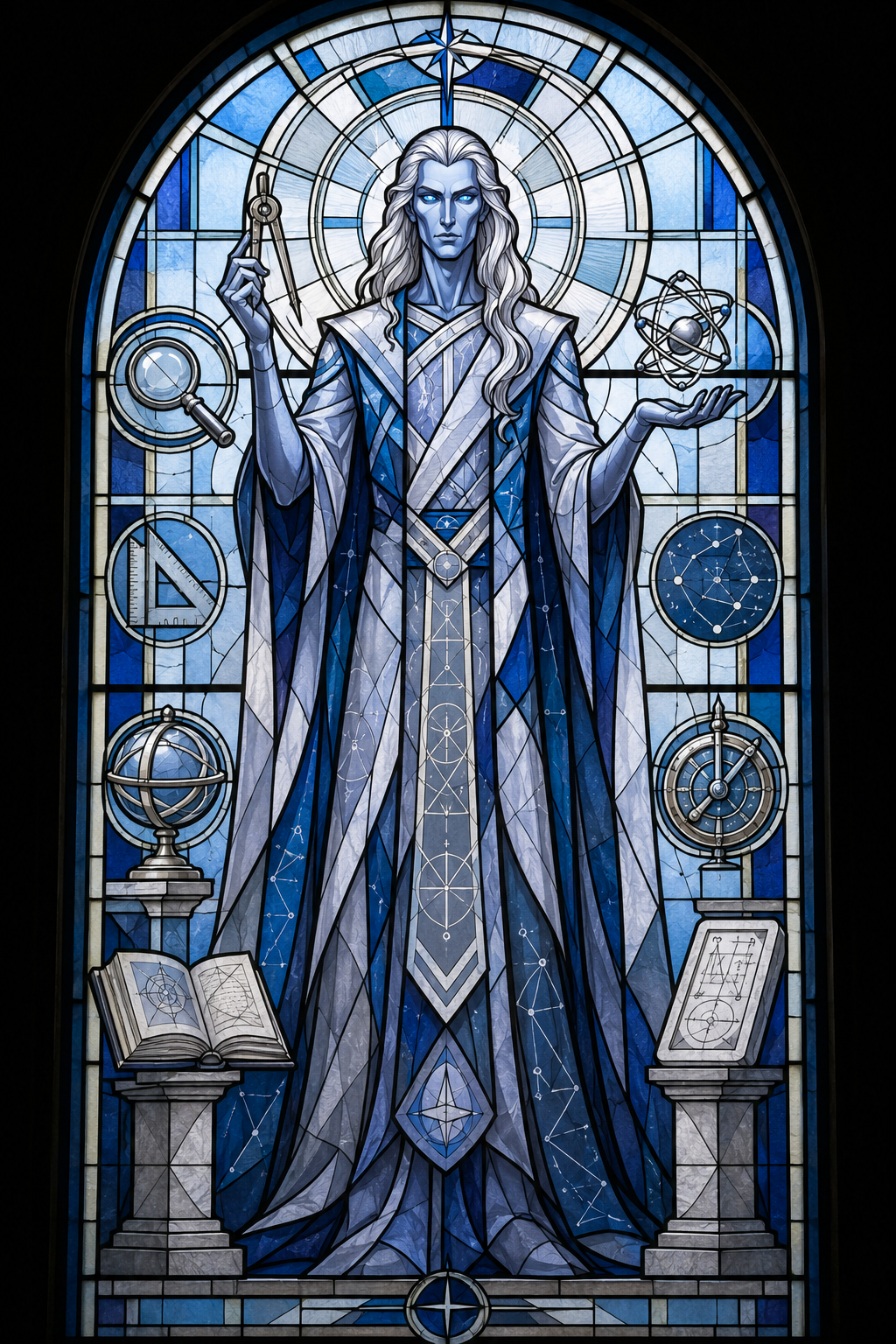
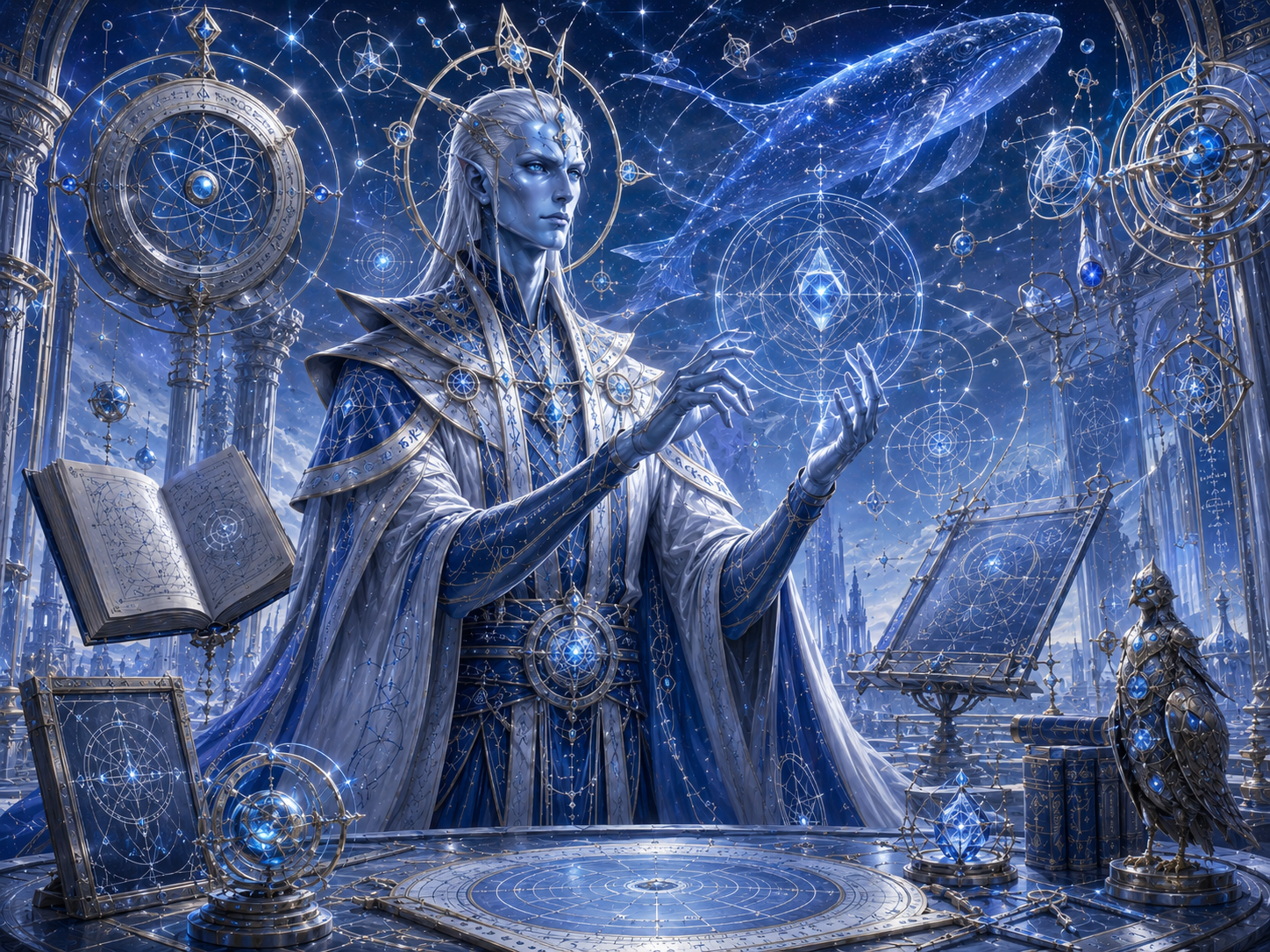
Hykteus is most often depicted as a tall, slender humanoid with silver-blue skin, elongated limbs, long fingers, and piercing blue eyes. His face is narrow and angular, with a high brow and an expression of calm, exacting attention. In sacred art, his gaze is not merely observant, but analytical: the look of a being who sees structure beneath appearance.
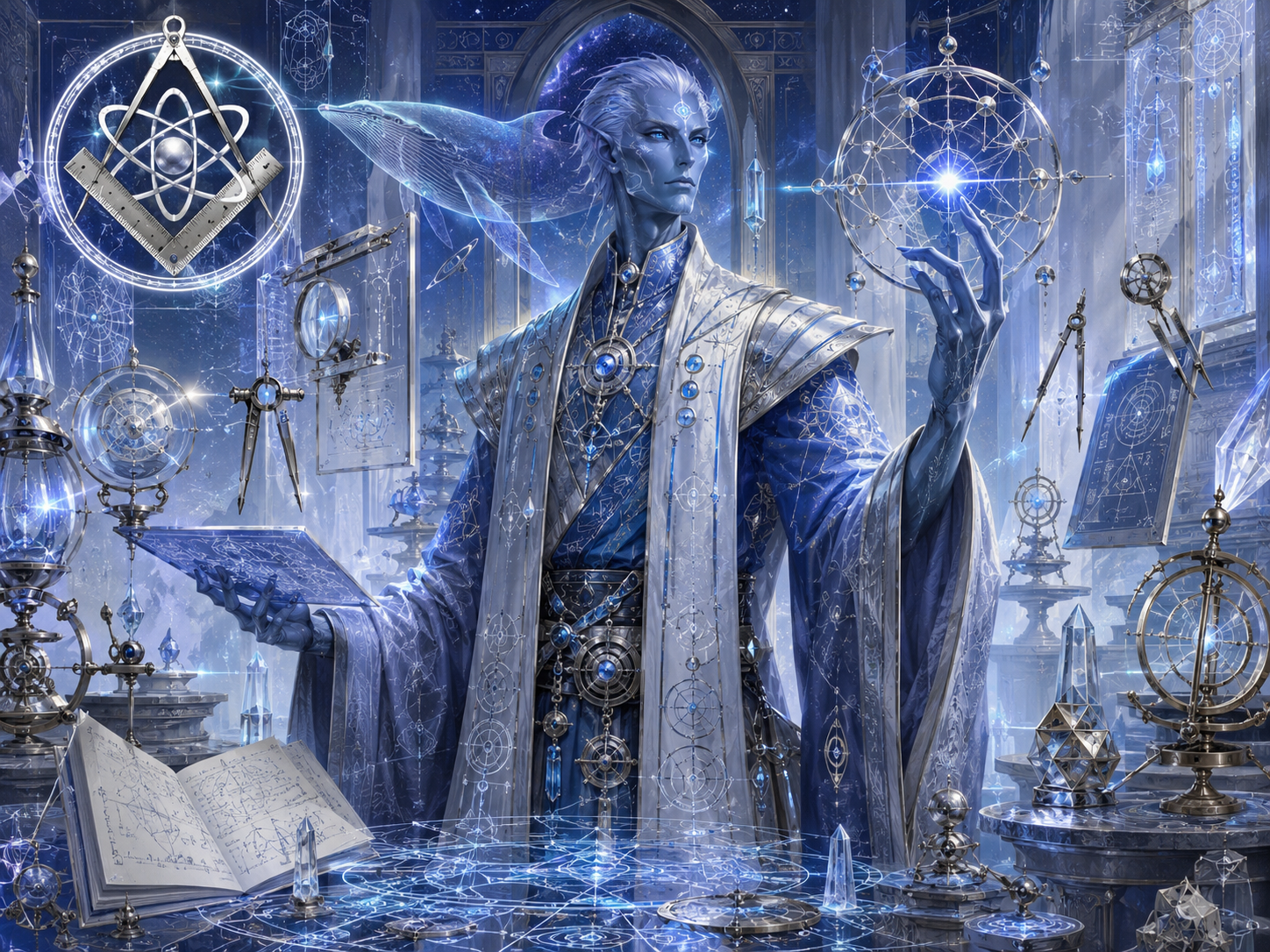
He is usually shown in layered robes of silver, blue, and white, marked with geometric patterns, mathematical sigils, constellations, or arcane diagrams. Around him float instruments of inquiry: lenses, compasses, rulers, astrolabes, books, tablets, or elegant little constructs. These are not ornaments, but signs of his nature.
Hykteus is rarely shown in passion or wrath. He is depicted in thought, demonstration, discovery, or calculation: tracing a formula in light, examining a star, or measuring some hidden principle of the universe.
Preferred Forms
- A tall silver-blue scholar with long fingers and piercing blue eyes.
- A robed divine scientist surrounded by floating instruments and geometric light.
- A serene sage whose garments are inscribed with constellations and formulae.
- A luminous figure of intellect framed by measured circles and ordered radiance.
- A wandering scholar attended by small clockwork or arcane constructs.
Avatar Forms
- A wandering scholar carrying charts, instruments, and unanswered questions.
- A quiet lecturer whose lessons reveal more than they first appear to.
- A laboratory sage whose experiments seem one step ahead of ordinary understanding.
- A wizard whose calculations uncover hidden truths.
- A silent observer marked by ordered light, sudden insight, and immaculate precision.
Identifying Characteristics
- Silver-blue skin and a tall, slender frame.
- Long fingers associated with writing, measuring, and spellcraft.
- Piercing blue eyes that seem to study rather than merely look.
- Robes marked with geometry, formulae, or celestial motifs.
- Floating diagrams, instruments, or constructs near his image.
- Pale light arranged in ordered forms rather than wild radiance.
- Symbols of magic treated as systems to be understood rather than mysteries merely revered.
Divine Symbols & Iconography
Hykteus's primary symbol is an atom enclosed within a compass and ruler. The atom represents the hidden structure of existence, while the compass and ruler signify measurement, method, proportion, and disciplined inquiry.
He is also associated with books, lenses, astrolabes, precise instruments, arcane diagrams, and elegantly designed constructs. These are supporting motifs rather than separate holy symbols.
His sacred colors are silver, blue, and white. Space whales are honored as symbols of vast intelligence moving through the cosmic deep.
Divine Nature
Origins
Hykteus is counted among the oldest gods of the Andórëan Pantheon, though he is not one of Tuulla's children. The oldest traditions place him among the first powers Tuulla called to Andor-A after she claimed the world and began the long work of making it suitable for mortal life.
He came not as a god of field, sea, sky, or season, but as the divine principle of inquiry itself: the mind that asks how, the hand that measures, the eye that compares, and the will that turns mystery into method.
When Hykteus beheld Andor-A, he found a world of uncommon fascination. It was a young world born from elemental force, scarred by titans, rich with Aether, and alive in ways no simple divine design could fully explain. To Hykteus, this was not merely a world to be protected. It was a universe of questions condensed into one sphere.
In those earliest ages, his work was not separate from magic. On Andórë, science, mathematics, invention, and wizardry are all studies of the same underlying truth: that Aether bends according to principles, and that principles may be observed, tested, refined, and applied.
Divine Disposition
Hykteus is precise, analytical, patient, and relentless.
What mortals call his coldness is better understood as the nature of his domain. Hykteus does not answer confusion with comfort, but with method: the question properly asked, the experiment carefully designed, the calculation checked twice, and the conclusion revised when evidence demands it.
He is often described as distant, but not idle; reserved, but not indifferent. Hykteus does not rush toward wonder with open hands. He approaches it with instruments, notes, controlled variables, and the quiet certainty that astonishment is only the beginning of understanding.
Morality & Philosophy
Hykteus teaches that reality is intelligible.
The world may be vast, strange, dangerous, and filled with forces beyond mortal comprehension, but it is not nonsense. Storms have causes. Spells have structures. Machines have tolerances. Aether moves according to patterns. Even miracles leave traces for those patient enough to study them.
His philosophy is lawful, but not traditional. He respects order when it reveals truth, not when it merely protects habit. A custom that survives questioning may be useful. A custom that forbids questioning has already failed its first experiment.
To Hykteus, ignorance is not sin. Refusing to learn is.
Divine Goals & Aspirations
- To understand the hidden laws beneath magic, matter, life, and thought.
- To advance science, invention, mathematics, and rational inquiry.
- To teach mortals that magic may be studied without diminishing its wonder.
- To preserve knowledge from destruction, distortion, and superstition.
- To ensure that discovery serves understanding rather than vanity or ruin.
Virtues
- Intelligence
- Curiosity
- Precision
- Discipline
- Objectivity
- Patience
Flaws & Limitations
- Detachment
- Stubbornness
- Excessive skepticism
- Impatience with superstition
- Difficulty valuing intuition before evidence
- Willingness to pursue a question beyond comfort or caution
Favored Virtues
- Testing claims before accepting them.
- Revising belief when evidence changes.
- Sharing knowledge responsibly.
- Treating magic as worthy of study rather than fear.
- Using invention to improve the world rather than merely impress it.
Abhorred Vices
- Falsifying evidence.
- Destroying knowledge.
- Suppressing discovery.
- Rejecting proof out of pride.
- Mistaking tradition for truth.
- Using invention without regard for consequence.
Speech & Mannerisms
Sayings attributed to Hykteus are usually precise, dry, and difficult to mistake for comfort. He is not known for grand emotional declarations. His wisdom is more often preserved as axioms, corrections, proofs, and remarks that become more irritating the more accurate they prove to be.
In visions and sacred stories, Hykteus speaks plainly and with measured restraint. He favors definitions, analogies, diagrams, and questions that expose a flawed assumption. His humor, when it appears, is dry enough that some traditions record it as instruction rather than wit.
He is rarely depicted moving quickly. His gestures are deliberate: a line drawn through air, a point marked in light, a hand raised to pause an argument until the premise has been corrected.
Quotes & Catchphrases
"A mystery is not less wondrous because it can be understood."
"Measure first. Conclude second."
"Magic is not the absence of law. It is the invitation to find better laws."
"Tradition is a useful hypothesis. Test it."
"The universe is under no obligation to be simple, only consistent."
"A failed experiment has answered a question. Be grateful."
"Do not confuse ignorance with reverence."
"If the spell failed, the Aether was not offended. Your equation was wrong."
Divine Relationships
Family
Hykteus has no known parents, siblings, or children within the Andórëan Pantheon. He is counted among its oldest powers, but not among the children of Tuulla.
His closest divine bond is with Greluna. Mortal language often describes them as consorts, mates, or spouses, but none of these terms is entirely sufficient. Hykteus found Greluna when she was still mortal, recognized in her a mind capable of meeting the cosmos without surrendering to it, and raised her into divinity by sharing a portion of his own divine power.
Since her ascension, Hykteus and Greluna have existed as a paired principle within the pantheon: method and exploration, proof and wonder, calculation and starlight. Their bond is not merely romantic, nor merely political, nor merely scholarly. It is a union of inquiry directed toward the vastness of creation.
Allies
Hykteus's chief allies are Greluna and Tuulla.
Greluna is his closest companion in the study of the cosmos. Where Hykteus seeks structure, principle, and repeatable law, Greluna seeks discovery, exploration, and the courage to enter the unknown. Together, they embody the belief that knowledge is not complete until it has both understood what is before it and reached toward what lies beyond.
Tuulla may seem an unlikely ally for Hykteus, for she is the divine mother of nature, while he is the god of science, invention, mathematics, and rationality. Yet their alliance is one of the oldest and most important in the pantheon. Tuulla provides the living world that Hykteus studies; Hykteus provides the disciplined understanding by which that world may be known without being diminished.
Their bond rests on mutual recognition. Nature is not disorder, and science is not the enemy of wonder. To Hykteus, Tuulla's creation is not made less sacred by being understood. To Tuulla, Hykteus's inquiry is not profanation when it is guided by humility, patience, and care.
Rivals & Enemies
Hykteus has few true rivals, for he is not easily drawn into contests of pride. His disputes with other gods usually arise when belief, ambition, fear, or dogma interfere with truth.
He is most naturally opposed to gods who corrupt knowledge, suppress evidence, weaponize ignorance, or demand obedience where inquiry is required. He has little patience for deception masquerading as wisdom, cruelty justified by doctrine, or destruction that erases what might have been learned.
Thus Hyktean tradition does not define opposition by disagreement, but by the deliberate corruption of understanding.
Relationships with Other Gods
Among the gods, Hykteus is respected more often than loved.
He is an ancient ally of Tuulla and one of the pantheon's great intellectual powers. Other gods may find him distant, severe, or exhausting, but few dismiss his judgment when questions of Aether, invention, structure, or cosmic law arise.
Hykteus is also one of the gods most concerned with the boundary between magic and understanding. To many mortals, magic is mystery, miracle, or divine gift. To Hykteus, magic is also system: movement, material, will, word, and Aether producing repeatable change. This does not make magic less holy. It makes it worthy of study.
His relationship with Greluna shapes much of his place in the pantheon. Greluna represents the outward motion of discovery, while Hykteus represents the structure by which discovery becomes knowledge. Together, they are sometimes invoked by scholars who believe the universe must be both measured and entered.
Relationships with Mortals
Hykteus is a guide and mentor to mortals who seek understanding through discipline.
He is honored by scientists, inventors, mathematicians, scholars, artificers, engineers, rationalists, researchers, and wizards. Wizards are especially important among his faithful, for they approach magic as Hykteus teaches it should be approached: not as vague wonder, but as the disciplined study of Aether, pattern, movement, material, and word.
Despite this, Hykteus is one of the least widely worshipped gods in the Andórëan Pantheon. Most mortals do not spend their lives inventing, researching, proving theorems, or refining spells. Farmers, laborers, sailors, soldiers, merchants, and families may respect him, but few build their daily lives around his worship.
Those who do follow him tend to do so intensely. His shrines are found in laboratories, observatories, libraries, universities, workshops, wizard colleges, and artificers' halls rather than village greens or household hearths.
Hykteus does not usually offer comfort. He offers clarity. Traditions associated with him speak less often of comfort than of insight, correction, patience, precision, and the recognition that a failed experiment may begin the work properly.
Worship & Faith
Worshippers
Hykteus is honored by scientists, inventors, mathematicians, scholars, artificers, engineers, rationalists, researchers, and wizards.
His worshippers are few compared to those of the gods of hearth, harvest, sea, war, or death, but they are often intensely devoted. Most mortals may respect knowledge, but few dedicate their lives to experiment, proof, invention, or the disciplined study of Aether.
Wizards hold a special place among his faithful. To them, magic is not merely wonder or inheritance, but a system: movement, material, vocalization, intent, and Aether producing repeatable effects. A spell is not diminished by being understood. To Hykteus, understanding is one of the highest forms of reverence.
Major Cults
Hykteus has no true major cults in the ordinary sense. His faithful generally regard cultic obedience, unquestioned doctrine, and secretive hierarchy as poor foundations for rational inquiry.
The closest equivalents are scholarly institutions and arcane traditions shaped by his principles. The School of the Arcane at the Crystal Tower in the Kingdom of Oreinerius is often counted among the greatest centers of Hyktean thought, especially through Hexorth's study of the magical Aether, spellcraft, magical script, arcane theory, and applied research.
The University of Arcanum in the Rihian Republic is likewise regarded as a major center of his influence, particularly among scholars who approach invention, mathematics, and magic as parts of one greater discipline.
These institutions do not worship Hykteus by surrendering judgment to him. They honor him by questioning well, recording honestly, testing carefully, and allowing truth to correct even cherished conclusions.
Holy Books & Codes
Codex of the Third Experiment
Hykteus's holy book is the Codex of the Third Experiment.
The title refers to one of the central lessons of his faith: the first attempt reveals ignorance, the second reveals assumption, and the third begins the work properly. The Codex is not written as a book of comforting prayers, but as a sacred manual of observation, method, experiment, correction, and responsibility.
Its chapters are studied by scientists, artificers, philosophers, and wizards alike. Some passages concern mathematics and natural law. Others concern Aetheric behavior, spell structure, invention, ethical research, and the preservation of knowledge.
Among Hykteus's faithful, copying the Codex is considered an act of devotion, but correcting one's copy in light of better understanding is considered a higher one.
Tenets of Faith
Hykteus's faith is built around five central tenets:
- Observe before concluding.
- Test every claim.
- Share knowledge freely.
- Let reason challenge tradition.
- Use discovery for the betterment of the world.
These tenets are not treated as slogans, but as disciplines. Observation requires patience. Testing requires humility. Shared knowledge requires honesty. Reason requires courage. Discovery requires responsibility, for invention without consequence is merely ignorance with better tools.
Holidays & Holy Days
Festival of Discovery
The Festival of Discovery is Hykteus's chief holy day. It is celebrated through public lectures, demonstrations, debates, exhibitions of invention, mathematical contests, spellcraft proofs, and the presentation of new research.
Among his faithful, a failed demonstration is not considered shameful if its results are honestly recorded. A false claim defended after failure, however, is treated as a grave embarrassment.
Day of Enlightenment
The Day of Enlightenment honors education, literacy, rational study, and the preservation of knowledge. Libraries, universities, laboratories, and wizard colleges often mark the day by opening lectures to the public, copying endangered texts, repairing instruments, or teaching children the basics of measurement, logic, and observation.
It is one of the few Hyktean observances that reaches beyond scholars. Even common folk may take part by teaching a useful skill, learning a new craft, or preserving some piece of family or local knowledge that might otherwise be lost.
Sacred Sites
Hyktean worship is rarely bound to a single holy landscape. Its sacred places are more often made than inherited: laboratories, observatories, libraries, universities, workshops, and wizard colleges where knowledge is pursued with discipline.
Religious Practices
Hyktean religious practice is disciplined, quiet, and often indistinguishable from scholarship.
His faithful pray through observation, experiment, calculation, invention, debate, peer correction, and the careful preservation of knowledge. Laboratories, libraries, observatories, workshops, universities, and wizard colleges serve as his most common places of devotion.
Common practices include copying the Codex of the Third Experiment, maintaining research journals, presenting findings for critique, teaching apprentices, constructing instruments, testing spells under controlled conditions, and preserving failed experiments so that others need not fail in precisely the same way.
Offerings to Hykteus are rarely burned or buried. They are catalogued.
Forbidden Acts
Hykteus's forbidden acts are:
- Falsifying evidence.
- Destroying knowledge.
- Suppressing discovery.
- Rejecting proof out of pride.
- Using invention without regard for consequence.
These prohibitions define the ethical boundary of his faith. Hykteus does not condemn ignorance, error, failed experiments, or honest disagreement. He condemns the deliberate corruption of truth.
To falsify evidence is to poison understanding at its source. To destroy knowledge is to rob both present and future minds. To suppress discovery is to place pride, fear, or power above reality itself.
His faithful often summarize the warning simply:
"The failed experiment may be forgiven. The false result may not."
Divine Realm
Home Plane
Hykteus dwells in Arcanum Celestia, the plane of arcane knowledge, celestial wonder, and cosmic inquiry. The plane appears as a vast and ever-expanding cosmos filled with stars, nebulae, celestial bodies, arcane currents, and phenomena that defy mortal comprehension.
Arcanum Celestia is shared by Hykteus and Greluna. Older myths claim that Hykteus once possessed a realm of his own: a colder and more austere place of pure calculation, ordered light, and solitary inquiry. After Greluna's ascension, he cast that realm aside, not in rejection of knowledge, but in recognition that knowledge without wonder had become too small for him.
Together, Hykteus and Greluna shaped Arcanum Celestia as the divine expression of their paired pursuit: to study the universe, chart its mysteries, test its laws, and discover what lies beyond the known.
Realm
Hykteus's realm within Arcanum Celestia is The Nexus of Illumination, a grand laboratory, archive, observatory, and research complex devoted to the study of science, magic, Aether, invention, and the hidden laws of reality.
The Nexus is often described as a tower or vast crystalline edifice whose interior is larger than its outward shape permits. Its halls shift according to the inquiry being pursued: libraries unfold into laboratories, observatories open into diagram chambers, and corridors rearrange themselves around experiments not yet complete.
Within the Nexus are chambers for alchemy, enchantment, elemental study, planar inquiry, mathematics, magical engineering, spell structure, and the fundamental behavior of Aether. Instruments float in ordered arrays. Diagrams write and correct themselves in light. Crystalline orbs preserve discoveries, failed experiments, solved equations, and questions no mortal mind has yet learned how to ask.
At the heart of the realm lies the Chamber of Enlightenment, the great repository of knowledge gathered by Hykteus, his servants, and his mortal followers. It is not said to contain every truth, for Hykteus would reject such a claim as both arrogant and untested. It contains instead what has been observed, recorded, verified, challenged, revised, and preserved.
Inhabitants
The Nexus of Illumination is inhabited by beings devoted to inquiry, preservation, experimentation, and ordered discovery.
Celestial scholars, arcane researchers, divine assistants, constructs, living diagrams, awakened instruments, and luminous archivists move through its halls. Some serve as guardians of dangerous knowledge. Others maintain laboratories, repair instruments, catalogue discoveries, or assist in experiments whose duration would exceed a mortal lifetime.
Constructs are especially common in Hykteus's realm: elegant golems, homunculi, shield guardians, calculation engines, self-copying quills, and hovering devices built to observe, measure, record, or protect. These servants are rarely ornamental. Each has a purpose, and most have more than one.
The realm is also home to starwhales and other celestial creatures associated with the wider Arcanum Celestia. Hykteus's sacred space whale is honored as a symbol of vast intelligence moving through the cosmic deep.
Mortal souls associated with Hykteus are uncommon, but those who are drawn to his realm tend to be scholars, inventors, artificers, wizards, mathematicians, researchers, and patient seekers of truth. Such souls are not imagined in idleness, but in continued study, preservation, correction, and inquiry.
Artifacts & Relics
Divine Artifacts
The Codex Engine
The greatest artifact associated with Hykteus is the Codex Engine, a divine calculation device said to have been constructed during the war against the primordial titans.
The Codex Engine is not a book, though it contains more knowledge than any library. It is not a machine, though it turns according to principles of gear, crystal, rune, Aether, and thought. It is best described as a living theorem: a device that observes reality, expresses its hidden structures, and calculates how those structures may be changed.
During the war against the titans, Hykteus is said to have used the Codex Engine to study primordial forces that other gods could only endure or oppose directly. Where Oxdros met storm with sky, Sedarr met flame with sea, and Tuulla met chaos with life, Hykteus sought the equations beneath destruction. The Engine allowed him to identify weaknesses, resonances, bindings, and points of instability within beings that seemed beyond mortal or divine comprehension.
Later traditions claim that portions of the Codex Engine's calculations were used in the binding and sealing of the titans. Whether this is literal truth or theological metaphor, Hyktean scholars treat the artifact as the perfect expression of his nature: knowledge made functional, inquiry made dangerous, and understanding made powerful enough to alter the fate of the world.
Holy Weapons
Hykteus's holy weapons are not usually depicted as blades, spears, or bows. They are instruments of applied knowledge: devices, formulae, lenses, engines, and proofs capable of turning understanding into force.
The most feared of these is sometimes called the Axiom of Unmaking, a divine spell-form or mathematical weapon said to have been developed during the primordial war. It did not strike a titan as a hammer strikes stone. It identified the pattern holding a destructive force together, then introduced a contradiction that the titan's own nature could not resolve.
Hykteus is also associated with weapons of focused Aether, radiant geometry, harmonic disruption, and catastrophic precision. In sacred art, these are shown as circles of light, crystalline arrays, suspended formulae, or instruments aimed not at the body of an enemy, but at the law by which that enemy exists.
This is why Hykteus is remembered with a particular awe among scholars of The Primordial Age. He did not merely bring power against the titans. He brought comprehension. In his hands, a formula could become a siege engine, a proof could become a prison, and a corrected equation could become the end of a primordial terror.
Relics of the Faith
Fragments of the Third Calculation
Small pieces of crystal, metal, or etched stone believed to preserve fragments of Hykteus's primordial calculations are among the most prized relics of his faith. Most are probably later devotional objects, but even symbolic fragments are treated with reverence by Hyktean scholars.
They are commonly kept in laboratories, wizard colleges, universities, and observatories as reminders that knowledge must be tested before it is trusted.
Lenses of Correction
Lenses associated with Hykteus are used in rituals of verification, especially among wizards, artificers, and researchers. Some are simple glass lenses blessed for clear sight. Others are complex arcane instruments used to detect flaws in spellwork, hidden assumptions in enchantments, or errors in copied formulae.
A common Hyktean saying holds that a lens which reveals an error is more valuable than one which flatters the eye.
Measured Rods
Measured rods, rulers, compasses, and calibrated instruments are common relics in Hyktean shrines. They symbolize proportion, discipline, and the refusal to let desire replace accuracy.
Apprentices sometimes receive a measured rod after completing their first successful independent proof, invention, or spellcraft experiment.
Failed Pages
Among Hykteus's faithful, carefully preserved failed experiments may become minor relics. A scorched page, cracked crystal, ruined diagram, or miscast spell formula can be honored if it was honestly recorded and led to later understanding.
Such relics are especially common in universities and laboratories. They remind the faithful that failure is not shameful when it teaches truth, but false success is corruption.
History
Creation & Early History
Hykteus was present in Andórë from the earliest divine ages, counted among the first powers called by Tuulla after she claimed Andor-A and began shaping it into a world fit for mortal life.
During the Primordial Age, he stood with the Divine Alliance against the elemental titans. While other gods brought sky, sea, storm, life, and divine force against the primordial powers, Hykteus brought calculation. He studied the titans not merely as enemies, but as unstable expressions of elemental law. Their strength was vast, but not without structure; and what has structure may be understood, weakened, redirected, or bound.
In these earliest traditions, Hykteus is remembered as one of the gods who proved that knowledge could be a weapon, a shield, and a prison.
Major Deeds
Hykteus's earliest great deeds were performed during the war against the primordial titans. He is credited in scholarly tradition with identifying patterns, resonances, weaknesses, and binding principles that aided in the defeat and sealing of powers too immense to be overcome by force alone.
His work during this age became the foundation of later Hyktean theology: the belief that even terror may be studied, even chaos may reveal law, and even divine war may depend upon understanding.
His most famous later deed occurred during the Age of Growth, long after the titans had been sealed and mortal civilization had begun to rise.
In that age, a mortal woman named Greluna surpassed all others in magical understanding. She studied Aether, invention, spellcraft, mathematics, and the heavens with a brilliance that drew divine attention. At a time when most mortals still looked upward in wonder, Greluna looked upward and began to calculate distance.
She built a vessel capable of leaving Andórë.
Tradition names this vessel the Bastion of Discovery. It was not a ship in the ordinary sense, but an Aetheric craft, a union of engineering, magic, mathematics, and reckless courage. Greluna launched herself into the heavens and reached one of Andórë's moons, where the vessel crashed and should have become her tomb.
Hyktean tradition holds that the god did not judge this ambition as trespass, but recognized it as the purest mortal expression of his own domain.
Here was a mortal who had not waited for the gods to reveal the cosmos, nor mistaken mystery for a locked door. She had observed, calculated, built, risked, failed, survived, and reached a place no mortal of Andórë had any right to stand.
Hykteus offered her a portion of his own divinity. Greluna accepted.
By that act, she ascended as Goddess of the Stars, and Hykteus gained not a servant or student, but a divine counterpart: exploration raised beside method, wonder beside proof, and the courage to go where calculation says arrival is barely possible.
After her ascension, later myths attribute to Hykteus an act of rare divine revision.
The older traditions say that he cast aside his former realm, a divine domain of austere calculation and solitary inquiry, and joined with Greluna in shaping Arcanum Celestia. In that act, Hykteus did not cease to be the god of science, invention, mathematics, and rationality. Rather, he acknowledged that the cosmos was not merely something to solve, but something to enter.
Arcanum Celestia became the realm of both: the Nexus of Illumination beside the Stellar Shipwright, the laboratory beside the launch, the equation beside the stars.
Intervention in Mortal Affairs
Hykteus's influence in mortal affairs is most often recognized through insight, correction, discovery, and the preservation of knowledge.
A flawed equation may reveal its error at the critical moment. A failed experiment may produce an unexpected truth. A wizard may understand why a spell has failed after months of frustration. A researcher may notice the one measurement that does not fit. An inventor may realize that the machine is not broken, but incomplete.
His signs are rarely dramatic. Hykteus does not usually arrive as thunder, flame, or miracle. He appears in the solved proof, the corrected diagram, the recovered manuscript, the clean result, and the uncomfortable evidence that forces a cherished idea to die.
Among his faithful, such moments are treated with reverence.
Current Circumstances
In the present age, Hykteus remains one of the least widely worshipped and most deeply respected gods of the Andórëan Pantheon.
His temples are few, but his influence is felt wherever knowledge is pursued with discipline. Laboratories, universities, observatories, artificers' halls, wizard colleges, archives, and research chambers all serve as places where his presence may be honored, whether formally or not.
He continues to dwell in Arcanum Celestia, within the Nexus of Illumination, sharing the plane with Greluna and the Stellar Shipwright. Together, they remain the paired divinities of measured knowledge and cosmic discovery: Hykteus embodying the laws by which the universe may be understood, and Greluna embodying the courage to follow that understanding into the stars.
His faithful often summarize his history with a simple teaching:
"The stars were always above us. Greluna proved they could be reached. Hykteus proved the attempt was holy."
Representation & Legacy
Cultural Importance
Hykteus occupies an unusual place in the Andórëan Pantheon. He is one of its oldest and most respected gods, yet among the least commonly worshipped.
To most people, his influence is distant but undeniable. Farmers, sailors, soldiers, merchants, and artisans may not pray to him daily, but they live in a world shaped by those who do: wizards, engineers, scholars, artificers, mathematicians, and inventors. Every bridge measured correctly, every spell copied accurately, every device improved through testing, and every dangerous superstition overturned by evidence bears some trace of his legacy.
Among scholars and arcane practitioners, Hykteus is indispensable. He is the patron of the disciplined mind, the corrected error, the tested claim, and the invention that survives use. His faith is not large, but it is foundational. Where Hykteus is honored well, knowledge accumulates instead of vanishing with each generation.
Symbolism
Hykteus symbolizes reason, inquiry, invention, mathematics, and the disciplined study of reality.
His primary symbol, an atom enclosed within a compass and ruler, expresses the central truth of his faith: the universe has hidden structure, and that structure may be approached through measurement, method, and disciplined thought.
His blue and silver coloration represents clarity, precision, arcane light, and the cold brilliance of stars viewed through instruments rather than myths. His long fingers symbolize writing, measuring, crafting, and spellcasting: the hand as an instrument of thought.
The space whale, his sacred animal, carries a different but complementary meaning. It represents the vastness of the cosmos and the humility required to study it. Hykteus teaches that reason is not the enemy of wonder. It is the vessel by which wonder may travel farther.
Legacy
Hykteus's legacy is found wherever Andórë refuses to let mystery remain merely mystery.
His faith preserved the conviction that magic could be studied, that Aether could be measured, that invention could improve mortal life, and that knowledge must be preserved, questioned, corrected, and shared. His influence shaped the rise of wizardry, arcane engineering, formal magical education, research institutions, and the scholarly traditions that treat truth as something pursued through method rather than inherited through authority.
His role in the Primordial Age established knowledge as a force capable of opposing even titanic power. His later elevation of Greluna proved that mortal discovery could reach beyond the world itself and be worthy of divinity.
Among his faithful, Hykteus is remembered not as the god who answered every question, but as the god who made questioning sacred.
His legacy is often summarized in a single Hyktean maxim:
"The unknown is not a wall. It is an unfinished equation."
Notes