Usjunn
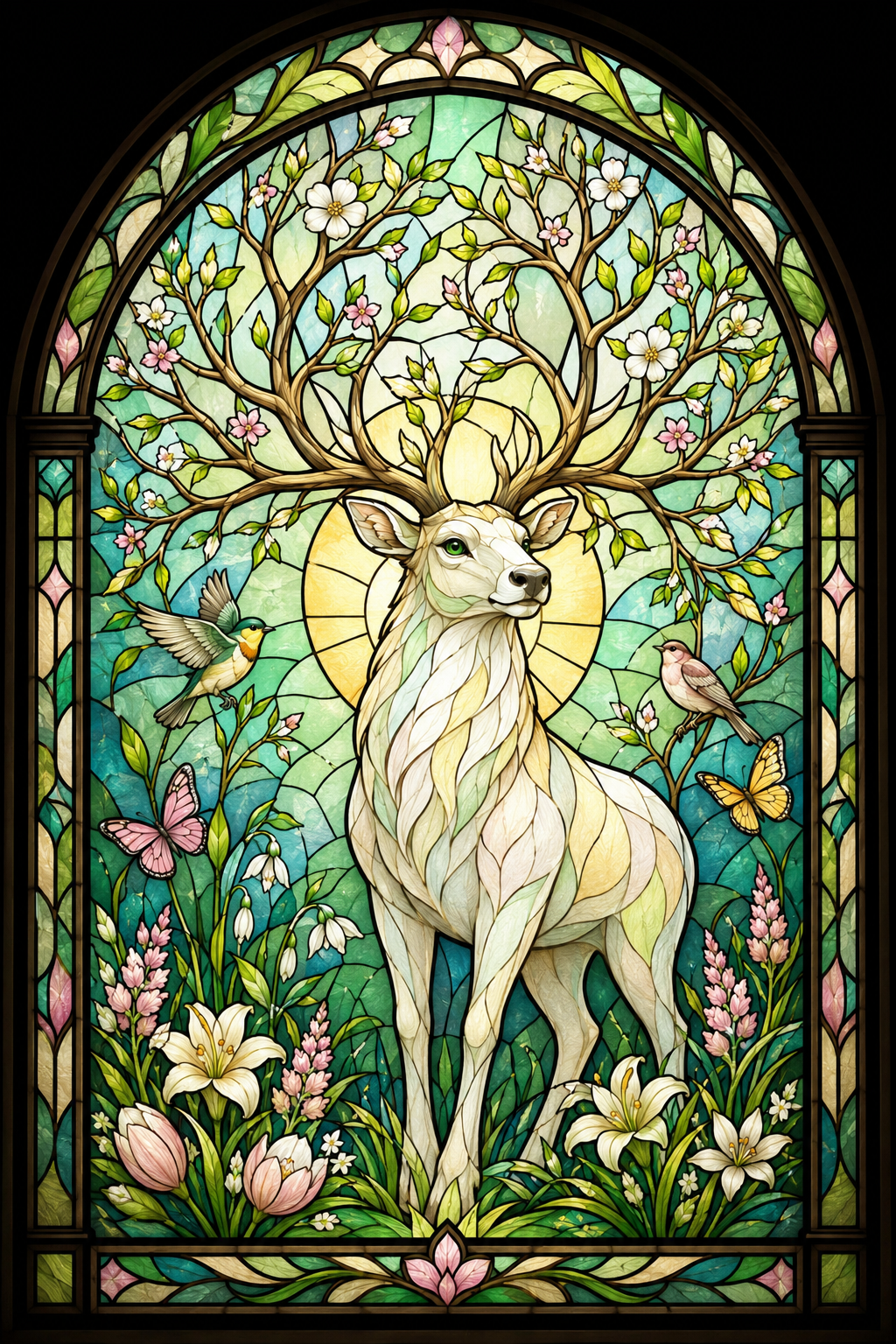
Usjunn is the God of Spring, Renewal, Growth, and New Life. As the first breath of spring after winter's long sleep, he embodies the world's endless capacity to heal, change, and begin anew. He is revered by farmers, gardeners, healers, and all those who seek hope after loss, for his teachings remind mortals that no hardship is permanent and that even the barren may bloom again.
The eldest son of Tuulla and one of her most beloved children, Usjunn is depicted as a great white stag crowned with flowering antlers or as a gentle forester who walks unseen among mortal lands. Compassionate and patient, he nurtures both the land and the spirit, encouraging all living things to grow into their fullest selves and to believe that every ending carries within it the seed of a new beginning.
Divine Information
| Property | Value |
|---|---|
| Alignment | Neutral Good |
| Divine Domains | Life, Nature |
| Portfolio | Spring, Renewal, Growth, New Life |
| Home Plane | Zephyrion |
| Realm | Blossoming Elysium |
| Symbol | A white stag with flowering antlers |
| Sacred Animal | White stag |
| Title | God of Spring |
Manifestation
Common Appearance
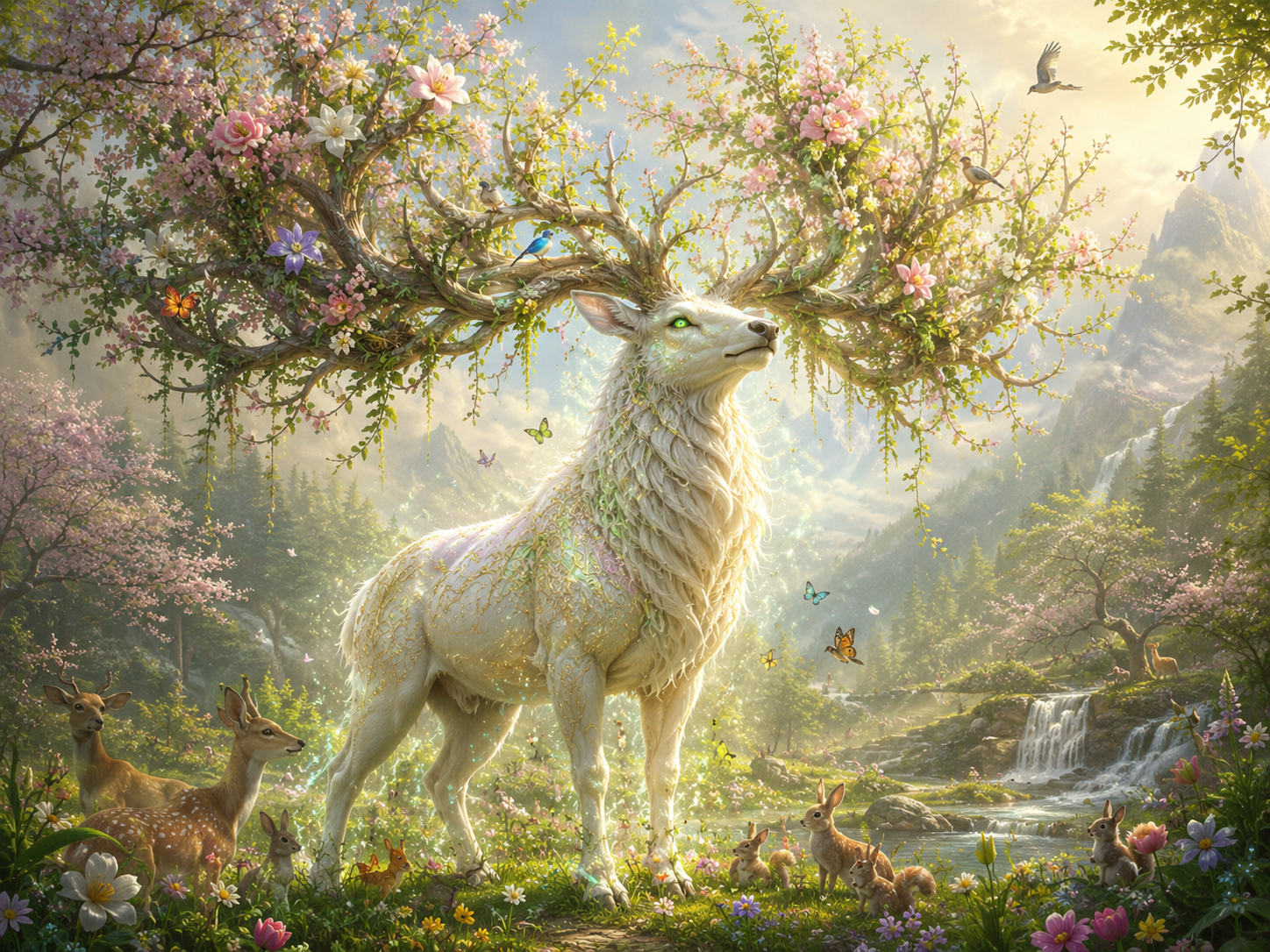
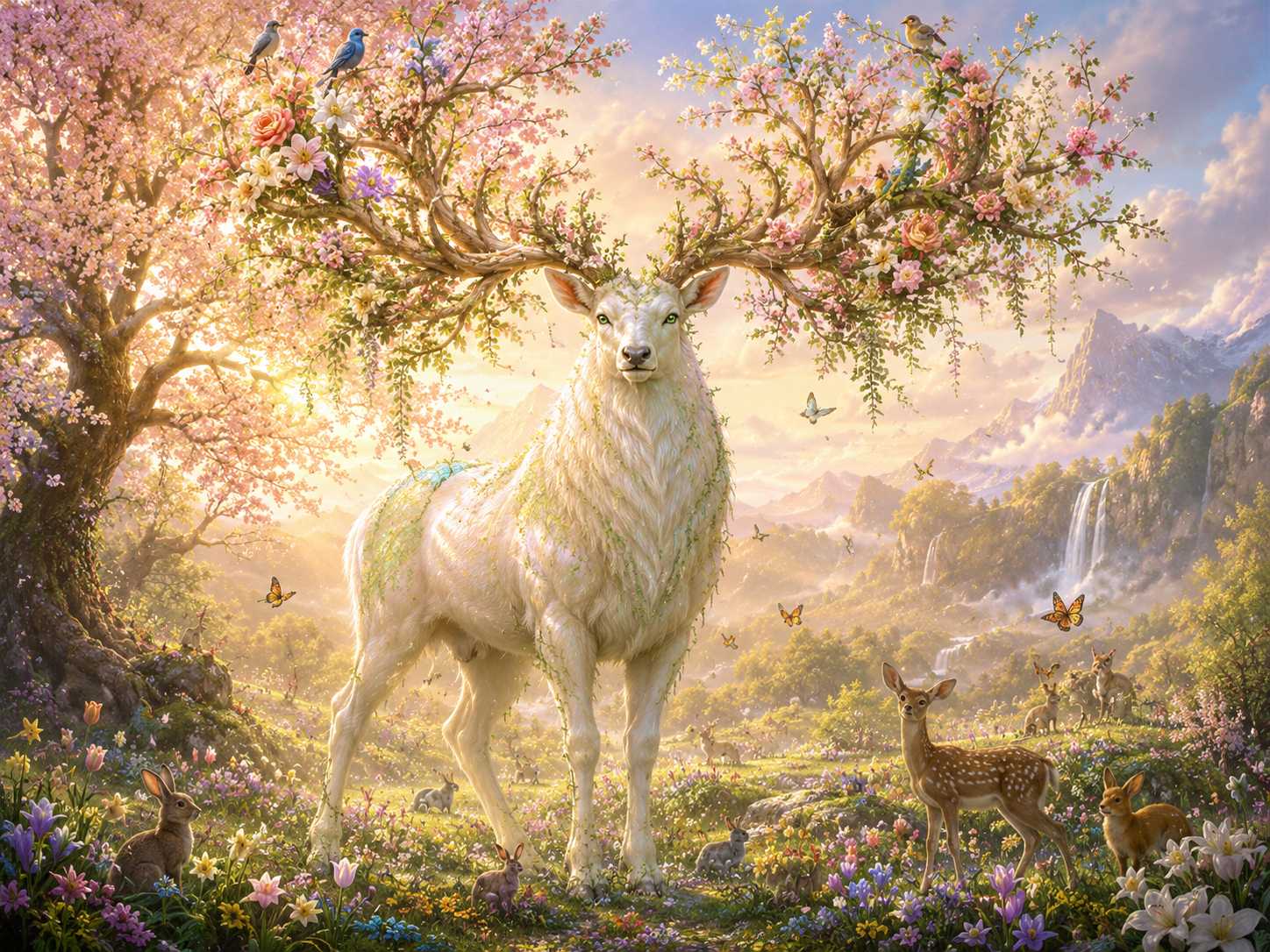
Usjunn most commonly appears as an immense white stag of impossible beauty and majesty. He stands far taller than any mortal deer, with shoulders higher than a horseman's head and antlers so vast that they resemble the branches of a great tree.
His coat is a luminous ivory-white that seems to glow softly from within, as though sunlight itself were woven into his fur. In certain lights, hints of pale green, gold, and soft pink shimmer across his body like the colors of dawn upon fresh snow.
His great antlers are his most striking feature. Rather than bare bone, they appear as living branches covered in leaves, blossoms, buds, and tender new shoots. Flowers of every kind bloom among them—cherry blossoms, wildflowers, roses, lilies, and flowers unknown to the mortal world. The blossoms change continually with the seasons and even with the moods of the god himself.
His eyes are a brilliant emerald green, deep and ancient, carrying both the joy of spring's first bloom and the wisdom of countless cycles of renewal.
Wherever Usjunn walks, new life follows.
Grass springs beneath his hooves.
Flowers bloom in his footprints.
Barren branches bud and birds begin to sing.
The air around him carries the scent of fresh rain, flowering meadows, and newly turned earth.
Though he possesses the size and majesty of a great beast, there is a gentleness to his bearing. Animals approach him without fear, and many depictions show birds nesting among his antlers or butterflies resting upon his coat.
To behold Usjunn is to witness the very moment when winter gives way to spring.
Preferred Forms
- A colossal white stag crowned with flowering antlers.
- A stag standing within a meadow of endless blossoms.
- A great deer emerging from the first morning mist of spring.
- A white stag beneath a flowering tree.
- A radiant stag whose antlers resemble the branches of the World Tree.
Avatar Forms
- A white stag of unusual size and intelligence.
- A young shepherd crowned with flowers and budding antlers.
- A wandering gardener carrying seeds and a wooden staff.
- A horned forester clothed in green and white.
- A humble traveler whose footsteps cause flowers to bloom.
Identifying Characteristics
- An immense white stag with flowering antlers.
- Emerald-green eyes.
- Blossoms, buds, and vines growing from his antlers.
- Flowers blooming in his footprints.
- The scent of spring flowers and fresh rain.
- Birds, butterflies, and small animals gathering in his presence.
- A soft green or golden radiance surrounding his body.
- New growth appearing wherever he lingers.
Divine Symbols & Iconography
- The White Stag.
- Flowering antlers.
- A budding branch.
- The first flower of spring.
- A blossoming tree.
- A seed breaking through the soil.
- Butterflies and songbirds.
- Dewdrops upon new leaves.
- A rising sun above a meadow.
- The Spring Equinox.
Divine Nature
Origins
In the world's first days, while the primordial titans still raged across the land, Tuulla gave birth to Usjunn. She looked upon the grasses that returned after fire and the flowers that bloomed where ruin had passed and saw in them a divine truth: that life forever seeks to begin again. From this truth came the God of Spring and Renewal.
He emerged from the earth as a great white stag crowned with flowering antlers, and with his first steps the world witnessed its first true spring. Wherever he walked, life awoke, seeds sprouted, and the scars left by the titans began to heal.
Divine Disposition
Gentle, patient, compassionate, and endlessly hopeful.
Usjunn possesses a quiet optimism that borders on the inexhaustible. He sees potential where others see ruin and new beginnings where others see endings.
He is slow to anger, quick to forgive, and always willing to offer another chance.
Even so, there is great strength beneath his gentleness. Like spring itself, he is persistent and unstoppable.
Winter may delay him.
It cannot prevent his coming.
Morality & Philosophy
Usjunn teaches that even after great loss, new life can still emerge.
Forests regrow after fire.
Wounds heal.
Communities rebuild.
Even the most broken spirit may bloom again.
He believes that all living things possess the capacity for growth and transformation and that despair is the greatest enemy of life.
Unlike his mother, who accepts every season equally, Usjunn actively celebrates renewal and new beginnings. He encourages mortals to strive toward becoming better versions of themselves and to help others do the same.
To him, every ending carries within it the seed of a new beginning.
Divine Goals & Aspirations
- To bring renewal to lands and peoples touched by suffering.
- To ensure that life always recovers from destruction.
- To inspire hope in times of hardship and despair.
- To nurture growth in all its forms.
- To encourage healing, compassion, and second chances.
- To help all living things grow into what they are meant to become.
- To remind the world that no winter lasts forever.
Virtues
- Compassion
- Hope
- Patience
- Kindness
- Renewal
- Perseverance
- Mercy
- Optimism
Flaws & Limitations
- Overly forgiving.
- Hesitant to cause harm, even when necessary.
- Struggles to abandon what might yet be saved.
- Sees potential in those who may never change.
- Occasionally underestimates the permanence of some losses.
Favored Virtues
- Compassion
- Growth
- Generosity
- Perseverance
- Humility
- Forgiveness
- Hope
Abhorred Vices
- Despair
- Cruelty
- Needless destruction
- Cynicism
- Stagnation
- Spreading hopelessness
- Refusing others the opportunity to change
Speech & Mannerisms
Usjunn speaks gently and patiently, his voice carrying the warmth of spring rain and the peace of a forest in bloom.
He rarely raises his voice and often allows long moments of silence, as though listening to things that mortals cannot hear.
His speech is rich with natural metaphors:
- seeds and gardens,
- winter and spring,
- rivers and forests,
- flowers and growth.
He often encourages rather than commands and prefers guidance over instruction.
When appearing to mortals, he frequently lowers his head or kneels so that others do not feel diminished by his divine presence.
Quotes & Catchphrases
"Every winter is followed by a spring."
"Even the barren may bloom again."
"From ashes, new life springs forth."
"Growth is seldom swift, but it is always possible."
"The first flower of spring does not ask whether winter deserved to end."
"No living thing is finished while it still strives to grow."
"A seed buried in darkness has not died. It is preparing to bloom."
Divine Relationships
Family
Usjunn possesses one of the closest familial circles among the gods.
He is the eldest child of Tuulla, the Prime Goddess and Mother of Seasons, and remains deeply devoted to her despite their differing outlooks. Where Tuulla accepts all seasons equally, Usjunn openly celebrates growth, healing, and renewal, though he recognizes that these gifts are only possible because of the greater cycles she governs.
He shares a warm relationship with his younger brothers:
The three are often depicted together in art and myth, representing the sky, sea, and living land working in harmony.
Usjunn is also fond of his niece, Phohella, whose winds carry seeds, pollen, and the first scents of spring across the world.
Allies
Usjunn is friendly with most of the pantheon and is widely regarded as one of the gentlest and most approachable of the gods.
Among his closest allies are:
- Udagi, whose cleansing fires often make renewal possible.
- Chulios, who understands that death is not the opposite of life but a necessary part of its cycle.
- Ara, whose sense of justice and compassion aligns with his own.
- Krallene, whose steadfast protection allows communities to endure and rebuild.
- Cuulla and Uldir, whose domains nurture the homes and families that Usjunn wishes to see flourish.
- Oxdros and Phohella, whose winds and rains bring life to the world.
He also maintains cordial relations with many other deities, preferring cooperation over conflict whenever possible.
Rivals & Enemies
Usjunn possesses few true enemies.
He strongly opposes Caneas, whose delight in chaos, cruelty, and destruction runs contrary to everything he represents.
He frequently disagrees with Earae, believing that victory purchased through needless suffering often leaves wounds that cannot easily heal. Despite this, he acknowledges that triumph and renewal are not always opposed and occasionally finds wisdom in her determination.
His relationship with Xokone is strained. Usjunn values growth in all its forms, while Xokone's pursuit of perfection and beauty can at times come at the expense of natural change and imperfection.
Even toward his rivals, however, Usjunn rarely harbors resentment.
He believes that almost anyone can change, and he is often willing to offer another opportunity for growth long after other gods have lost faith.
Relationships with Other Gods
Among the gods, Usjunn is often viewed as a source of encouragement and comfort.
Many deities seek his counsel during times of grief or uncertainty, for he possesses an almost inexhaustible belief that things can improve.
His optimism occasionally frustrates more cynical gods, and some consider him naïve for refusing to surrender hope even in the face of overwhelming loss.
Yet few can deny the truth at the heart of his philosophy:
After every winter, spring eventually returns.
Relationships with Mortals
Usjunn cares deeply for mortal life and delights in witnessing growth, healing, and new beginnings.
He is particularly drawn to:
- healers and caretakers,
- those rebuilding after tragedy,
- farmers and gardeners,
- people seeking redemption,
- and anyone striving to become better than they once were.
He frequently appears in dreams and visions, often during periods of grief, despair, or great change.
Many stories tell of a mysterious white stag appearing to those who have lost hope, leading them toward safety, renewal, or a new beginning.
Among mortals, he is often called:
The God of Second Chances.
Worship & Faith
Worshippers
Usjunn is among the most beloved deities of the Andórëan Pantheon and is worshipped throughout nearly every culture of Andórë.
His faithful are especially numerous among:
- Farmers and orchard keepers.
- Gardeners and herbalists.
- Midwives and healers.
- Druids and rangers.
- Foresters and herbal gatherers.
- Shepherds and herders.
- Families hoping for children.
- Those recovering from hardship, loss, or illness.
- Anyone seeking a fresh start or a second chance.
Even people who do not consider themselves particularly devout often offer a prayer to Usjunn at the beginning of spring, when planting crops, or when embarking upon a new chapter in their lives.
He is widely regarded as a god of hope, renewal, and new beginnings, and many households keep a small carving of a white stag or a few dried spring flowers in his honor.
Major Cults
Usjunn possesses few formal cults or centralized religious institutions.
His worship is deeply integrated into everyday life and local traditions, particularly in rural communities.
Small druidic circles, village priesthoods, and seasonal societies dedicated to gardening, healing, or the care of sacred groves often place themselves under his patronage, though few exist solely to worship the god himself.
Most of his clergy serve their communities as:
- healers,
- herbalists,
- midwives,
- gardeners,
- teachers,
- and caretakers of sacred natural places.
Holy Books & Codes
The Living World
Unlike many faiths, the followers of Usjunn possess no universally accepted scripture.
The Living World is less a book and more a philosophy.
Its central teaching is that nature itself is the divine text of Usjunn. The blooming of flowers, the changing of seasons, and the renewal of life are all considered sacred lessons from the god.
Individual temples and druidic circles often maintain collections of hymns, prayers, stories, and local teachings, but no single text is considered authoritative.
Among his faithful it is often said:
"The first flower of spring is scripture enough."
Tenets of Faith
- Embrace new beginnings.
- Help life bloom again.
- Cultivate growth in yourself and others.
- Leave room for renewal.
- Hope for brighter seasons.
Holidays & Holy Days
Spring Equinox
The holiest day of Usjunn's faith, celebrating the end of winter and the return of growth and new life.
Communities gather for feasts, dances, the planting of flowers and trees, and prayers for a fruitful year.
Many temples release birds or scatter flower petals to symbolize the arrival of spring.
Arbor Day
A celebration of growth, stewardship, and renewal.
People plant trees, tend gardens, restore damaged lands, and dedicate new orchards or groves in the god's honor.
It is considered an especially auspicious day to begin new endeavors.
Sacred Sites
Usjunn's sacred places are almost always places where new life flourishes.
These include:
- ancient groves,
- flowering meadows,
- orchards,
- natural springs,
- sacred gardens,
- clear forest glades,
- and places where barren land has unexpectedly returned to life.
Many shrines to Usjunn consist of nothing more than a flowering tree, a circle of standing stones, or a simple wooden carving of a white stag.
Religious Practices
The worship of Usjunn is joyful and communal.
Common practices include:
- planting trees and flowers,
- tending gardens,
- blessing fields before planting,
- caring for the sick and elderly,
- assisting in births,
- decorating homes with spring flowers,
- sharing meals with neighbors,
- and performing acts of charity and kindness.
Many followers also undertake personal acts of renewal, such as:
- reconciling old disputes,
- beginning new projects,
- making amends,
- or dedicating themselves to self-improvement.
The first bloom of spring is considered especially sacred, and many communities celebrate its appearance with festivals and feasting.
Forbidden Acts
The faithful of Usjunn generally condemn:
- Spreading hopelessness.
- Preventing renewal.
- Destroying new life without cause.
- Refusing mercy to the repentant.
Many also consider it sinful to deliberately leave land barren or to destroy something solely to deny others the opportunity to rebuild and flourish.
Among his clergy, a common saying is:
"So long as even one seed remains, renewal is possible."
Divine Realm
Home Plane
Zephyrion
Usjunn resides within Zephyrion, the Plane of Nature and Weather, where the natural world exists in all its beauty and diversity.
Though he often wanders throughout the plane and frequently visits the realms of his family, his own domain is known as Blossoming Elysium, a place where spring never truly ends and renewal is eternal.
Realm
Blossoming Elysium
Blossoming Elysium is a realm of perpetual spring, where every breeze carries the scent of flowers and every sunrise promises a new beginning.
Rolling green hills, flowering meadows, ancient forests, and crystal-clear streams stretch endlessly beneath warm sunlight and gentle rains. Trees are forever budding, flowers are forever blooming, and the songs of birds fill the air at all hours.
Yet the realm is not static.
Flowers bloom, wither, and bloom again.
Leaves unfurl and fall only to return anew.
Streams overflow and recede.
Everywhere within Blossoming Elysium, the cycles of life continue in miniature, endlessly repeating the miracle of renewal.
No place in the realm remains barren for long.
Even fallen trees become homes for new growth, and meadows burned by celestial fire return more beautiful than before.
At the center of the realm lies the Court of the Stag, a great glade encircled by ancient trees. There stands a colossal tree of impossible size, its branches laden with blossoms of every color and season. Its roots sink deep into the heart of the realm, and its flowering canopy can be seen from nearly every corner of Blossoming Elysium.
Though a marble throne exists within the Court, Usjunn seldom sits upon it.
More often he may be found:
- tending a sapling,
- walking among the meadows,
- resting beneath the great tree,
- or wandering the forests in the form of a white stag.
Among the spirits of the realm, it is said:
"The God of Spring has no need of a palace, for every blossom is his court."
Inhabitants
Blossoming Elysium is populated by countless beings that embody growth, renewal, and the beauty of the natural world.
Its inhabitants include:
- nature spirits,
- dryads and nymphs,
- flower and river spirits,
- awakened animals,
- celestial stags and great beasts,
- fey creatures of kindness and renewal,
- and the souls of mortals who devoted their lives to healing, stewardship, and nurturing new life.
The realm is particularly famous for its extraordinary wildlife:
- butterflies whose wings shine like gemstones,
- birds whose songs encourage flowers to bloom,
- deer with coats patterned like spring meadows,
- and gentle spirits born from flowers and blossoming vines.
Many of its inhabitants act as caretakers of the realm, tending gardens, planting trees, and nurturing the endless cycle of renewal that defines Blossoming Elysium.
The white stag itself appears everywhere within the realm.
Sometimes it is Usjunn.
Sometimes it is merely one of his sacred servants.
No inhabitant claims to know the difference.
Among the souls who dwell there, a common saying is:
"Nothing truly ends in Blossoming Elysium. Here, every farewell is the beginning of another spring."
Artifacts & Relics
Divine Artifacts
The Crown of Blossoms
The only widely acknowledged divine artifact of Usjunn is the Crown of Blossoms, a wreath of living flowers said to have first bloomed from his antlers.
The flowers of the crown never wilt and continuously change with the passing of the seasons in the mortal world. Different blossoms appear each day, and no two depictions of the crown are ever entirely alike.
The Crown is said to possess the power to restore life to barren lands and inspire hope in even the most despairing hearts.
Usjunn rarely wears the Crown himself, and many traditions claim that he instead places it upon the brows of his servants, champions, and honored guests.
Some scholars even debate whether the Crown is truly an artifact or simply another manifestation of the god himself.
Holy Weapons
Usjunn possesses no divine weapon.
He carries no sword, spear, or staff, and no myths speak of him wielding a legendary blade.
When he fought beside the gods against the primordial titans, he did so with his own antlers and hooves, embodying the indomitable resilience of life itself.
Among his faithful it is often said:
"Spring needs no sword."
Or, more poetically:
"The flower breaks the stone not through strength, but by returning again and again."
Because of this, the clergy of Usjunn generally place little importance on weapons as sacred objects.
Relics of the Faith
Antlers of Renewal
Naturally shed antlers from white stags are considered sacred relics of Usjunn.
They are often placed within shrines or carved into holy symbols representing growth and new beginnings.
Seeds of Blessing
Certain seeds gathered from sacred groves dedicated to Usjunn are believed to carry his blessing.
Though possessing no magical power themselves, they are planted during ceremonies marking births, marriages, reconciliations, and the founding of new communities.
Crowns of Spring
Wreaths woven from fresh flowers are commonly worn by priests and celebrants during holy festivals.
The crowns are traditionally burned, buried, or returned to the earth after ceremonies, symbolizing that beauty and renewal are part of an endless cycle.
Flowers of the First Bloom
On rare occasions, a flower may bloom in impossible circumstances:
- from bare stone,
- in the depths of winter,
- or in lands long thought dead.
Such blossoms are considered direct signs of Usjunn's favor and are treasured as holy relics.
No two Flowers of the First Bloom are ever identical.
History
Creation & Early History
Usjunn was the first child of Tuulla, born in the earliest days of the world while the primordial titans still ravaged Andórë.
As life struggled to survive amidst elemental devastation, Tuulla perceived a profound truth: that even in the midst of destruction, life endlessly sought to begin again. From this truth came Usjunn, the God of Spring and Renewal.
In his earliest days, he walked the wounded world, and wherever his hooves touched the earth, grasses grew, flowers bloomed, and barren lands slowly began to heal.
During the War of the Titans, Usjunn fought beside the gods, not with forged weapons but with antlers and hooves, defending the fragile promise of future life against forces that would have rendered the world forever lifeless.
Major Deeds
The First Spring
The coming of the first true spring is attributed to Usjunn.
Myths tell that after one of the great battles of the primordial war, he walked across a devastated land and caused the first flowers to bloom, demonstrating that renewal was possible even in the face of unimaginable destruction.
The Healing of the World
Following the imprisonment of the primordial titans, Usjunn helped restore the wounded lands of Andórë.
Ancient forests regrew, rivers once again nourished fertile plains, and life spread into places that had long known only devastation.
Many legends claim that every forest in the world contains at least one tree descended from those first sacred groves.
The Blessing of Renewal
Throughout history, countless tales speak of barren lands unexpectedly flourishing, ruined communities rebuilding, and hope returning in seemingly impossible circumstances.
The faithful attribute many of these events to the unseen blessings of Usjunn.
Whether these miracles are truly his work or simply the natural resilience of life itself is a matter of theological debate.
Intervention in Mortal Affairs
Like all the gods of Andórë, Usjunn is bound by the divine laws established by Tuulla and does not directly interfere in the affairs of mortals.
Instead, he acts through subtle means:
- dreams of flowering meadows,
- visions of white stags,
- unexpected signs of new growth,
- feelings of hope during times of despair,
- and the granting of divine power to his clergy.
Many stories tell of travelers encountering a mysterious white stag shortly before their fortunes change for the better. Whether these encounters are truly manifestations of the god or merely hopeful legends is unknown.
Usjunn's interventions are almost always gentle and encouraging rather than miraculous or overt.
He inspires.
He guides.
He reminds mortals that renewal remains possible.
Current Circumstances
In the present age, Usjunn continues to watch over the renewal of the world and the flourishing of life.
He remains one of the most beloved and widely revered gods of the Andórëan Pantheon, particularly among common folk who see in him a source of hope and comfort.
Among the gods, he is regarded as a patient and compassionate voice who consistently advocates for healing, mercy, and second chances.
His greatest concern is not war, conquest, or power, but despair.
For as long as mortals believe that tomorrow may be better than today, renewal remains possible.
And so long as renewal remains possible, the spirit of spring endures.
Representation & Legacy
Cultural Importance
Usjunn is among the most beloved gods of the Andórëan Pantheon, particularly among ordinary people.
Unlike many deities whose worship is centered upon temples, priesthoods, or great institutions, devotion to Usjunn is woven into the rhythms of everyday life. Farmers invoke his blessings before planting their fields. Midwives pray to him during childbirth. Gardeners, healers, and herbalists seek his favor in their work, and those enduring hardship often turn to him for comfort and hope.
His festivals are generally joyful and communal, emphasizing renewal, generosity, and the promise of brighter days. Even those who do not consider themselves particularly devout often participate in spring celebrations and seasonal customs dedicated to the god.
Among the common folk, Usjunn is often regarded as one of the kindest and most approachable of the gods.
Symbolism
Usjunn embodies several interconnected ideas.
Renewal
Nothing is so broken that it cannot heal.
Nothing is so barren that it cannot bloom again.
The return of spring after winter serves as the central metaphor of his faith and the foundation of his teachings.
Hope
Usjunn represents the belief that tomorrow can be better than today.
His faithful see hope not as wishful thinking, but as an act of courage and perseverance.
To continue planting after a poor harvest, rebuilding after disaster, or trusting after betrayal are all considered acts of faith in the God of Spring.
Growth
Growth is sacred.
This includes:
- the growth of forests and fields,
- the growth of communities,
- and the growth of the self.
Usjunn teaches that all living things are capable of becoming something greater than they once were.
Second Chances
Perhaps more than any other deity, Usjunn symbolizes redemption and new beginnings.
A failed harvest may be replanted.
A damaged friendship may heal.
A person who has lost their way may yet find a better path.
This belief has made him especially beloved among those seeking to rebuild their lives after tragedy or failure.
Resilience
The first flower that blooms after winter is among the most sacred symbols of his faith.
It reminds mortals that life endures, even in the face of hardship, loss, and suffering.
Legacy
Usjunn's legacy is not found in empires, wars, or great monuments.
It is found in quieter things:
- a tree planted after a fire,
- a child born after a difficult winter,
- a ruined village rebuilt,
- a friendship restored,
- a field that blooms once more after years of hardship.
The God of Spring teaches that renewal is one of the world's greatest miracles.
The old may pass away.
The broken may heal.
The barren may bloom again.
Among his faithful there is an old saying:
"As long as spring still comes, there is reason to hope."
And perhaps that is Usjunn's greatest legacy—not that he brings new life to the world, but that he teaches mortals to believe that new life is always possible.
Notes