Battle of Hope and Magma
The Battle of Hope and Magma: Elumis and Magmokar, the Blazing Depths
By the time Elumis came against Magmokar, Verlanis was already dead.
The news had passed through the Divine Alliance not as sound, nor as message, nor even as grief, but as absence. A place in the pattern of divine awareness had gone hollow. The shadows still existed, but they no longer listened. Darkness still fell, but it no longer answered. Across the broken face of young Andórë, every god felt the wound where Verlanis had been.
Elumis felt it most keenly.
Hope is not ignorance. It does not survive because it fails to understand loss. Hope survives because it understands loss completely, looks upon the grave with open eyes, and still reaches for tomorrow.
So when the sundering fires split the earth beneath the southern mountains, when rivers of molten stone began crawling across the newborn world, when the sky turned copper and black with ash, Elumis did not look away.
Magmokar had risen.
He did not rise as a beast rises, nor as a king, nor as an army. He rose as a wound in the world. The crust of Andórë split apart for leagues in every direction, and from the wound came a shape so vast that mountains seemed like stones at his feet. His body was molten rock and churning magma, plates of blackened basalt floating upon a core of endless fire. His shoulders dragged storms of cinder behind them. His hands were not hands, but crushing shelves of burning stone, each finger a volcanic ridge, each knuckle a crater. His eyes were open vents into the deep places of the world, and when he breathed, whole valleys became furnaces.
He was not fire alone. Fire leapt, danced, devoured, and vanished, but Magmokar endured. He was the hatred of the deep earth, pressure without release, the slow red hunger beneath all mountains, and the promise that everything built upon the surface would one day be dragged down, melted, and made meaningless.
Around him, the war of the gods had scattered. Tuulla was far away, locked in her own struggle against a titan whose waters sought to drown the roots of continents. Oxdros fought in the screaming vault of the sky. Sedarr had driven himself into the heart of flame. Rildir held back the rage of mountains with impossible calm. Hykteus and Yxtuna bent their minds toward the great bindings that would make victory more than a temporary reprieve. Tiseyr guarded the wounded from madness and despair. Phohella moved like a living contradiction wherever the battle turned strangest.
None could come, not yet, and Elumis knew this before her servants asked.
Her host gathered around her on a ridge of pale stone that had once been the edge of a green basin. There had been life there, not mortal life, not yet, but the early work of Tuulla and her children: mosses bright as emerald glass, warm pools where simple creatures stirred, white flowers that opened to the young sun. Magmokar’s passing had ended all of it. The basin below was now a lake of lava. The flowers were ash. The pools screamed steam into the sky.
The deva knelt first.
They were bright beings, Elumis’s lesser messengers and healers, robed in white and gold, their wings dimmed by falling soot. Their hands had closed wounds since the first wounds were made. Their songs had carried courage into places where courage had no reason to survive.
Behind them stood planetars, tall and terrible in their beauty, with emerald eyes and great wings folded behind armor of living light. Their blades shone with dawnfire. Each of them bore strength enough to shatter hosts, and each of them looked small beneath the shadow of Magmokar.
Around them gathered archons of many forms: hound-headed guardians with shields of pearl and bronze; lantern archons burning like patient stars in the choking air; winged archons bearing spears of judgment; throne-bound archons whose wheels of radiance spun with holy law; lion-helmed archons whose roars could steady the hearts of the dying. They had followed Elumis from her realm into the unmade world, not because hope promised safety, but because hope gave danger meaning.
One of the planetars, Araveth of the Unbroken Wing, stepped forward.
“My lady,” he said, “this field cannot be held.”
Elumis looked down into the valley. Magmokar’s feet moved through lava as though it were shallow water. Each step forced new eruptions from the earth. Hills burst open before him. Stone ran like wax. The air itself bent in waves around his body.
“No,” Elumis said. “It cannot.”
The planetar’s jaw tightened. “Then we should withdraw. Preserve the host. Rejoin the Alliance. Strike when—”
“When another stands where we stand?” Elumis asked.
Araveth fell silent.
The goddess turned to him, and even beneath the ash, her light was gentle. She bore no iron crown, carried no banner of conquest, and wore no armor meant to terrify the enemy. Her strength did not announce itself through thunder or command. It gathered quietly around her, like dawn gathering beneath the edge of the world. She wore a circlet of living branches that still bloomed despite the heat. Her wings were white touched with gold and the faintest blush of spring. Her dark curls were threaded with flowers that had no right to survive in that air.
“When Magmokar reaches the roots of the western mantle,” she said, “the bindings Hykteus and Yxtuna have prepared will fail. The deep fire will remain open. Every prison made after this day will crack from beneath. The world will become a kiln, and all that Tuulla has planted will burn before it learns to breathe.”
A deva whispered, “Then this is where the war is decided.”
Elumis shook her head.
“No. This is where we decide whether the war still deserves to be won.”
Magmokar saw them then.
His head turned slowly, grinding like continents. The vents of his eyes narrowed. A sound rose from him, deep enough that the ridge beneath the host fractured. It was not speech, not as gods understood speech. It was pressure given anger. It was the groan of buried stone, the roar of magma through a wound, the hatred of the deep earth for everything fragile enough to grow upon its skin.
Meaning formed within it only because divine minds were strong enough to survive hearing it.
“LIGHT.”
The word broke loose from him like a boulder torn from a mountainside.
Elumis stepped to the edge of the ridge.
“Magmokar.”
The titan’s answer was not a sentence. His claws drove into the molten basin below, and the whole valley heaved upward in reply. Stone split. Lava climbed the cracks. The earth beneath Elumis’s feet tried to open.
“DOWN.”
The ridge shuddered.
Deva spread their wings around the wounded. Planetars drew blades of dawnfire. Archons locked shields along the ledge, their forms bright and small against the furnace below.
Elumis did not move.
“No.”
Magmokar’s shoulders rose. A curtain of molten stone spilled down his chest and struck the basin in waves. His breath rolled over the ridge, hot enough to turn prayer-scrolls to ash and soften the metal of celestial armor.
The vents of his eyes burned wider.
The surface had closed over the deep.
Now the surface shone.
Magmokar lifted one arm.
Magma gathered along it, flowing upward against the pull of the world, condensing into a sphere of molten stone larger than some mountains. Within it, boulders tumbled like sparks. Its outer shell cooled black, cracked open, and revealed white fire beneath.
The titan made one more sound, neither command nor threat, but weight, heat, and burial given voice.
“ASH.”
He hurled the burning mountain at the ridge.
The host moved as one.
Planetars rose into the air, blades crossed, calling down spears of white radiance that struck the molten mass and carved glowing wounds through it. Deva sang healing into the cracking ridge, binding stone to stone for precious seconds. Lantern archons surrounded the falling sphere in constellations, each sacrificing a measure of its own light to cool the outer shell. Hound archons braced their shields against the earth and howled prayers of endurance.
Elumis raised one hand.
The sphere burst apart above them.
For an instant the sky became a rain of burning mountains.
Elumis’s light spread through the fragments. Each piece slowed. Each piece dimmed from white to orange, from orange to red, from red to black. What fell upon the ridge was still hot enough to shatter stone, but not hot enough to annihilate the host. The archons endured. The devas pulled the wounded back to their feet. The planetars dove through smoke and ash toward the titan.
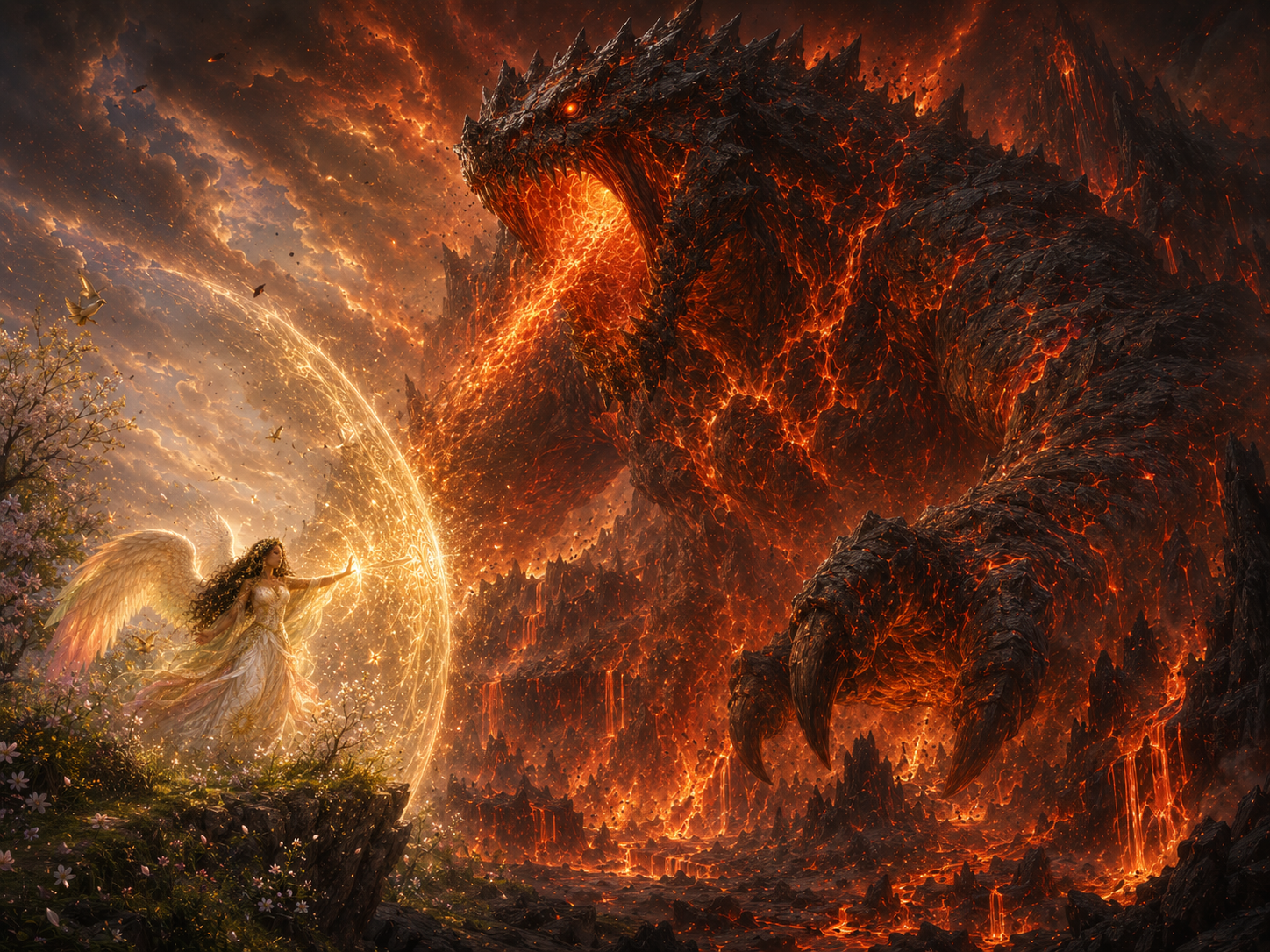
The battle began, and days passed, though days had little meaning beneath the ash-dark sky. The sun vanished. The stars were buried. Time became eruption, charge, wound, retreat, and return; the number of times Elumis’s servants broke against Magmokar and rose again; the number of times the Blazing Depths was forced aside, only to rise from the molten wounds beneath him.
The first assault belonged to the planetars.
Seven descended upon Magmokar’s right arm, their wings burning at the edges, their blades striking the seams between basalt plates. Each blow released torrents of magma. Each wound closed almost as quickly as it opened, but not completely. Where their swords struck, Elumis sent threads of golden-green light, and stone hardened around the wounds. Cracks remained.
Magmokar bellowed and swept his arm through the air. Three planetars were struck from the sky. One vanished beneath a wave of lava and did not rise. Another emerged with his wings burning down to bone, only for a choir of deva to surround him, pour themselves into his wounds, and give him back enough strength to fly once more.
The archons struck next.
The hound archons advanced across cooling stone, shields locked, creating a path where no path could exist. Lantern archons drifted before them, drawing Magmokar’s gaze with flashes of radiant defiance. The throne archons spoke words of binding, not enough to imprison the titan, but enough to make his steps heavy. The lion archons roared, and the roar carried a single command into every divine heart on the field.
Stand.
Magmokar answered by opening the earth.
A fissure tore through the host. Lava geysers erupted in lines of perfect malice. Dozens of archons were swallowed. Deva flew into the fissures after them, not to save bodies already consumed, but to catch the sparks of celestial essence before Magmokar’s heat could unravel them completely. Elumis descended into the smoke, wings spread, light pouring from her hands in rivers.
Everywhere she passed, despair failed. That was her miracle: not victory, not safety, not certainty, but the refusal of failure to finish its work.
A planetar with half his face burned away rose again because Elumis looked at him. A deva whose voice had been scorched silent found one more note because Elumis touched her brow. A hound archon trapped beneath a slab of cooling basalt pushed upward, not because the stone had become lighter, but because giving up had become impossible.
Magmokar began to understand. Stone broke, and light returned. Fire consumed, and light returned. The deep opened, and still light remained above it.
He had broken storm. He had broken sea. He had broken shadow, order, and spell. Strength could be met with greater strength; stone could crush it, fire could devour it, and pressure could grind it down until nothing remained but heat and silence. This was different. The small bright things did not become greater than him. They did not overpower him. They did not turn his fire aside or still the molten heart beneath his skin. They simply refused to finish breaking.
Magmokar lowered his head.
The vents of his eyes burned white.
The light stood on the surface.
So the deep rose to cover it.
He drove both arms into the molten lake.
The basin answered.
Lava climbed the ridge in sheets. Not thrown, not hurled, but lifted from below as if the world itself had become a cup overturned. The cooling paths the archons had crossed split apart. Stone shelves buckled and slid. The ridge groaned beneath Elumis’s host as magma forced its way through every seam, every crack, every place where the wounded earth could open.
The battlefield tilted.
Deva took to the air with the wounded in their arms. Lantern archons vanished beneath curtains of burning stone and emerged dimmer, flickering, still shining. Hound archons drove their shields into the ground and were pushed backward step by step, their claws carving lines through softening rock. Planetars struck downward, not at Magmokar, but at the rising flood, carving channels through lava that closed almost as soon as they opened.
Magmokar pulled again.
The ridge broke.
A whole face of pale stone sheared away and slid into the basin, carrying archons, shattered shields, and burning fragments of celestial armor with it. Magma surged over the fallen shelf and climbed higher. It did not chase. It did not choose. It covered.
That was the answer of the Blazing Depths: above must become below, and light must become buried.
Elumis spread her wings and rose from the collapsing ridge.
Her host followed, but she outpaced them all. Through ash and burning rain she climbed until she hung before Magmokar’s face, small against the furnace of him, bright against the black glass of his wounded skin.
“Not below,” she said.
Magmokar’s eyes flared.
The vents along his chest opened. Heat rolled outward in a red wave. The air around Elumis burned. Her wings curled at the edges. The flowers in her hair charred but did not fall.
The titan made a sound.
“DOWN.”
Then he struck her.
No servant intercepted the blow. No archon shield reached her in time. Magmokar’s fist closed around her like a mountain folding shut and drove her down through the air, through smoke, through the breaking ridge, into the molten basin below.
The host faltered.
For the first time, silence touched them.
Then the basin bloomed.
Light burst from beneath Magmokar’s fist, not white, not gold, but dawn seen through leaves after a storm. Green threaded the molten red. Flowers of radiance opened across cooling stone. The titan’s hand cracked.
Elumis rose from beneath it.
Her wings were burning.
Her left arm hung at her side, light spilling from it like blood. The circlet upon her brow had blackened, but from the charred branches came new buds. Her face was marked with ash. Her eyes were bright.
She held in her right hand a spear that had not existed before.
It was not a weapon of war. It was a promise given shape. Its haft was living wood, its head a shard of morning, its edge the first breath taken after grief. Every servant of Elumis felt it as it appeared, and every one of them knew its name without being told.
The Last Dawn.
Elumis drove it into Magmokar’s chest.
The titan screamed.
Where the spear entered him, magma did not cool. It remembered. It remembered stone that could bear roots. It remembered heat that could warm rather than consume. It remembered pressure that could raise mountains instead of breaking worlds. The wound spread through Magmokar’s torso in branching lines of gold and green, a radiant fracture that crossed his chest, climbed his throat, and split the basalt plates of his left shoulder.
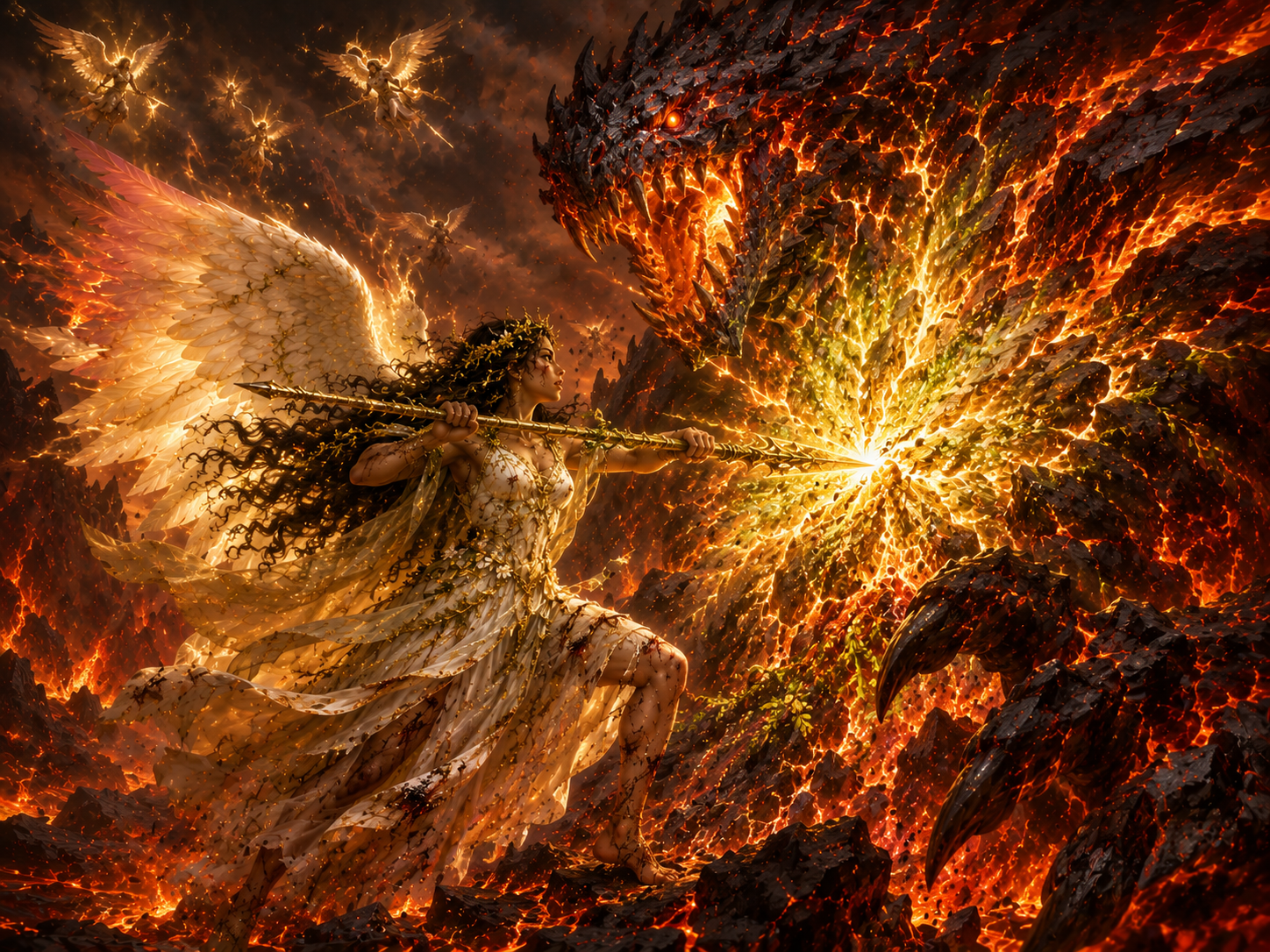
The titan staggered.
Across Andórë, gods fighting their own impossible battles felt Magmokar weaken. Hykteus turned his mind toward the opening. Yxtuna marked the pattern. Somewhere beyond sight, Tuulla wept without stopping her own war.
Magmokar grasped the spear and tried to pull it free.
It burned him.
The Blazing Depths, who could bathe in the heart of the world, burned at the touch of hope.
Elumis descended upon him with all her host behind her.
The planetars struck the radiant fractures, widening them. The archons poured words of restraint into the cracks. Deva sang not of healing now, but of endurance, of the long labor of survival, of seeds beneath ash, of roots beneath stone, of wings lifting after fire, of light remaining where all things should have gone dark.
Magmokar fell to one knee.
The impact flattened the ridge.
The host pressed forward.
For one impossible moment, it seemed they would win.
Then Magmokar laughed.
It was the sound of a continent splitting.
He closed both hands around the wound in his chest, not to heal it, but to tear it wider.
Magma surged out of him in a flood, carrying Elumis’s light with it, scattering radiant fragments across the battlefield. The Last Dawn cracked. Its living haft charred. Its spearhead remained embedded, but the promise within it had been forced outward, diffused through the titan’s molten blood.
Magmokar had chosen agony over defeat.
He rose, grievously wounded, diminished, but not broken.
The left side of his body had hardened into black glass veined with gold. One arm hung heavy and slow, its joints fused by Elumis’s light. His chest remained split around the spearhead, and each movement tore the wound open again.
He opened it further.
Magma poured from his chest and struck the ground in hissing rivers. Light came with it, unwilling and undrowned, gold threading through the red. Wherever the mingled flood touched stone, the surface hardened into root-shaped veins.
Magmokar dragged one foot forward.
The wound widened.
He dragged the other.
The wound widened again.
He turned his pain outward.
The vents along his body opened one by one: shoulders, throat, ribs, spine, palms, crown. Red light became white. Black glass split. The gold in his wounds flared and vanished beneath deeper fire.
Magmokar still stood.
But he no longer stood whole.
And he could still kill.
The battlefield became the inside of a star.
There was no direction from which the eruption came, because it came from all directions. The ground exploded. The air ignited. The lava lake rose as a wall. The ash clouds above collapsed downward in burning spirals.
Magmokar poured the wrath of the deep earth into a single cataclysm.
The servants of Elumis gathered around their goddess.
Deva carried the wounded inward. Planetars planted themselves at the edge of the breaking stone. Archons locked shields in rings that glowed red, then white, then began to fail. The host had followed her into the furnace, and now the furnace closed around them.
Elumis looked upon them.
She saw burned wings and broken blades. She saw lantern archons dimming in the ash. She saw hound archons braced beneath shields already melting against their arms. She saw Araveth of the Unbroken Wing standing with one wing gone, his sword held in both hands because one alone could no longer bear its weight.
Behind her, they endured.
Before her, Magmokar opened.
There was still a path through the fire. Narrow. Terrible. Empty. A path only she could take.
Elumis did not take it.
She smiled.
“I am not leaving you.”
Araveth bowed his head. “Then we remain.”
“No,” she said softly. “You endure.”
She spread her wings.
The barrier was not merely light.
It was Elumis poured outward. Her mercy. Her grief. Her refusal. Her certainty that loss was not the same as ending. Around her, the last living green of the basin answered. Roots that should have burned held fast beneath the stone. Seeds that had not yet opened stirred in the ash. Broken servants lifted their faces and found that some part of them still believed in rising.
It was hope, not as comfort, but as defiance.
The inferno struck.
The first layer of the barrier shattered instantly.
Elumis gave more.
The second layer held long enough for the deva to pull the fallen inward.
The third layer cracked as the planetars drove their swords into the ground and used their own bodies as anchors.
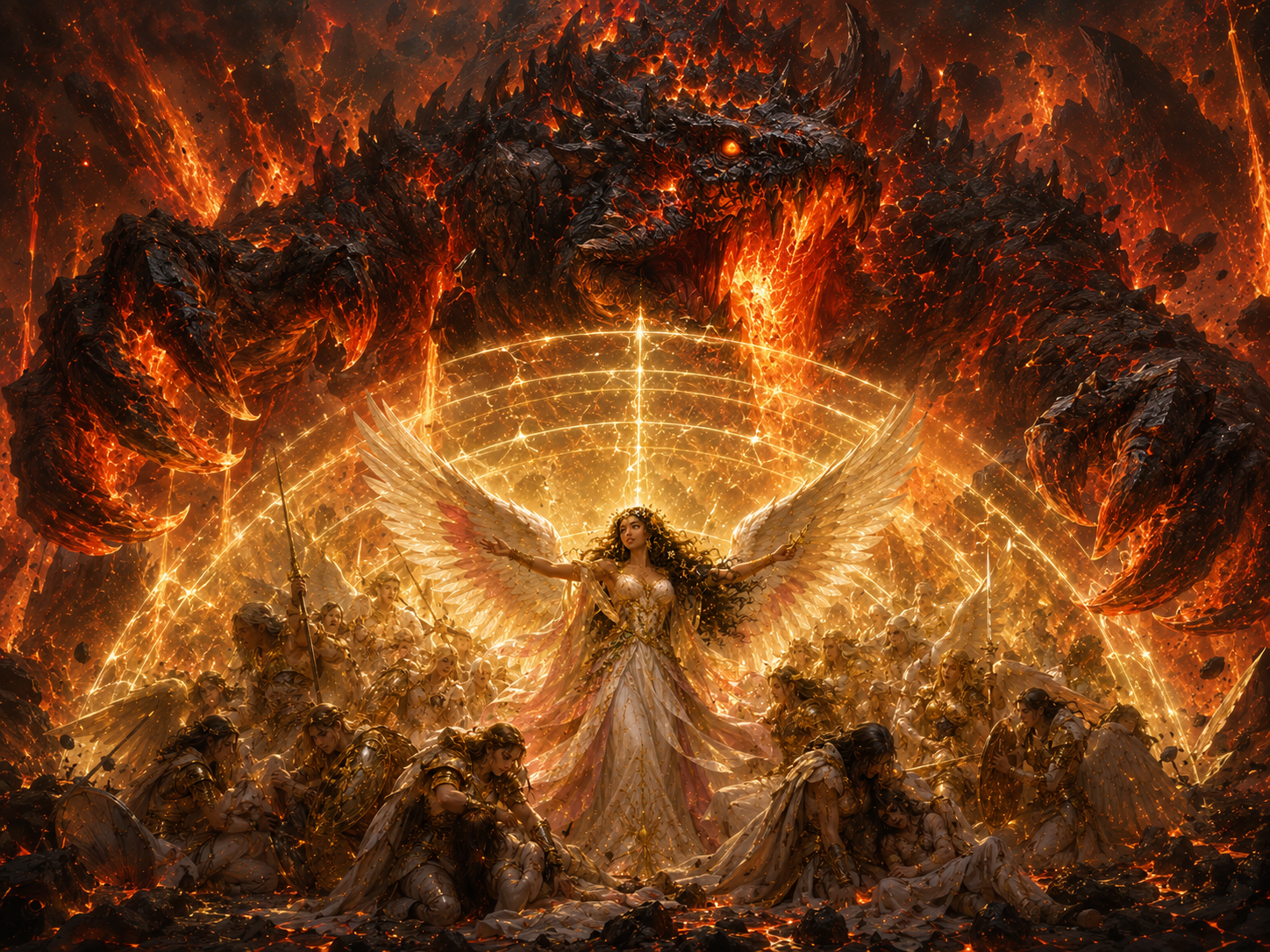
The fourth layer bent beneath a wave of magma that would have buried the host beneath a new mountain.
Elumis gave more.
Her burning wings became silhouettes. Light shone through the cracks in her hands. The flowers in her hair smoked and curled. Her skin shone brighter and thinner, as though her divinity had become a lamp inside a vessel beginning to break.
Magmokar pushed harder.
The wound in his chest widened with every breath. Gold burned in the cracks of him. Black glass split along his ribs. Magma poured from his body and vanished into the greater fire.
Still the barrier held.
The titan’s vents opened wider.
More.
The word rolled through the cataclysm like the cracking of the world’s first mountain.
“M O R E.”
The inferno deepened.
Elumis answered, but not to him.
“To every dawn after me,” she whispered. “Come.”
The final barrier opened outward.
Not breaking.
Opening.
It received the eruption.
It took into itself the magma, the fire, the crushing stone, the poisonous ash, the pressure, the wrath of the deep earth. It took all of it and held it away from the host.
For one breath, Elumis stood between the Blazing Depths and every servant who had followed her into the furnace.
Then the barrier failed.
The light did not vanish.
That was what Magmokar did not understand.
It withdrew.
Not all at once.
It drew back from the air, from the shield, from the burning sky. It gathered around her heart, around the woundless center of her, around the place where hope had lived before it had ever been given a name.
Her wings blackened first, white feathers curling into ash at the edges while the bones beneath them shone with fading gold. The flowers in her hair charred but did not fall. The living circlet upon her brow cracked, its green branches turning black, its last white blossoms closing against the heat.
Her hands lowered.
The inferno passed over her.
It did not consume her.
It left her standing for a moment, blackened and still, her wings spread in ruin, her head bowed, her body charred like a tree struck by divine fire and yet not fallen.
Then her knees touched the cooling stone.
Where her blood fell, lava hardened. Where her feathers broke, pale green light sank into the ash. Where her hands came to rest, the burning ground cooled into dark glass threaded with roots of gold.
The last of her breath left her.
Elumis died.
And hope remained.
It sank down through cracked stone, down through cooling magma, down into the wounded earth beneath the battlefield, carrying grief, mercy, and refusal into the deep places of Andórë.
Magmokar’s eruption spent itself.
The titan stood over her, chest split, arm ruined, body veined with wounds that would not close. At his feet lay the blackened body of Elumis, wings broken around her, circlet charred upon her brow.
He had killed a goddess.
And still the light remained.
Araveth rose first.
His wings were ragged. His armor had melted into his flesh. In one hand he held his sword. The other was closed around ash and broken feathers.
He did not speak a command.
He did not need to.
The deva rose, their songs broken but not ended. The planetars lifted their blades. The archons formed their circles. Lanterns of celestial fire drifted into the air like new stars beneath the ash-dark sky.
They did not have Elumis’s power. They did not have her presence. They did not have the impossible warmth of her voice telling them that tomorrow could still be reached.
They had only what she had left inside them.
It was enough.
The host advanced.
Magmokar took one step toward the blackened body of the goddess.
His wounded leg failed.
The titan caught himself on one molten hand, and the ground beneath it hardened against him. Gold-veined stone spread outward from his palm. The wound in his chest flared. The spearhead of the Last Dawn remained buried there, broken haft charred away, its light sunk deep into basalt and magma.
Magmokar roared.
The wound answered in gold.
The host struck.
Planetars fell upon his ruined side, their blades biting into black glass already cracked by Elumis’s final blow. Winged archons drove spears into his knees and ankles. Hound archons formed shield walls against the lava spilling from him, breaking and reforming, breaking and reforming, each line angled to force the flood away from the place where Elumis lay.
Deva rose above the battlefield with songs too damaged to be beautiful. Their voices cracked. Their wings bled light. Still they sang, and where their song fell, the cooling ground held firm beneath the host and broke beneath the titan.
Magmokar swung his ruined arm.
A line of hound archons vanished beneath the blow, shields crushed into sparks. A gout of magma consumed three deva before their song could end. One planetar was caught in the titan’s fist and driven into the ground with such force that the ridge split beneath him.
Still the host pressed forward.
Magmokar dragged one foot back.
The battlefield shook.
He dragged the other.
The host surged.
Every movement widened Elumis’s wound. Every roar forced light from the cracks in his chest. Every time he tried to pour himself into the earth beneath them, the stone hardened, remembering her hands. Every time he opened a vent, gold threaded the fire. Every time he reached toward the fallen goddess, the servants of Elumis threw themselves between him and her body.
At last, Araveth climbed.
He did not fly. His wings no longer bore him. One was broken, the other burned down to a ragged fan of bone and light. He climbed with one hand and drove his sword into Magmokar’s blackened side with the other, hauling himself upward through heat that stripped the armor from his flesh.
Below him, the host drove the titan step by step across the ruined basin.
Not back.
Not down.
Away.
Araveth reached the broken spearhead.
Magmokar’s burning eyes turned toward him.
The titan spoke one word.
“ASH.”
Araveth answered with his sword.
He drove the blade into the spearhead of the Last Dawn.
The broken weapon flared.
Light erupted from every wound Elumis had made. It burst from Magmokar’s chest, his shoulder, his ruined arm, and his hardened leg, pouring from the seams between basalt plates and splitting the black glass of his body in branching lines of green and gold. It was not enough to destroy him, but it was enough to hurt, enough to blind, enough to turn the next step.
Magmokar reeled.
The host struck as one.
Planetars drove their blades into his legs. Archons locked chains of light around his arms and broke them an instant later, buying only heartbeats. Deva poured their last strength into the cooling ground, hardening each place his feet tried to claim.
The Blazing Depths stumbled away from the body of Elumis, one step, then another, then another.
The basin cracked beneath him. Lava followed in his wake. His wounded arm dragged through the molten stone, carving a trench of fire and gold. His roar shook ash from the sky, but the sound no longer filled the world. It receded. It moved away across the broken land, carrying pain, rage, and Elumis’s light buried deep within him.
The host could not follow far.
When Magmokar passed beyond the ridge and into the burning haze, Araveth fell from the titan’s side.
A deva caught him before he struck the stone.
Together, the remnants of Elumis’s host watched the Blazing Depths withdraw into the ash-dark distance.
He was not defeated and he was not bound, but he was wounded, he was moving away, and Elumis remained.
For a long time afterward, no one moved.
The battlefield cooled around them. The ash thinned. Far above, through a wound in the clouds, the first pale suggestion of morning touched the blackened land.
There was no song, no victory cry, and no goddess to turn and tell them they had done well.
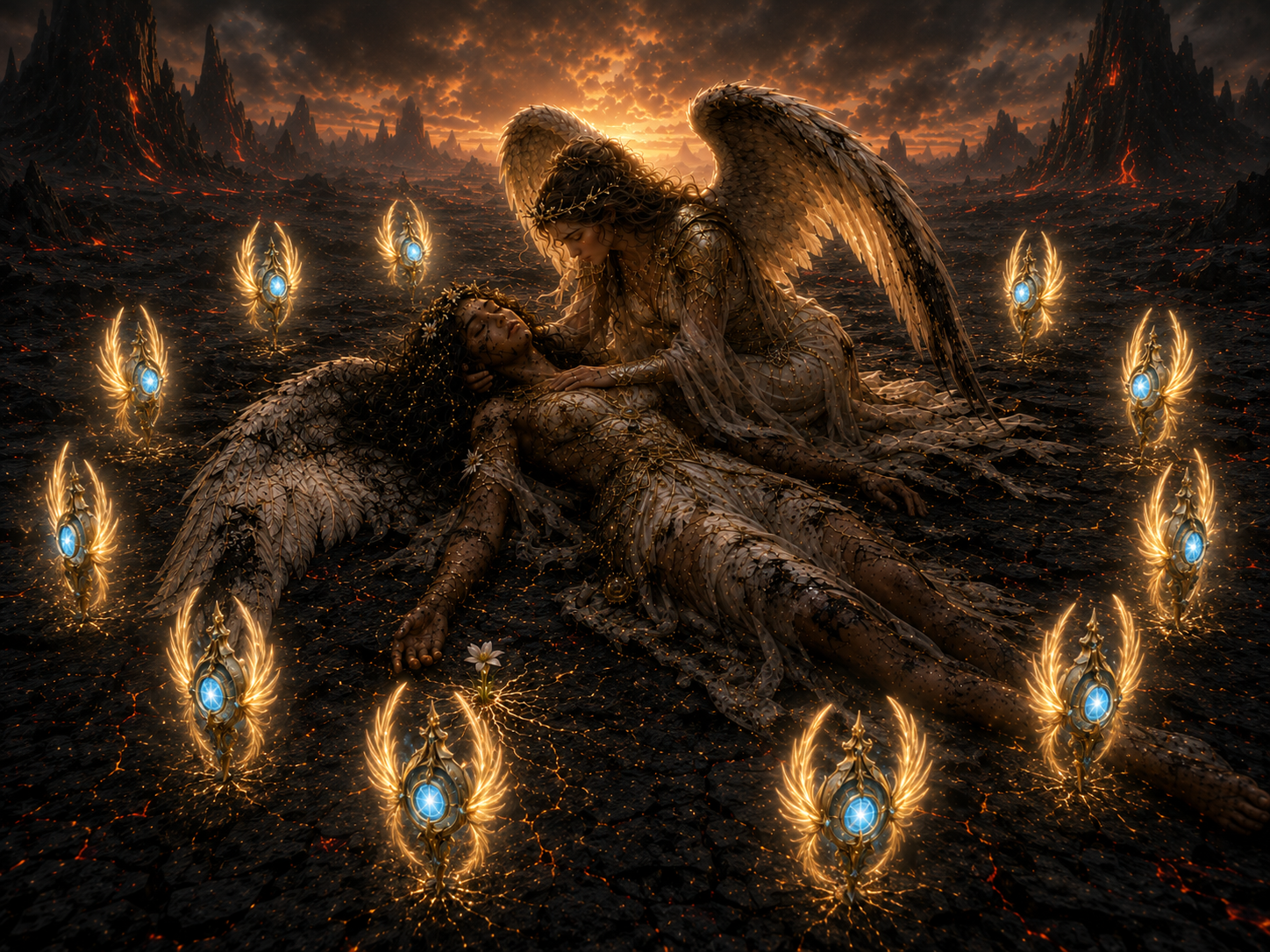
Elumis lay where she had fallen, charred and still, her broken wings spread across the cooling stone. The living circlet upon her brow was blackened. The flowers in her hair were ash-dark and closed. Her hands rested against the glassy ground, and beneath her palms, gold-veined roots of light sank into the wounded earth.
The servants of Elumis gathered their dead.
Where bodies remained, they carried them. Where only sparks remained, they cupped them in their hands. Where nothing remained, they remembered.
Araveth of the Unbroken Wing knelt beside his goddess.
He could not lift her.
None of them could.
The place had already begun to claim her. The stone held her as gently as stone could hold. The gold beneath her had sunk too deep. Her light was no longer only above the world. It was within it.
Araveth bowed his head until his brow touched the blackened ground.
Around him, deva, planetars, and archons did the same.
The branches of Elumis’s circlet were black.
As dawn touched them, one white flower opened.
The host remained until the light strengthened.
Then Araveth rose.
The war had not ended. Magmokar still moved beyond the ash. The other gods still fought. Somewhere beyond the broken horizon, another field waited, and another titan had to be driven down before the world could breathe.
Araveth turned from Elumis and faced the remnant host.
No command passed his lips.
None was needed.
The planetars gathered their broken blades. The archons lifted their shattered shields. The deva took up the sparks of the fallen and held them close. One by one, the servants of Elumis turned from the blackened stone and began the long march through ash and cooling fire.
But not all departed.
One deva remained.
Her name was Ilyrane, whose songs had carried the wounded through the first breaking of the ridge. Her wings were burned ragged. Her voice had been reduced to a whisper. Still, when Araveth looked to her, she bowed her head and knelt beside Elumis.
Twelve lantern archons descended around her, dim as embers beneath the morning haze. They arranged themselves in a circle around the goddess’s body, not as guards against armies, but as lights against forgetting.
Araveth placed his hand over his heart.
Ilyrane answered the gesture.
Then the host departed.
They moved away from the place where hope had fallen, following the trail of Magmokar’s retreat toward the wider war. Behind them, the battlefield cooled. Ash drifted down like gray snow. The first dawn touched the black glass, the gold-veined roots, the broken wings of Elumis, and the twelve small lights keeping vigil around her.
Ilyrane began to sing.
The song was thin. The song was broken.
The song remained.