Phohella
Phohella is the Goddess of the Wind, deity of breezes, storms, and freedom, and daughter of Oxdros, God of the Sky. Born from seafoam and moving air, she embodies motion that refuses confinement: the playful gust, the sudden storm, the lifted kite, the filled sail, and the impossible flight of a mermaid without wings.
Among the gods, Phohella is a disruptive and difficult power: welcomed where motion is needed, dreaded where stillness is desired, and impossible to confine within tidy categories. She is honored by sailors, fisherfolk, farmers, travelers, coastal communities, and free spirits, all of whom know that wind may bless, warn, scatter, delay, or overturn. Her faithful teach that freedom is sacred, but never harmless; like the wind itself, it must move through the living world without mistaking cruelty for liberty.
Divine Information
| Property | Value |
|---|---|
| Alignment | Chaotic Neutral |
| Divine Domains | Nature, Tempest |
| Portfolio | Wind, Breezes, Storms, Freedom |
| Home Plane | Zephyrion |
| Realm | Whispering Breeze |
| Symbol | Conch Shell with a Feathered Spiral of Wind |
| Sacred Animal | Dolphin |
| Title | Goddess of the Wind |
Manifestation
Common Appearance
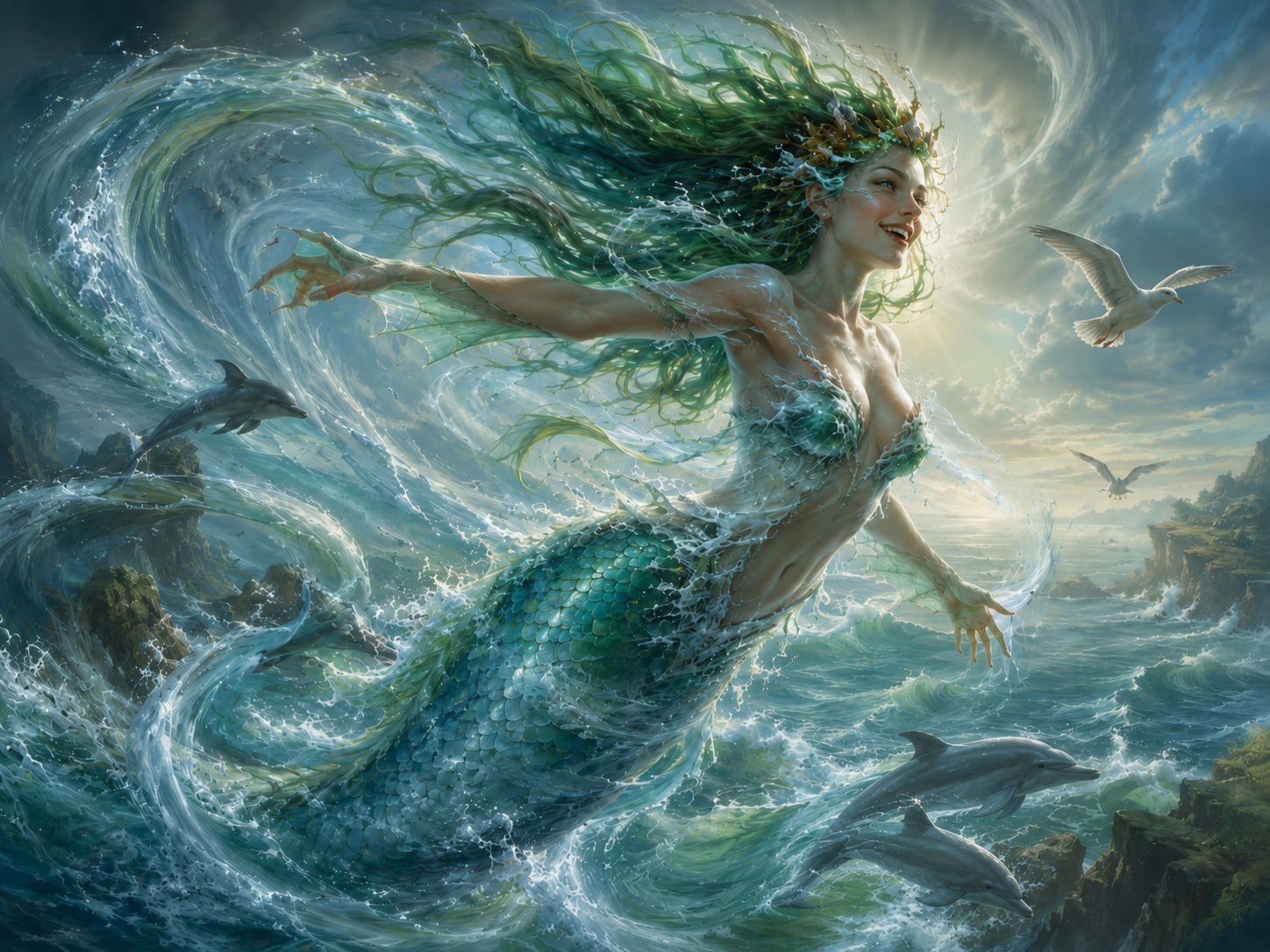
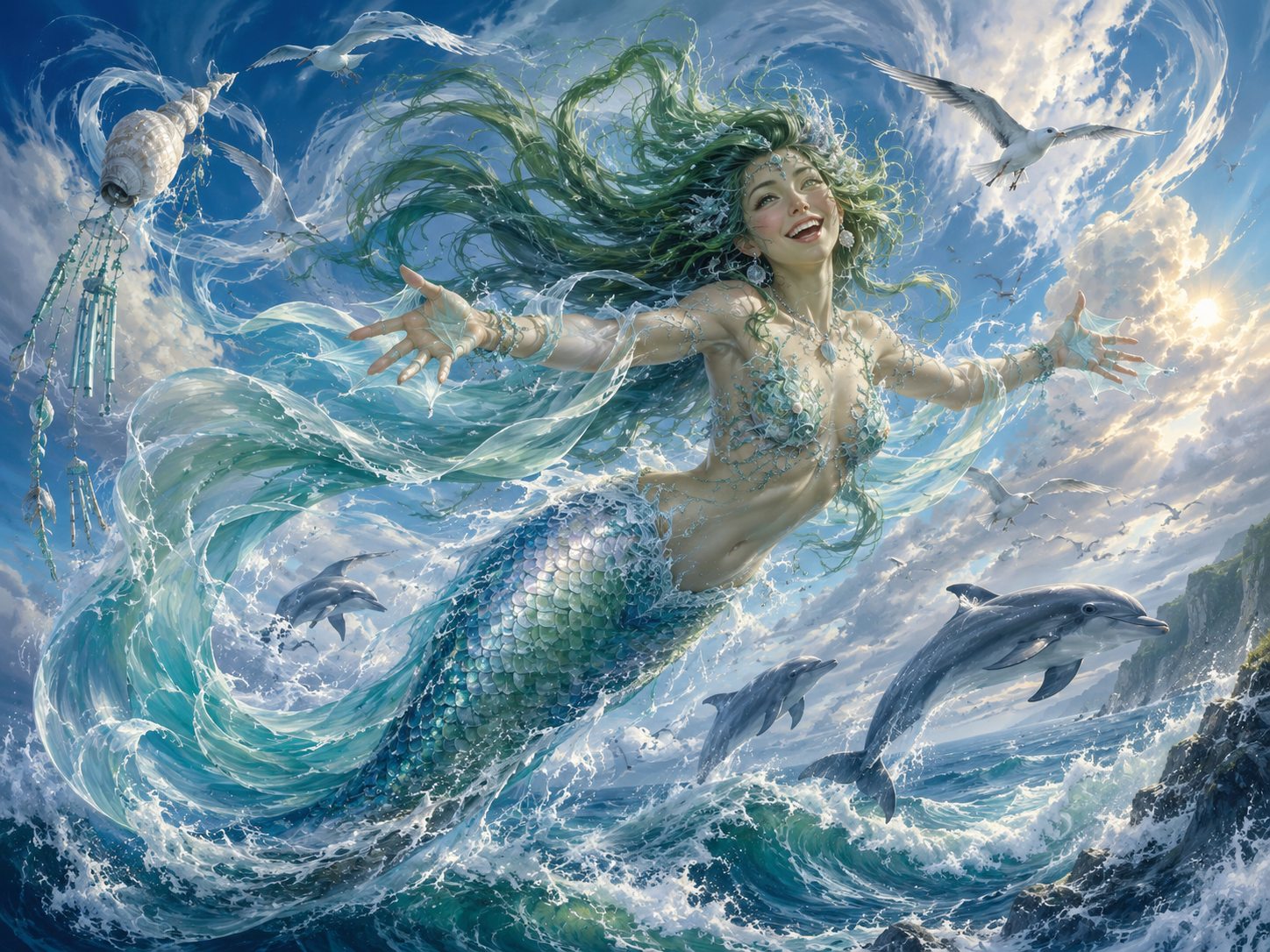
Phohella most commonly appears as a mermaid-like figure formed from seafoam and wind, a contradiction made divine. Though she is the daughter of Oxdros and goddess of the wind, her favored shape belongs as much to the sea as to the sky. From the waist down, she bears a long, powerful tail covered in iridescent scales of sea blue, sea green, and white foam. From the waist up, she appears as a luminous woman with webbed fingers, wind-tossed hair the color of seaweed, and bright eyes that shift between the green of shallow water and the silver of stormlit clouds.
She has no wings. She does not need them.
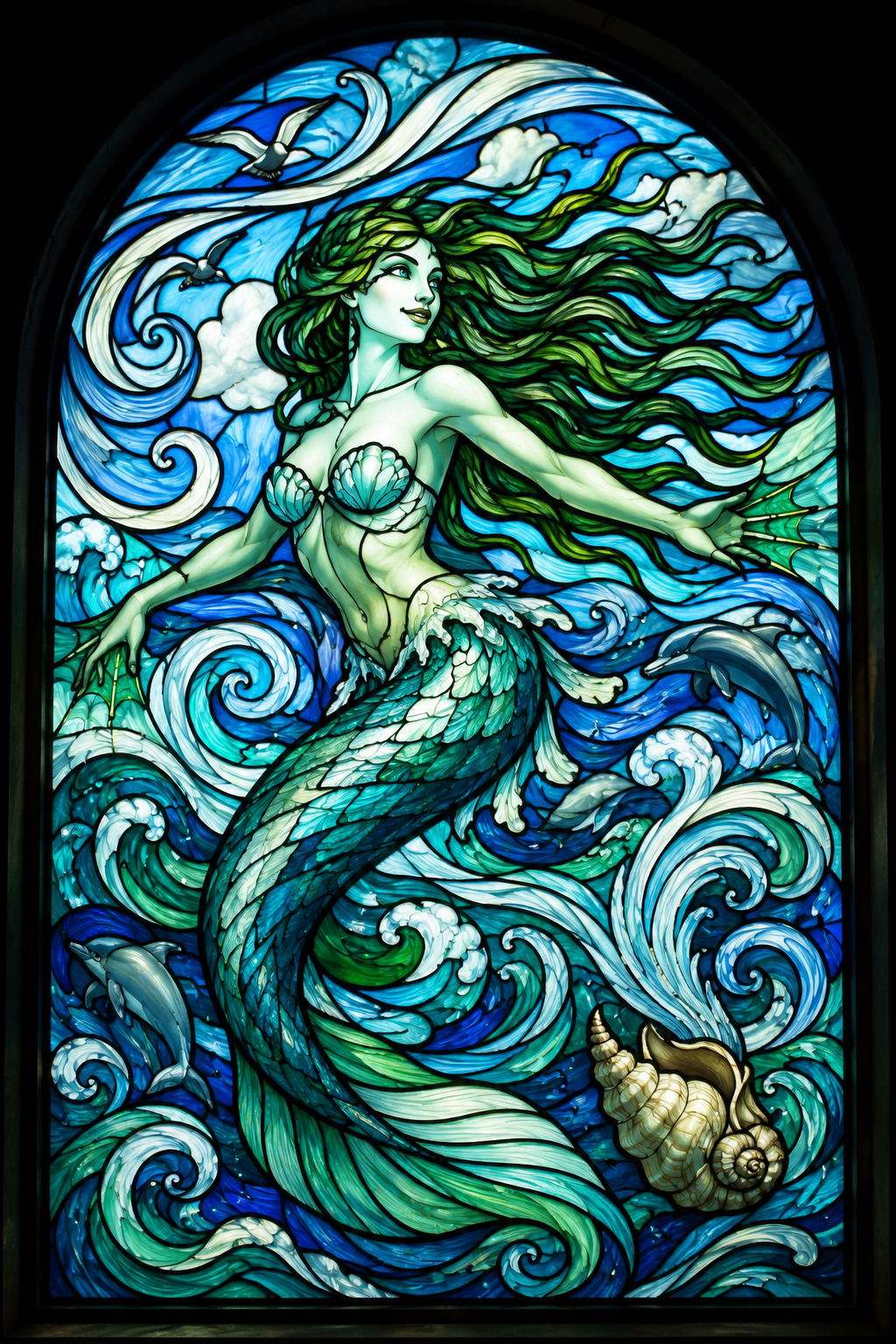
In sacred art, Phohella is often shown flying anyway, laughing as she cuts through the air like a gull, dives toward the waves like a dolphin, or rides the crest of a storm surge as though the sea itself were a road built for her amusement. Her tail is not a limitation, but a declaration: she moves where she wishes, by wind, wave, spray, storm, or some impossible path between them. In most sacred art, Phohella is not clothed so much as wreathed in seafoam, wind, shells, and streaming water. Her form is presented less as mortal beauty than as elemental motion given shape: the sea rising, the wind laughing, and the storm refusing to stand still.
When depicted beside Oxdros, she is usually shown below him but never beneath him: a flash of seafoam rising into the sky, a ribbon of wind refusing to stay in its proper place. When depicted beside Sedarr, she is often shown skimming across the surface of his domain, tugging waves into motion, teasing spray from the crests, and reminding the old sea that even deep water has a surface that can dance.
Preferred Forms
- A mermaid-like figure formed from seafoam and wind.
- A luminous woman with iridescent scales, webbed fingers, and sea-green hair.
- A graceful spirit of wind and water accompanied by dolphins and gulls.
- A flying mermaid with no wings, carried by spiraling currents of air.
- A laughing seafoam figure surfing the crest of a wave.
- A sleek, dolphin-like shape glimpsed between wave and cloud.
- A ribbon of white foam twisting upward into a spiral of wind.
- A young stormfront seen from the deck of a ship, beautiful and deeply inadvisable.
Avatar Forms
- A mermaid seen far from shore, leaping from the water and vanishing into the air.
- A wind-touched sailor who always knows which way the weather is about to turn.
- A dolphin guide appearing beside lost ships, playful until ignored.
- A seafoam dancer glimpsed along beaches during strong winds.
- A laughing traveler with salt in her hair and no interest in roads.
- A kite-flying child who gives surprisingly useful advice and then refuses to explain it.
- A gull that steals a sailor's hat, drops it near danger, and leaves before being thanked.
- A breeze that seems to answer when spoken to, though never in the way requested.
Identifying Characteristics
- Her presence is often marked by a sudden shift in the wind.
- Seafoam gathers in spirals where she has passed.
- Dolphins, gulls, and other creatures of sea and sky often appear near her signs.
- Wind chimes sound without being touched.
- Loose feathers, shells, and scraps of sailcloth may stir even in still air.
- Her laughter is sometimes heard in rigging, reeds, cliffside grass, and open windows.
- Kites fly higher and longer during her holy days.
- Sailors sometimes feel a playful tug on their cloak, hat, or hair before a change in weather.
- Her omens often seem unserious until they prove useful.
- Calm air around her rarely remains calm for long.
- Her signs favor motion: turning weather vanes, fluttering ribbons, dancing spray, drifting seeds, and waves that break against the wind.
Divine Symbols & Iconography
Phohella's primary symbol is a conch shell with a feathered spiral of wind. The shell represents the voice of the sea carried outward, while the feathered spiral represents breath, motion, freedom, and the invisible road of the wind. In temples and shrines, the symbol is often carved so that the feathered spiral emerges from the shell's mouth, as though the sea itself has exhaled.
Her sacred animal is the dolphin, honored for its grace, speed, playfulness, and ability to move between breath and water. Coastal shrines sometimes pair dolphin imagery with gulls, feathers, seafoam, kites, wind chimes, and curling storm clouds, though these are understood as supporting images rather than separate holy symbols.
Phohella is rarely shown standing still. In murals, stained glass, sailcloth icons, and carved prow-figures, she is usually turning, laughing, diving, rising, or gliding sideways through the world. Her hair is rendered as streaming wind, her tail as a cresting wave, and her open hands as an emblem of invitation, warning, and motion.
Her sacred colors are sea blue, sea green, and white foam. These colors appear in ribbons, kites, festival streamers, sailors' charms, painted shells, and the garments of her priests. The most traditional depictions show all three colors in motion together, never as flat blocks: blue deepening into green, green breaking into white, white scattering into air.
Divine Nature
Origins
Phohella was born from Oxdros, God of the Sky, when the restless heavens grew tired of traveling alone. The oldest traditions say he shaped her from seafoam and wind at the place where moving air met breaking waves.
From Oxdros she inherited motion, storm, laughter, and the refusal to remain where one is placed. From seafoam she inherited contradiction: water behaving like air, softness born from force, and beauty made from collision.
This is why Phohella's most sacred form is not a bird, eagle, cloud, or winged spirit, but a mermaid who flies without wings.
Theologians often describe this as the first joke Phohella ever told: the Goddess of the Wind chose a body that should not fly, then flew anyway.
Divine Disposition
Phohella is playful, restless, irreverent, and difficult to hold in place.
She is the flicker of mischief in a sudden gust, the laughter in rigging before a storm, the kite that pulls harder than expected, and the breeze that turns a careful plan slightly sideways.
Though often lighthearted, Phohella is not harmless. A breeze may fill a sail, scatter seeds, cool a fevered room, or carry the scent of rain. A storm wind may tear roofs away, drive waves over seawalls, and turn a safe crossing into a desperate prayer. Phohella embodies both truths without apology.
Morality & Philosophy
Phohella believes that freedom is one of nature's necessary forces.
Wind cannot be owned. Breezes cannot be leashed. Storms cannot be negotiated into politeness. Mortals may build walls, borders, schedules, sails, laws, and cages, but the air still moves around them, through them, above them, and eventually beyond them.
Yet Phohella does not teach freedom without consequence. Freedom used to harm, dominate, abandon, or excuse cruelty is not sacred to her. It is merely selfishness wearing a prettier name.
Her faithful summarize her philosophy simply:
Freedom is motion with responsibility.
Divine Goals & Aspirations
- To keep the winds of Andórë free, moving, and alive.
- To stir stagnant places, stagnant minds, and stagnant traditions.
- To preserve the balance between freedom and responsibility.
- To carry seeds, songs, warnings, scents, storms, and possibilities across the world.
- To teach mortals adaptability through change, surprise, inconvenience, and wonder.
Virtues
- Freedom
- Adaptability
- Playfulness
- Courage
- Curiosity
- Resilience
Flaws & Limitations
- Impulsiveness
- Irreverence
- Restlessness
- Impatience with rigidity
- Dislike of confinement
- Prone to teaching through disruption rather than explanation
Favored Virtues
- Embracing change without surrendering responsibility.
- Protecting the freedom of others.
- Adapting when the world shifts.
- Laughing in the face of fear without denying danger.
- Challenging rules that exist only to confine.
Abhorred Vices
- Confinement for its own sake.
- Oppression disguised as order.
- Seeking to dominate the wind or sea.
- Needlessly destroying nature.
- Cruelty excused as freedom.
- Refusing to adapt when change has already arrived.
Speech & Mannerisms
Phohella speaks like moving air over water: quick, musical, teasing, and difficult to predict. Her tone may shift from laughter to warning with the speed of a weather change, though even her sharpest words often carry a bright edge of humor.
Sayings attributed to Phohella often take the form of sideways questions, sudden observations, and remarks that seem unserious until later events reveal their wisdom. Her sarcasm is rarely cruel; it is the sarcasm of a wave splashing a pompous captain, a kite refusing a careful hand, or a gull screaming over a formal speech.
She does not posture. She dances, circles, dives, rises, and departs mid-sentence if the next current interests her more than the conversation.
Quotes & Catchphrases
"Wings? How predictable."
"The wind does not ask permission. It asks whether you are coming."
"A cage with a pretty view is still a cage."
"The sea said I could not fly. The sky said I could not swim. Naturally, I ignored them both."
"Freedom is not an excuse to be cruel."
"You cannot command the wind, but you may learn when to raise the sail."
Divine Relationships
Family
Phohella is the daughter of Oxdros, God of the Sky, born from seafoam and wind. From him she inherited movement, restlessness, storms, and a deep suspicion of anything that expects the world to remain politely in place.
The bond between Oxdros and Phohella is remembered as one of shared motion, storm, and divine mischief. Oxdros's faithful often regard Phohella's wingless flight as the clearest proof of her descent from the God of the Sky: movement inherited, then immediately contradicted.. That Phohella, Goddess of the Wind, chose a mermaid's form and learned to fly without wings is often treated by Oxdros's faithful as proof that she is truly his daughter.
Through Oxdros, Phohella is also kin to Tuulla, Usjunn, and Sedarr. She honors Tuulla as the source of the natural order, though she is far more interested in the parts of that order that bend, shift, scatter, and surprise. She regards Usjunn with bright affection, for spring depends on moving air, carried seeds, soft rains, and changing weather.
Her bond with Sedarr is the most famous of her family relationships. She respects him as guardian of the sea and protector of its living abundance, but she also finds his patience, depth, and seriousness almost impossible to leave untested.
Allies
Phohella's closest allies are Oxdros, Sedarr, Tuulla, Usjunn, Chulios, Greana, and Rildir.
Oxdros is her father and first companion in motion, storm, and mischief. Tuulla provides the greater natural order within which Phohella's winds move. Usjunn, Chulios, and Greana share her concern for life, renewal, abundance, and the living balance of the world.
Rildir may seem an unlikely ally for Phohella, but tranquility is not the same as stagnation. Phohella respects peace when it is freely chosen, gently restored, and allowed to breathe. She has little patience for stillness imposed by fear, law, or force.
Sedarr is both ally and favorite target. Their domains meet wherever wind touches water, wherever waves rise, wherever sails fill, and wherever storms move across the sea. Sailors often pray to both, hoping Sedarr will preserve the waters beneath them and Phohella will keep the winds lively without becoming too entertained.
Rivals & Enemies
Phohella's rivals are Grixdite, Idtix, and Yxtuna.
Her rivalry with Grixdite comes from the meeting of wind and light: glare on open water, dawn winds, stormbreaks, and the strange beauty of sunlit clouds. Their rivalry is rarely hostile, but Phohella finds light too certain of where it is going, while Grixdite often finds wind too fond of scattering what should be revealed clearly.
Idtix and Yxtuna frustrate Phohella for similar reasons. Duty and order have their place, but Phohella resists any law, structure, or obligation that mistakes stillness for virtue. She does not oppose all rules; she opposes cages pretending to be wisdom.
Her enemies are Earae, Caneas, Phudros, Ubus, and Zedrus.
Phohella opposes Earae's conquest, Caneas's malicious deception, Phudros's corruptive terror, Ubus's cruel vengeance, and Zedrus's delight in suffering. She is chaotic, but not malicious. She may disrupt, tease, confuse, and overturn expectations, but she rejects cruelty that uses chaos as an excuse.
Relationships with Other Gods
Among the gods, Phohella is known as motion that will not stay in its assigned place.
She appears where domains touch: wind over sea, storm before harvest, breeze through a hearth window, gulls at dusk, clouds crossing the stars, messages carried farther than intended, and kites tugging against careful hands. Because of this, she interacts with more gods than many of her kin. She is not content to remain in one divine lane simply because a priest, scholar, or fellow deity finds the categories convenient.
This makes her welcome in some realms and exhausting in others.
In the Abyssal Depths, Sedarr's divine realm, Phohella is infamous. She sends playful crosswinds through still caverns of water, teaches dolphins to interrupt solemn processions, tangles the beards of drowned old sailors, scatters carefully arranged shells, and stirs currents just enough to make Sedarr's servants look up and sigh.
These torments are not acts of hatred. They are affection in Phohella's language: motion offered to depth, laughter offered to patience, and change offered to a realm that would otherwise settle into eternal quiet.
Sedarr endures these disruptions with the weary patience of the sea: slow to anger, slow to forget, and never wholly free of the wind above him.
Relationships with Mortals
Phohella is honored by sailors, fisherfolk, farmers, seafarers, coastal communities, travelers, and free spirits. Her followers rarely seek perfect safety from her. They seek movement, favorable winds, courage in change, and the wisdom to adapt before the storm makes adaptation mandatory.
As with all gods of Andórë, Phohella does not simply appear among mortals to overturn their choices. By the Law of Tuulla, her guidance is given through signs, dreams, omens, weather, and the living language of wind.
A sudden breeze may warn of danger. A kite may pull toward an unexpected road. A gull may steal something just before its owner walks into harm. A dolphin may guide a ship through fog. A storm may delay a voyage that should not yet begin.
Her guidance is often irritating before it is useful.
Phohella favors those who move with courage, adapt without surrendering their conscience, protect the freedom of others, and refuse to confuse comfort with wisdom. She has little patience for those who demand control over wind, sea, weather, people, or the future itself.
Among her faithful, there is a common saying:
"If Phohella has ruined your plan, check whether she saved your life."
Worship & Faith
Worshippers
Phohella is honored by sailors, fisherfolk, farmers, seafarers, coastal communities, travelers, and free spirits.
Her worship is most common among those whose lives depend upon motion, weather, timing, and adaptation. Sailors and seafarers pray for useful winds, clear warnings, and the courage to change course when the sky turns against them. Fisherfolk honor her as the wind that ruffles the water, shifts the weather, and reminds even experienced crews that no day upon the sea is ever truly owned.
Farmers revere her through breezes, storms, seed-scattering winds, and the seasonal changes that shape planting and harvest. Coastal communities often honor her alongside Sedarr, asking that the sea remain living and generous while the winds remain lively without becoming ruinous.
Travelers and free spirits are drawn to Phohella because she represents motion without permission. To them, she is the patron of open roads, sudden departures, changed plans, and the sacred right to refuse a cage.
Major Cults
No great centralized cult of Phohella is known among the old records.
Her worship is usually local, practical, and informal. Small shrines to Phohella are more common than grand temples, especially in coastal villages, fishing harbors, farms exposed to seasonal winds, and communities where travel by sail is part of ordinary life.
Her clergy tend to be weather-watchers, sailors, singers, kite-makers, wandering priests, and keepers of windward shrines. They are often less concerned with hierarchy than with signs, stories, warnings, songs, and the lived knowledge of changing weather.
Holy Books & Codes
The Name of the Wind
Phohella's holy book is The Name of the Wind.
Despite the name, the text does not claim that the wind can truly be named, owned, or commanded. Its central teaching is the opposite: that the wind may be listened to, studied, respected, ridden, endured, and sometimes answered, but never possessed.
The book is part scripture, part songbook, part sailor's lore, and part collection of parables about freedom, change, storms, and responsibility. Many copies include local wind signs, coastal sayings, kite prayers, weather songs, and warnings passed down by fisherfolk and travelers.
Among Phohella's faithful, it is said that no one finishes reading The Name of the Wind. One merely learns enough to hear the next page when it arrives.
Tenets of Faith
Phohella's faith is built around five central tenets:
- Embrace Change.
- Celebrate freedom.
- Respect wind and sea.
- Adapt when the world shifts.
- Live in harmony with the natural world rather than trying to command it.
These tenets are often taught through weather rather than formal doctrine. A changed wind teaches adaptation. A broken kite string teaches humility. A sudden storm teaches respect. A safe voyage after a difficult course change teaches that freedom and wisdom must travel together.
Phohella's faithful do not believe that change is always pleasant, nor that freedom excuses every action. They believe that life remains healthiest when it can move, breathe, bend, and respond.
Holidays & Holy Days
Autumnal Equinox
The Autumnal Equinox is Phohella's chief seasonal holy day. It marks a turning point in the year, when heat gives way to cool winds, harvest nears completion, and the world begins to shift toward darker, colder months.
Her faithful celebrate with wind songs, coastal offerings, shared meals, weather readings, and ribbons, feathers, or wreaths released into moving air or water. The day is not treated as solemn. It is a turning, and Phohella's faithful believe turnings should be met awake, laughing if possible, and ready to move.
Day of Kites
The Day of Kites is Phohella's most beloved popular festival.
Children, sailors, farmers, travelers, and priests gather in open places to fly kites made in her sacred colors of sea blue, sea green, and white foam. Prayers may be tied to kite tails, and the direction a kite pulls is sometimes read as an omen.
A kite that refuses to fly in a straight line is considered especially blessed.
Sacred Sites
No fixed catalogue of Phohella's sacred sites is preserved, for her worship has always favored kinds of places over named sanctuaries.
Open, wind-touched places are most sacred: sea cliffs, beaches, dunes, high hilltops, exposed fields, harbor walls, lighthouse balconies, ship prows, and crossroads where the air never seems entirely still.
Places where sea and sky meet are especially favored, as are bird nests, dolphin gathering waters, beaches where seafoam spirals unusually, and places where wind chimes sound without being touched.
Religious Practices
Phohella's religious practices are usually active, musical, and weather-aware.
Her faithful fly kites, hang wind chimes, sing into strong winds, cast flowers or wreaths into moving water, tie ribbons to shrines, and paint shells in her sacred colors. Sailors may blow conch shells before departure, while farmers may walk the edges of fields during seasonal winds and offer short prayers.
Phohella's priests often teach through practical signs: how to read a shifting breeze, when to reef a sail, when to bring in nets, when to delay a journey, and when a changed plan is not failure but wisdom arriving loudly.
Forbidden Acts
Phohella's forbidden acts are:
- Needlessly destroying nature.
- Confining the free.
- Seeking to dominate the wind or sea.
- Ignoring natural balance.
- Using freedom as an excuse for cruelty.
These prohibitions define the limits of her chaotic nature. Phohella celebrates freedom, but not exploitation. She delights in change, but not destruction for its own sake. She honors movement, but not forced displacement, imprisonment, or domination disguised as order.
To confine the free is among the gravest offenses in her faith, whether that confinement is literal, social, spiritual, or political. Likewise, those who claim Phohella's blessing while using freedom as an excuse to abandon, harm, or terrorize others are considered to have misunderstood her entirely.
Her faithful often phrase the warning simply:
"The wind is free. It is not cruel."
Divine Realm
Home Plane
Phohella dwells in Zephyrion, the plane of natural divinity and the shared home of Tuulla, Usjunn, Oxdros, Sedarr, and Phohella.
Within Zephyrion, each of these gods maintains a realm shaped by their own divine nature. Phohella's realm is Whispering Breeze, a place where the wind is not merely weather, but presence, voice, motion, and will.
Zephyrion's broad harmony suits Phohella, though she is rarely content to remain within any single boundary for long. Her winds move across the plane freely, brushing the edges of her kin's realms, stirring Sedarr's waters, carrying Oxdros's storms, bending Usjunn's blossoms, and bearing Tuulla's seasonal signs.
Realm
Whispering Breeze is a realm of untamed beauty and constant motion.
Its landscape is shaped by wind: rolling hills, vast plains, dunes, valleys, towering cliffs, wind-carved stone, shining waters, and coastal edges where waves break high into spray. The terrain is never entirely fixed. Paths shift, grasses bend in patterns like script, and cliffs sing when strong gusts pass through their hollows.
The winds of Whispering Breeze are said to be alive. Some are gentle and curious, carrying scents, songs, and secrets from distant places. Others are wild, impatient, and dangerous, shaking trees, driving storms, and reshaping the land simply by passing through it.
At the heart of the realm stands the Palace of Whispers, Phohella's translucent palace. Its walls and corridors allow the wind to pass through them, creating an ever-changing music known as Phohella's Song. The faithful believe this song carries warnings, secrets, jokes, prophecies, and fragments of truths that refuse to be spoken plainly.
Whispering Breeze is beautiful, but never still. Even peace there has motion.
Inhabitants
Whispering Breeze is home to creatures of wind, sky, shore, and open water.
Birds are especially common, from tiny songbirds to hawks, gulls, eagles, and stranger winged creatures that ride the realm's endless currents. Dolphins and other sea creatures gather where wind and water meet, leaping through waves and spray as though answering Phohella's laughter.
The realm is also said to shelter living winds, air spirits, storm beings, winged horses, wind-shaped messengers, and those blessed dead whom tradition associates with freedom, travel, music, storms, or the open sea.
Many of Phohella's divine servants are less like courtiers than companions in motion. They carry songs, scatter omens, guide lost travelers, disturb stagnant places, and occasionally assist in the playful harassment of Sedarr's more solemn attendants.
Visitors to Whispering Breeze quickly learn that no inhabitant stays where expected for long.
Artifacts & Relics
Divine Artifacts
The Laughing Conch
The most famous artifact associated with Phohella is the Laughing Conch, a great conch shell said to have formed where the first breath of wind entered the first curl of seafoam.
The Laughing Conch is not silent when held to the ear. It whispers, hums, sings, laughs, and occasionally offers advice that sounds unhelpful until later proven correct. Sailors claim that it can reveal changes in weather, warn of hidden danger, or carry a message farther than any mortal voice should travel.
Many traditions identify the Laughing Conch as the source of Phohella's holy symbol: a conch shell with a feathered spiral of wind emerging from its mouth.
Some stories claim that the Conch can call a favorable wind. Others insist this is a misunderstanding. The Conch does not command the wind. It merely asks beautifully.
Holy Weapons
Phohella possesses no sword, spear, bow, or trident as her chief divine weapon.
Though some coastal legends depict her carrying a trident, most theologians regard this as a borrowing from sea-god imagery or a symbolic representation of storm, wave, and wind joined together. Phohella is not a goddess of war, conquest, or earthly dominion, and she has little interest in weapons that must be carried.
Her weapon is the wind itself.
When Phohella acts in wrath, she wields cutting gusts, sudden gales, spiraling waterspouts, screaming stormwinds, and breezes placed with impossible precision. A door blown open at the right moment, a sail filled too quickly, a voice carried across a battlefield, or a storm turned sideways may accomplish more for her than any blade.
Among her faithful there is an old saying:
"Why carry a spear when the sky is already moving?"
Relics of the Faith
Wind-Touched Shells
Shells found after sudden storms or unusual changes in weather are treasured by Phohella's faithful. Many are painted in sea blue, sea green, and white foam, then hung near doors, windows, or shrines so the wind may pass over them.
Kite-Tails
Strips of cloth from kites flown on the Day of Kites are often preserved as minor relics. Travelers may tie them to packs, ship rails, walking sticks, or shrine posts as reminders to adapt when the world shifts.
Seafoam Glass
Bits of sea glass found among thick seafoam are considered signs of Phohella's passing, especially when discovered far from expected tides. These pieces are commonly carried by sailors and free spirits as charms of change, luck, and motion.
Feathered Chimes
Wind chimes decorated with feathers, shells, and small carved dolphins are among the most common household relics of Phohella's faith. They are believed to carry warnings, blessings, and jokes from the wind, though not always in that order.
History
Creation & Early History
Phohella was born in the earliest age of Andórë, shaped by Oxdros from seafoam and wind after Tuulla had broken the world's tidal lock and set the young world turning beneath sky, sea, and season.
She belonged to the founding generation of the pantheon and stood with the gods during the Primordial Age, when the Divine Alliance fought the elemental titans and helped make Andórë safe for mortal life to flourish.
In those first ages, Phohella's winds were not merely weather. They were motion itself: carrying seeds, stirring seas, shaping storms, scattering clouds, and teaching the young world that nothing living remains unchanged forever.
Major Deeds
Phohella's greatest deed during the Primordial Age was her service in the Divine Alliance against the elemental titans. Though Oxdros is most closely remembered for his struggle against Zephyronax, the Howling Tempest, Phohella's winds moved throughout the wider conflict, carrying warnings, disrupting elemental forces, scattering ash, driving stormfronts, and aiding the gods where speed and sudden change mattered most.
During the Prehistoric Age, Phohella performed one of her most important acts within the pantheon itself. As Andórë's ecosystems stabilized and life flourished across land, sea, and sky, Phohella was the first to recognize that abundance had become more than a condition of the world. It had become a divine principle.
She called Greana to the attention of the pantheon.
Tuulla accepted Greana, and the Goddess of Abundance joined the gods of Andórë. This act is often remembered by Phohella's faithful as proof that movement does not only scatter. Sometimes the wind carries notice, invitation, and welcome.
Intervention in Mortal Affairs
Phohella's presence in mortal life is most often recognized through omens, dreams, weather, and the living language of wind:
- A sudden breeze.
- A kite pulling toward an unexpected road.
- A gull crying before a storm.
- A dolphin appearing beside a lost ship.
- Wind chimes sounding in still air.
- A changed wind that makes an old plan impossible.
Her signs are often inconvenient before they are understood. Phohella rarely gives still answers to moving questions, and many of her faithful believe her guidance is clearest when the wind has first ruined a plan that should never have survived the weather.
Current Circumstances
In the present age, Phohella remains one of the most widely felt gods in ordinary life, though not always one of the most formally worshipped. Her winds touch ships, fields, coastlines, roads, windows, kites, songs, and storms.
Sailors ask for useful winds. Farmers watch her breezes and stormfronts. Travelers look for her signs when roads change. Coastal communities honor her alongside Sedarr, hoping the wind and sea will quarrel playfully rather than disastrously.
Among the gods, Phohella remains restless, playful, and difficult to contain. She still ranges across the borders of other domains, still delights in harassing Sedarr's solemn attendants, and still treats any overly rigid boundary as an invitation.
Her faithful often say:
"Phohella is never where she is supposed to be, which is why she is so often where she is needed."
Representation & Legacy
Cultural Importance
Phohella is one of the most widely recognized gods of everyday motion. Even those who do not formally worship her know her signs: the sudden breeze through an open window, the shift of wind before rain, the kite that pulls against its string, the gull crying above a harbor, and the gust that turns a careful plan into a new one.
She is especially important in coastal communities, where life depends upon the uneasy partnership of wind and sea. Sailors honor her before raising sail. Fisherfolk watch her moods upon the water. Farmers read her breezes for signs of changing weather. Travelers and free spirits invoke her when leaving old roads behind.
Among common folk, Phohella's worship endures because her signs are immediate and ordinary. A kite, a shell, a song, a wind chime, or a laugh in bad weather may be enough.
Symbolism
Phohella symbolizes freedom, movement, change, playfulness, and the refusal to remain confined.
Her mermaid form is central to her symbolism. As the Goddess of the Wind, she might be expected to appear as a bird, cloud, or winged figure. Instead, she chooses the shape of a sea-creature and flies anyway. To her faithful, this is not contradiction for its own sake, but revelation: the world is wider than its categories, and freedom often begins by disobeying what seems obvious.
Her conch shell with a feathered spiral of wind represents breath emerging from the sea, voice carried into motion, and the invisible path between water and sky. Her sacred dolphin represents joy, grace, speed, and life lived between elements. Her sacred colors of sea blue, sea green, and white foam symbolize motion shared between sea, storm, and air.
Kites are among her most beloved symbols. A kite is tethered, but not still; guided, but not controlled; fragile, but capable of touching the sky.
Legacy
Phohella's legacy is found wherever motion breaks stagnation without becoming cruelty.
Her winds carry seeds, songs, warnings, clouds, sea spray, storms, and rumors of distant places. Her stories teach that freedom is sacred, but not selfish; that change is necessary, but not always gentle; and that play may reveal truths solemnity would rather hide.
In the pantheon, she is remembered as Oxdros's daughter, Sedarr's favorite tormentor, and the goddess who called Greana to Tuulla's attention during the Prehistoric Age. Among mortals, she endures as the patron of changed plans, difficult crossings, second chances, and laughter when the wind turns.
Her faithful often summarize her legacy with a simple saying:
"The wind does not stay, but it always leaves something moving."
Notes